Attosecond hard X-ray pulses at an X-ray free-electron laser: average duration measured at 170 as
Authors established metrology of attosecond hard X-ray pulses and measured their average duration directly in the time domain. This removes a limit on attosecond X-ray experiments.
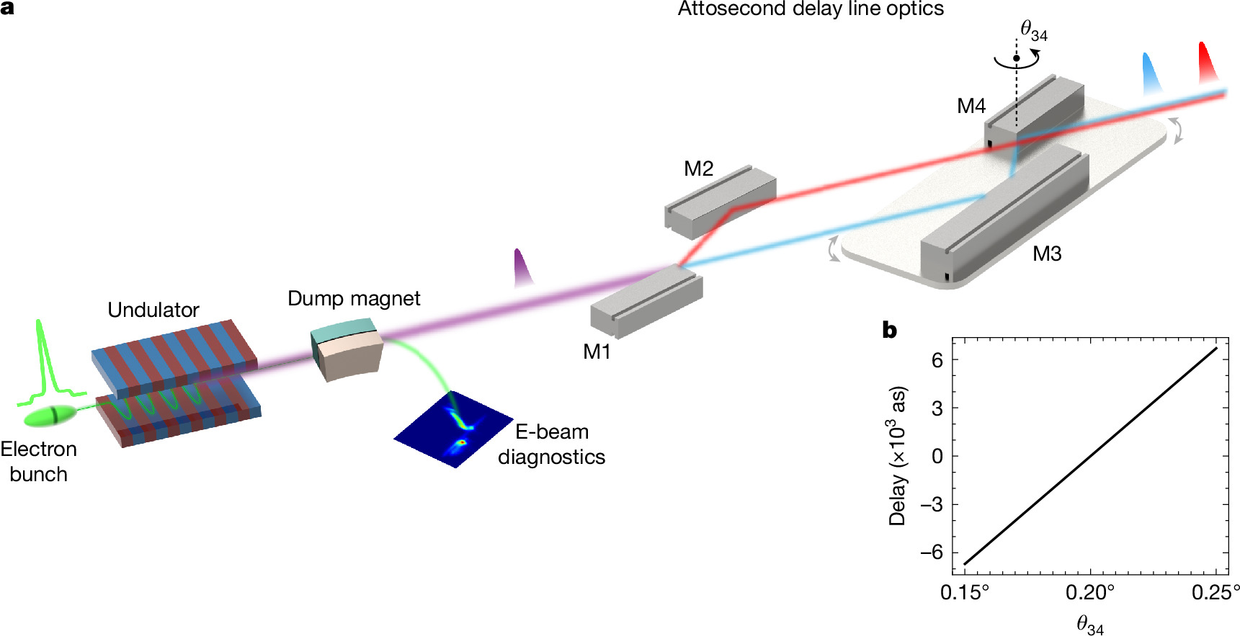
A study in Nature reports metrology of attosecond hard X-ray pulses generated at X-ray free-electron laser sources. Intensity autocorrelation measured directly in the time domain gives an average pulse duration of 170 attoseconds doi.org
Naturedoi.orgOpen source ↗. The work builds on a broadband X-ray split-delay line, which produces pairs of pulses with a controlled delay
doi.org
Naturedoi.orgOpen source ↗.
Why pulse metrology was needed
Sub-ångström spatial resolution combined with attosecond temporal resolution makes it possible to observe electron motion in matter directly, the authors write doi.org
Naturedoi.orgOpen source ↗. Attosecond hard X-ray pulses from X-ray free-electron lasers provide the required spatiotemporal sensitivity. Their use, however, has been limited by the absence of precise pulse metrology and control
doi.org
Naturedoi.orgOpen source ↗.
What was measured
Field-correlation measurements gave the first time-domain characterization of the pulse coherence time doi.org
Naturedoi.orgOpen source ↗. The same measurements demonstrated attosecond synchronization between the generated pulse pairs
doi.org
Naturedoi.orgOpen source ↗. These two results characterize the pulses and show that the delay between the pair members is controlled at the attosecond scale.
For the duration, the authors used non-sequential two-photon absorption as a nonlinear probe. Intensity autocorrelation based on this process quantifies the average pulse duration directly in the time domain, and the value obtained is 170 as doi.org
Naturedoi.orgOpen source ↗. The figure is an average over pulses, as reported by the authors.
Intended applications
The authors state that the demonstrated experimental tools and techniques enable systematic attosecond time-resolved experiments. They name X-ray pump–X-ray probe spectroscopy and diffraction among them doi.org
Naturedoi.orgOpen source ↗. According to the authors, the approach opens a pathway to probing electronic phenomena with unprecedented spatial-temporal resolution
doi.org
Naturedoi.orgOpen source ↗.
The available material is the abstract of the paper; the full text is behind a subscription. Details of the facility, the instrument parameters and the measurement statistics are therefore not covered here.