Sungkyunkwan University twists two atom-thin semiconductors to tune infrared wavelength and polarization
Korean researchers stacked and rotated two 2D semiconductors in a lab structure, controlling infrared wavelength and polarization together and raising brightness up to tenfold with multiple layers.

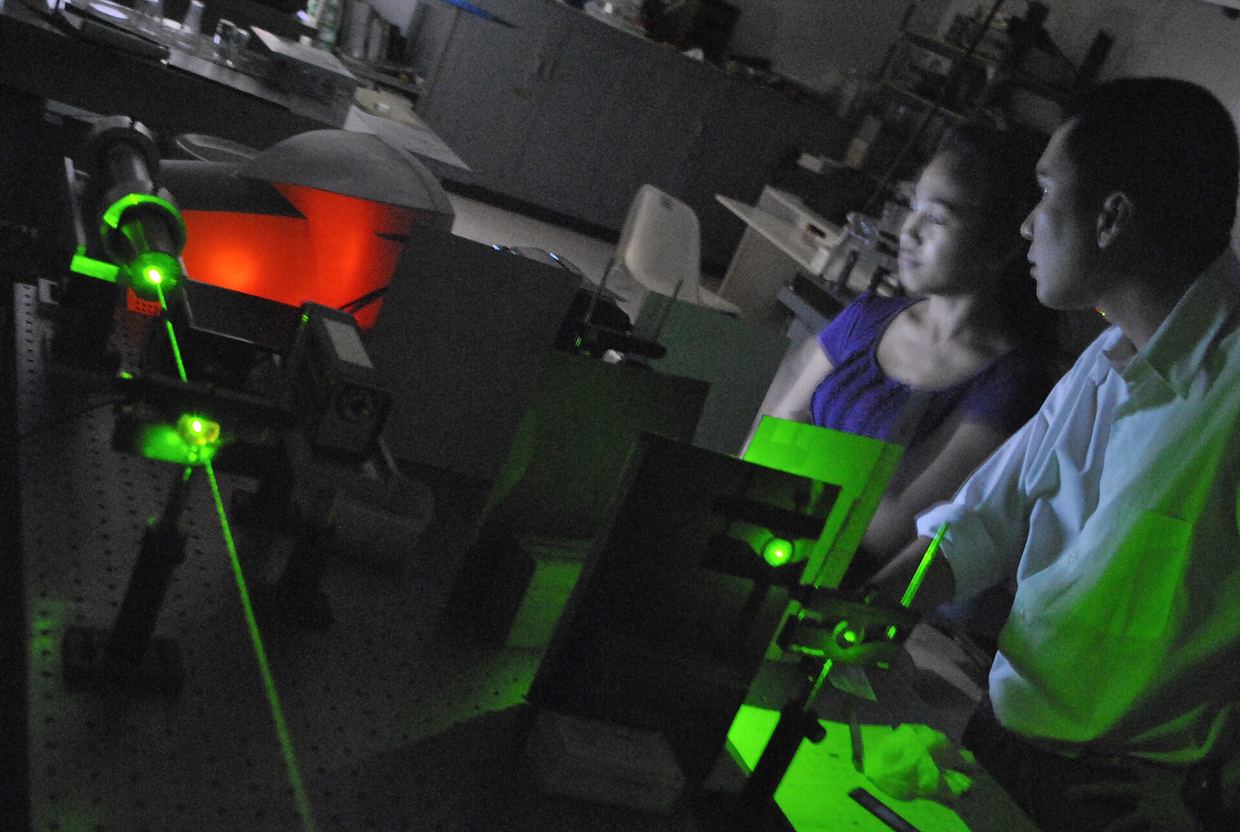
A research team at Sungkyunkwan University in Seoul has developed a method to control infrared light by stacking two atomically thin semiconductors and twisting them relative to each other. The group of Professor Kim Jung-yong (Department of Energy Science) worked jointly with Professor Roh Hee-seok of Jeonbuk National University. The results were published in the journal ACS Nano, news1.kr reports news1.kr
news1.krnews1.krOpen source ↗.
Infrared light is invisible to the human eye, but it is used to measure distance to objects and to detect signals from the human body. According to the researchers, controlling its wavelength and oscillation direction can help in developing optical elements for different applications news1.kr
news1.krnews1.krOpen source ↗. The authors name lidar for autonomous vehicles, night-surveillance equipment and biosensors as possible areas of use; these are the authors' expectations, not demonstrated devices
news1.kr
news1.krnews1.krOpen source ↗.
Twisted bilayer and interlayer excitons
When light hits a semiconductor, an electron and the vacancy it leaves behind, a hole, can form a bound pair called an exciton. In the structure formed between two semiconductors, an interlayer exciton keeps its light-emitting state relatively long, which makes it suitable for next-generation optical elements news1.kr
news1.krnews1.krOpen source ↗. Existing 2D semiconductors offered only limited conditions for generating light or controlling its oscillation direction
news1.kr
news1.krnews1.krOpen source ↗.
The team overlaid two sheets of 2D semiconductors, rhenium disulfide and rhenium diselenide, and rotated them against each other. The new atomic arrangement formed by the overlap changes the properties of the infrared light news1.kr
news1.krnews1.krOpen source ↗.
Results
By varying the twist angle from 1 to 88 degrees, the researchers generated infrared light at a range of angles. Changing the angle and the number of stacked layers shifted the light energy over a range of about 100 millielectronvolts (meV), which means the infrared wavelength can be tuned news1.kr
news1.krnews1.krOpen source ↗. With multiple layers stacked, the brightness of the light rose up to tenfold or more
news1.kr
news1.krnews1.krOpen source ↗.
The team also confirmed that polarization, the direction of light oscillation, can be controlled. Thus both wavelength and oscillation direction are controlled in a single semiconductor structure news1.kr
news1.krnews1.krOpen source ↗.
Kim stated that the team achieved the first such technique in the world, and that he expects it to be applied as a core underlying technology in lidar, night-surveillance equipment and biosensors news1.kr
news1.krnews1.krOpen source ↗. The material does not describe a finished sensor or device.