KAIST separator with aligned liquid crystal polymer keeps 94% capacity after 100 cycles at 4C
KAIST chemists aligned liquid crystal polymer molecules in a lithium metal battery separator, cutting ion path tortuosity about 2.5 times and suppressing dendrites.
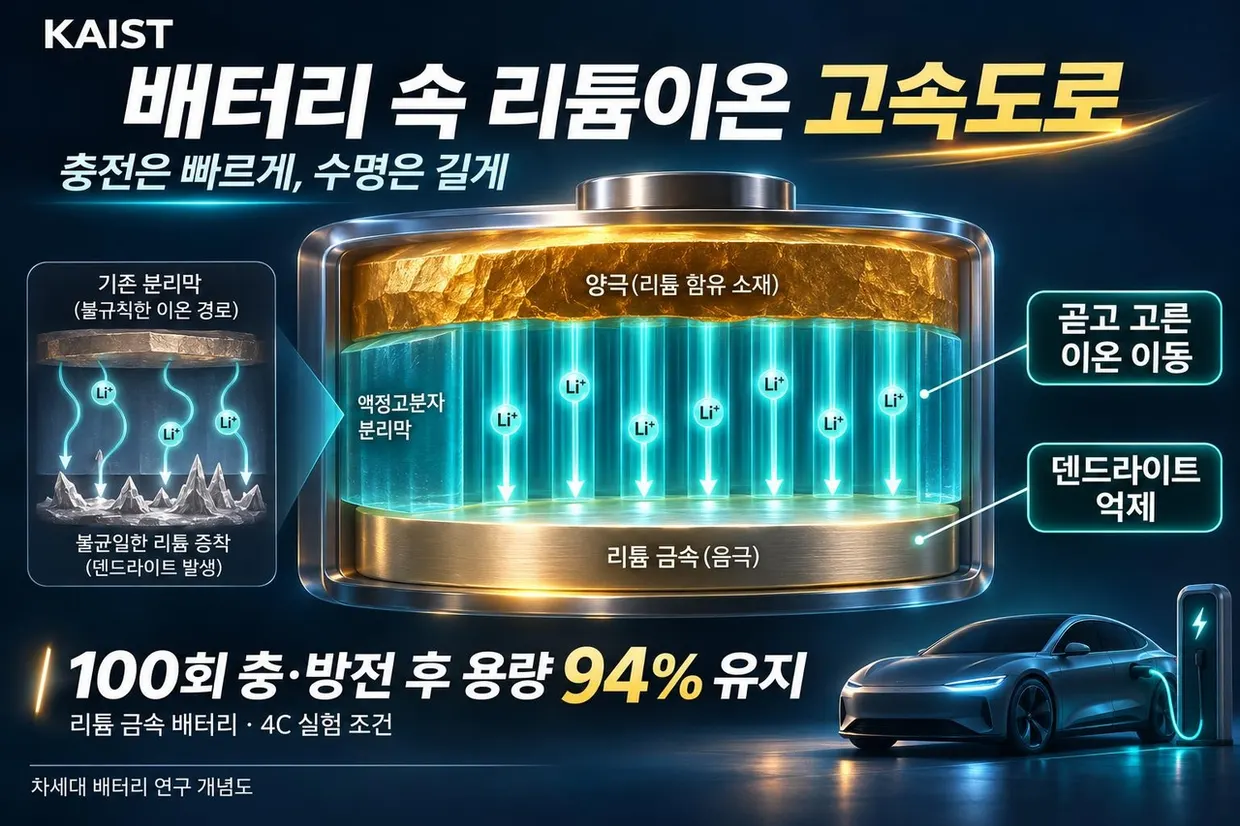
A joint team of Professors Yoon Dong-ki and Byun Hye-ryeong from the Department of Chemistry at KAIST developed a battery separator in which the molecular alignment of a liquid crystal polymer is controlled to speed up lithium-ion transport and improve stability. KAIST announced the result on the 9th, according to biz.heraldcorp.com. biz.heraldcorp.com
biz.heraldcorp.combiz.heraldcorp.comOpen source ↗
The dendrite problem in lithium metal cells
Lithium metal batteries can store more energy than conventional lithium-ion cells, which is why they are considered candidates for next-generation electric vehicle batteries. Their commercialization is held back by dendrites: needle-like lithium growths that form during charging.
Dendrites shorten battery life and damage the separator, which can cause an internal short circuit and fire. The risk grows during fast charging, when lithium deposits unevenly.
Aligned channels in the separator
The team set out to change the path of lithium ions so that they move straight and uniformly toward the electrode instead of along a winding route. To do this, they made a liquid crystal polymer separator with pores a few nanometers across and introduced polyethylene glycol (PEG) chains that assist ion movement. The liquid crystal molecules were then aligned vertically, which straightened the channels for the ions. biz.heraldcorp.com
biz.heraldcorp.combiz.heraldcorp.comOpen source ↗
The vertically aligned separator had about 2.5 times lower tortuosity of the ion path than a horizontally aligned one. According to the report, ions moved faster and more evenly, and dendrite formation was effectively suppressed.
When the separator was used in a lithium metal battery, the cell retained 94% of its initial capacity after 100 charge-discharge cycles at 4C, which corresponds to a theoretical 15-minute charge.
The approach improves charging performance and stability by controlling molecular alignment inside the separator without changing the battery materials themselves. For commercial use, the report notes that large-area separator manufacturing and long-term durability verification are still required. biz.heraldcorp.com
biz.heraldcorp.combiz.heraldcorp.comOpen source ↗
Professor Yoon said the work showed that controlling the alignment of liquid crystal polymers can be used to design lithium-ion pathways efficiently and improve battery performance and stability. The results were published in the September issue of ACS Nano.