Soongsil University coating cuts ice adhesion on copper from 454 to 6.4 kPa in lab tests
Researchers in Seoul combined PDMS, polyborosiloxane and silicone oil. In lab tests ice released from coated aluminium at about 20° tilt, though the layer does not stop freezing.
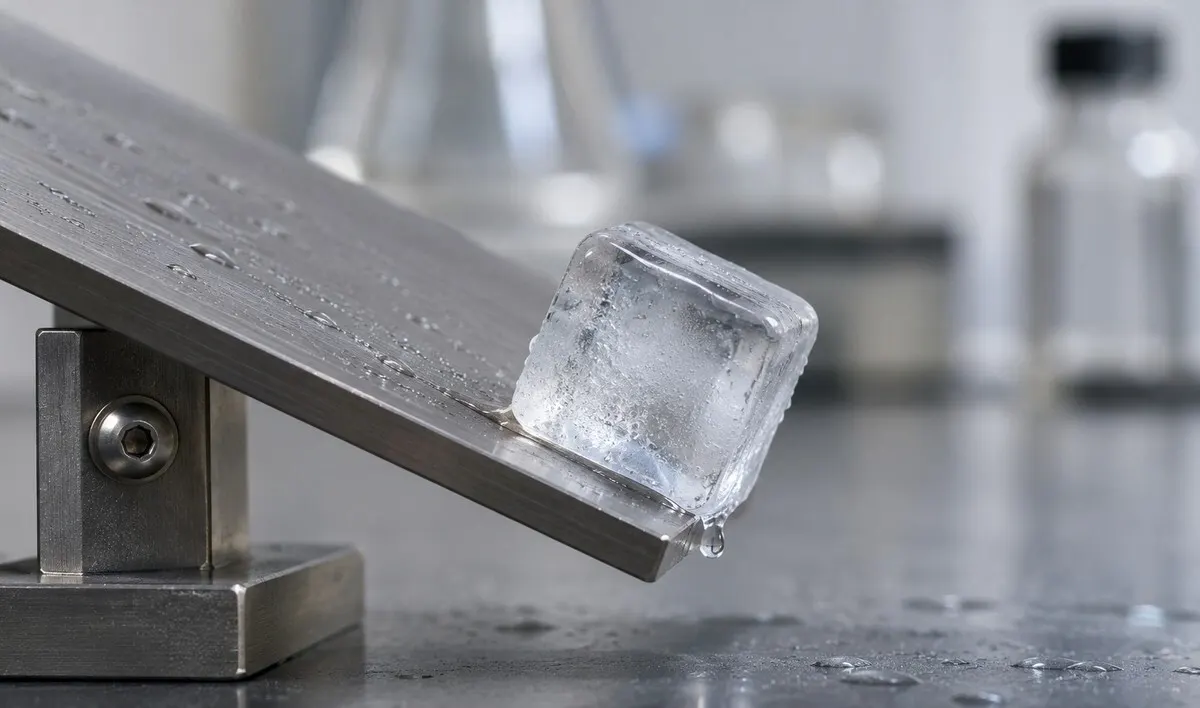
Kun-Woo Nam and Sung-Hoon Park of Soongsil University in Seoul have developed a thin coating that bonds firmly to metal yet lets ice go easily, reports Forschung und Wissen. The study appeared in Nature Communications on 24 August 2026. In lab tests, ice adhesion fell to 6.4 kPa, against about 454 kPa on bare copper forschung-und-wissen.de
Forschung und Wissenforschung-und-wissen.deOpen source ↗. In a separate large-area test, ice detached from coated aluminium at a tilt of about 20°. The layer does not prevent freezing; it makes ice that has already formed easier to remove.
Composition and measured values
The coating combines polydimethylsiloxane (PDMS), polyborosiloxane (PBS) and silicone oil. The optimized variant P-PBS1, with 5 wt% PBS1, reached about 6.4 kPa, a reduction of roughly 98.6%. This figure refers only to the shear stress needed to detach ice from the surface, not to the amount of ice formed or to energy use. PDMS alone gave about 103 kPa, and the variant with silicone oil about 31 kPa.
Adhesion of the coating to its substrate was about 2,620 kPa, against about 300 kPa for the PDMS reference, roughly 8.7 times higher. According to the authors, reversible B–O–Si bonds in PBS can break under load, rearrange and re-form, which spreads stress through the mobile polymer instead of concentrating it at one point. The authors report no sign of oil phase separation in the optimized formulation.
In the shear test, 1 cm³ ice blocks were frozen for over 30 minutes at −15 °C and loaded at 0.25 mm/s. On bare copper the ice still adhered after 60 seconds. On P-PBS1 it began to slide within 0.5 seconds and was fully detached within six seconds at most forschung-und-wissen.de
Forschung und Wissenforschung-und-wissen.deOpen source ↗. Separately, an ice block could slide off the coating under gravity alone.
Thickness, durability and limits
Standard films were about 2 µm thick. Thinner films of 0.378 and 0.91 µm showed no noticeable loss of performance. After 100 icing and de-icing cycles, adhesion stayed near 6 kPa. An abrasion test ran 500 cycles with 1000-grit sandpaper under a 250 g load. The coating was applied by spraying and dipping.
In the large-area test, sprayed aluminium was iced at −20 °C and then tilted; the ice released at about 20°, which is the tilt angle, not a temperature. Soongsil's release of 6 November is a university-provided statement and not independent proof of industrial use. Long-term outdoor stability, series production and repair of damaged areas remain untested.