Leiden University: nanowire detector signal analysis tells one, two and three photons apart
Leiden physicists distinguished one, two and three or more photons in recorded signals of a superconducting nanowire detector, a step toward optical quantum computers.
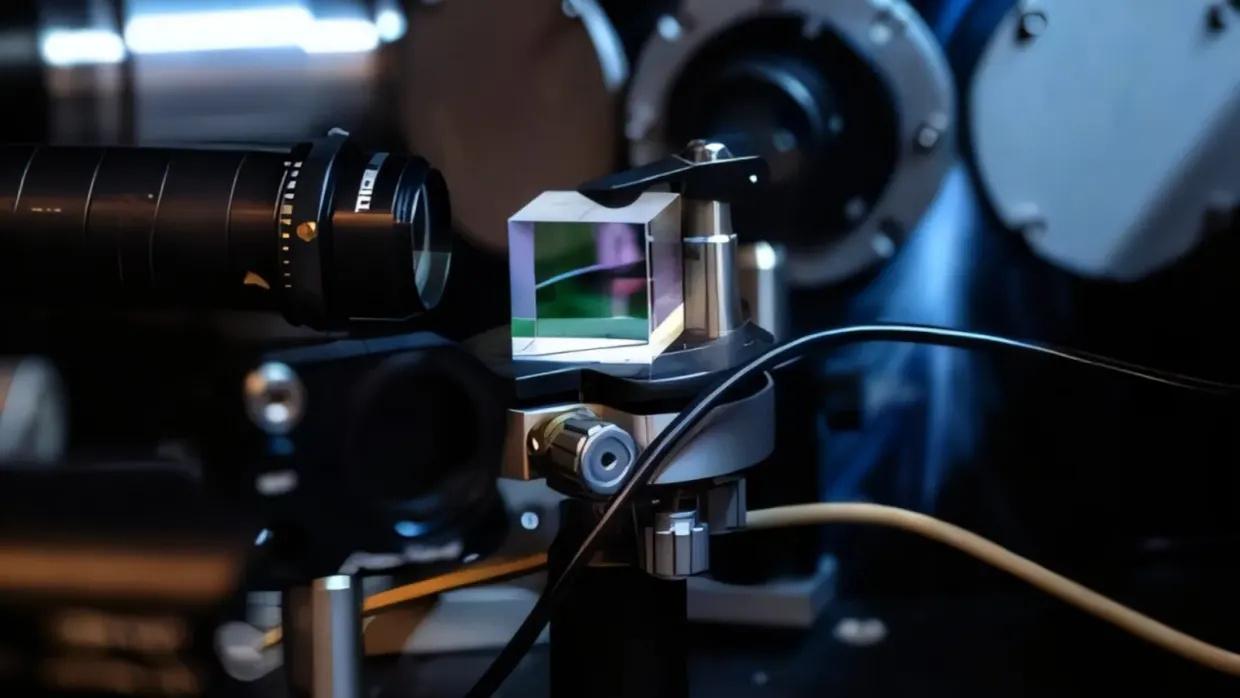
Physicist Erik Baalbergen defended his PhD thesis "Photon-Number Resolution with Superconducting Nanowires" at Leiden University on 3 November 2026. According to universiteitleiden.nl, he and colleagues developed a technique that distinguishes one, two and three (or more) photons in the signals of superconducting nanowire detectors universiteitleiden.nl
universiteitleiden.nluniversiteitleiden.nlOpen source ↗. Until now, such detectors could only determine whether light particles were present or not.
How the detector counts photons
A superconducting nanowire has zero electrical resistance at very low temperatures. When a photon strikes the wire, its electrical state changes and a measurable signal is generated. Baalbergen, theoretical physicist Ilse Kuijf and Master's student Lars Seldenthuis looked not only at the amplitude of this signal but also at how it changes over time, which allowed them to deduce more accurately how many photons were detected. The method places relatively few demands on the readout electronics.
In the experiments, a commercial nanowire detector was cooled to two kelvin, and two million voltage traces were recorded at different light intensities. The processing worked with a sampling rate of five billion points per second and three gigahertz of analog bandwidth. The authors report a separation measure of 0.81 for one versus two photons and 0.73 for two versus three or more, where one means complete separation and zero complete overlap. These values are not hit rates. The distributions overlap, so the exact number is not determined unambiguously for every event, and timing jitter of the signals limited the accuracy.
Role in an optical quantum computer
An optical quantum computer uses photons to perform calculations, so it needs a detector able to count exactly how many pass through universiteitleiden.nl
universiteitleiden.nluniversiteitleiden.nlOpen source ↗. Baalbergen notes that almost all components of such a machine operate at room temperature, so no large cooling system down to near absolute zero is needed.
Baalbergen worked with QuiX Quantum, which launched the first working prototype of its optical quantum computer in the summer of 2026. He expects a detector like his to feature in the next generation of that computer. The detector still needs further development, and the tests used recorded voltage signals rather than a fully integrated real-time photon counter. The work was published in APS Open Science; his supervisors are Michiel de Dood and Martin van Exter.