CUNY ASRC: elastic waves in a hyperbolic metamaterial cavity form stable chiral attractors, not chaos
Researchers showed experimentally that odd-shaped cavities in a hyperbolic metamaterial replace chaotic wave motion with robust, broadband wave attractors.
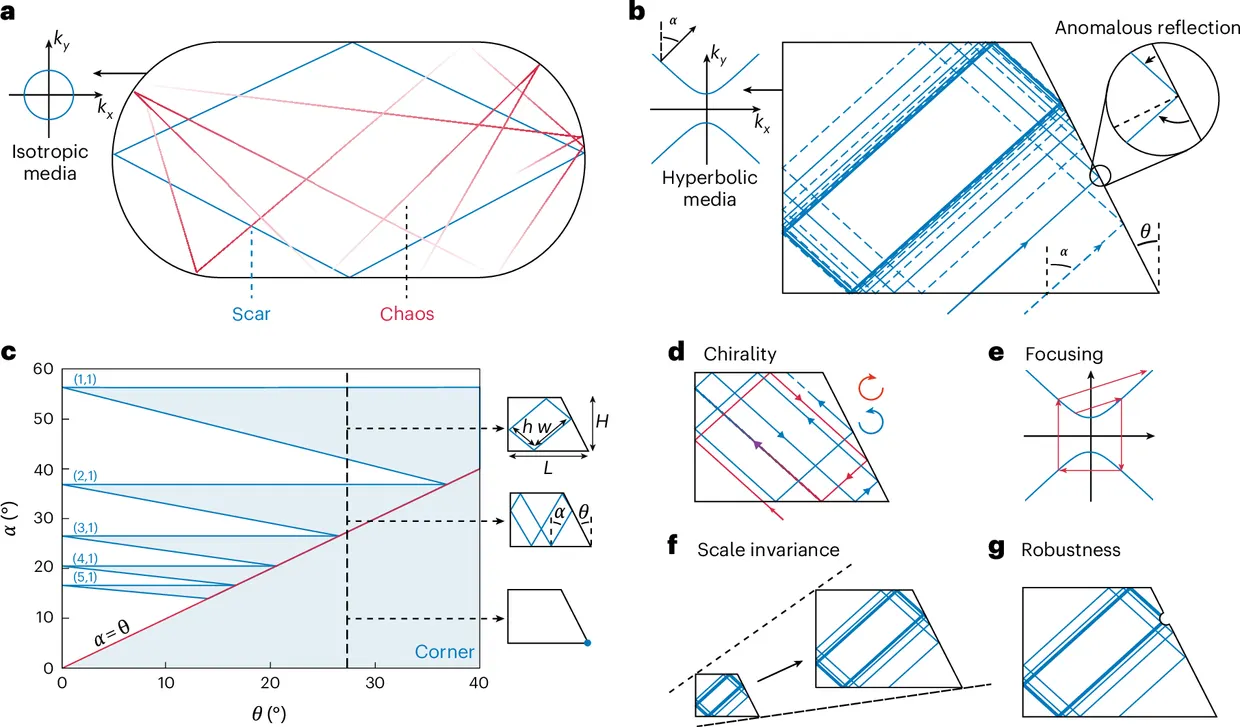
Researchers at the Advanced Science Research Center at the CUNY Graduate Center (CUNY ASRC) report in a study on nature.com that odd-shaped cavities formed in hyperbolic media suppress chaotic wave dynamics. Instead, the cavities produce "hyperbolic wave attractors" nature.com
nature.comnature.comOpen source ↗. The team demonstrated the effect experimentally with elastodynamic waves in a hyperbolic metamaterial engineered to control vibrations. The principal investigator is Andrea Alù; Simon Yves is a first author.
Why chaos usually dominates
Wave behaviour in irregular cavities is typically dominated by chaos. Trajectories diverge and are highly sensitive to initial conditions because of complex internal reflections, which limits control and stability. In ordinary materials a wave reflects at the same angle at which it strikes a surface. Repeated reflections inside an irregular enclosure can then produce chaotic motion, a problem studied in physics as a dynamical billiard.
Hyperbolic materials are named after the mathematical curve called a hyperbola. According to the researchers, they direct waves along specific paths and alter how waves reflect from angled surfaces. Inside an irregular cavity these reflection rules can make waves converge toward organized trajectories.
Properties of the attractors
The attractors are robust, chiral, broadband and scale-invariant. They organize wave motion analogously to limit cycles in nonlinear dynamical systems, and their properties differ from both conventional resonant cavities and chaotic modes nature.com
nature.comnature.comOpen source ↗. Chirality means the paths circulate clockwise or counterclockwise. The authors say stability and direction depend on the cavity geometry and on the wave properties of the material.
Repeated reflections guide waves into closed trajectories that remain stable across scales. The researchers attribute this partly to broken mirror symmetry in the reflection process, which makes wavelengths progressively shrink as waves travel through the cavity. The experiments also revealed attractor phase transitions, symmetry-driven features and robustness against defects.
The authors conclude that wave-attractor physics extends across natural and artificial hyperbolic media. They describe the robust, chiral organization as arising from simultaneous symmetry breaking in the material and in the cavity geometry, in a fully linear system. They also point to possible compact, multifunctional devices for wave-based signal processing and sensing. Such devices would combine functions usually associated with large, wavelength-scale structures with those of deeply subwavelength cavities.