Study of 1,479 Korean firms links organizational culture and work style to new-hire turnover
A regression analysis of KRIVET panel data for 2020–2023 found that relationship-oriented culture and mentoring go with lower new-hire turnover, while more autonomy goes with higher.
Professor Roh Yong-jin of the Seoul National University of Science and Technology presented a study, "Human Relations Management and New-Hire Turnover," at a recent academic conference, according to biz.heraldcorp.com, citing the Korea Research Institute for Vocational Education and Training (KRIVET). The analysis covered 1,479 companies over four years. It found that early turnover among new hires may depend on organizational culture and work style more than on working conditions such as pay and hours biz.heraldcorp.com
biz.heraldcorp.combiz.heraldcorp.comOpen source ↗.
Data and method
The study used KRIVET's Human Capital Corporate Panel (HCCP) for 2020–2023. Using regression analysis, the author estimated how organizational culture, teamwork methods, and coaching and mentoring programs affect turnover among new hires with no prior work experience.
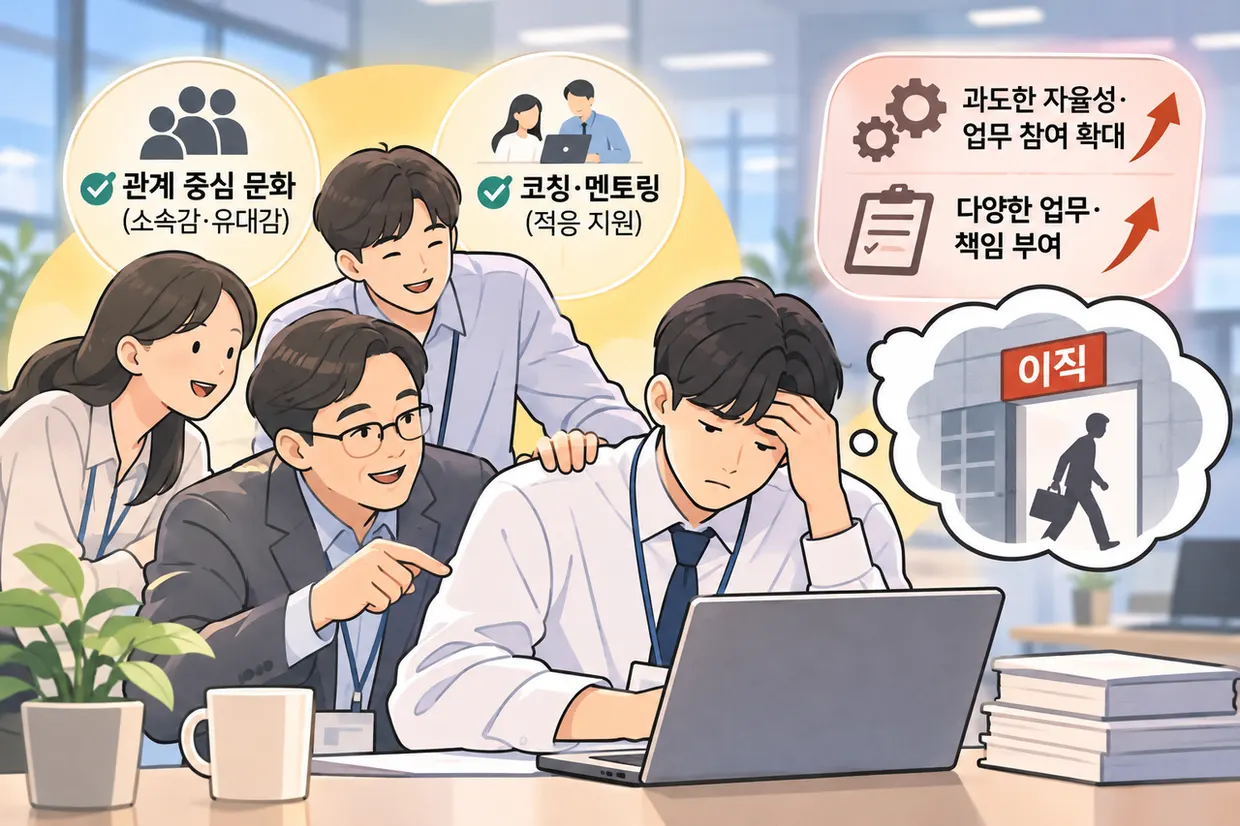
A relationship-oriented culture, meaning a family-like atmosphere and a strong sense of unity among members, was associated with lower turnover. Its regression coefficient was -3.403, a statistically significant reduction factor.
Autonomy, pay and mentoring
Task-oriented practices produced the opposite of the expected result. These include involving members in problem solving and decisions, assigning varied tasks and responsibilities, and giving broad autonomy in work. Their coefficient was 4.914, meaning that the stronger these practices, the higher the new-hire turnover biz.heraldcorp.com
biz.heraldcorp.combiz.heraldcorp.comOpen source ↗.
The coefficients for pay level and weekly working hours were -0.048 and -0.271. The effect of culture and work style therefore appeared larger than that of pay and hours, although the report notes that coefficient sizes of different variables cannot be compared directly without caution. Coaching and mentoring that support adaptation to the organization were also linked to lower turnover, with a coefficient of -1.382.
According to the report, the findings suggest that giving inexperienced new hires autonomy and responsibility without sufficient training and support may burden their adaptation. The report also notes that early turnover is not always negative: some of it is voluntary, as young workers search for a suitable job and conditions, and adaptation failure should be distinguished from such job exploration.
Roh said the effect of human relations management on turnover was stronger for workers without experience than for experienced ones. In his view, the lack of work experience may contribute to interpersonal maladjustment and turnover. He added that for new hires of the so-called MZ generation, who have had fewer chances for direct interpersonal contact, adaptation to the organization can be a major challenge biz.heraldcorp.com
biz.heraldcorp.combiz.heraldcorp.comOpen source ↗.