Varda Space tests microgravity drug crystallization across three orbital capsules
Three washing-machine-sized capsules were placed in orbit to formulate cancer drug crystals and qualify reentry systems.
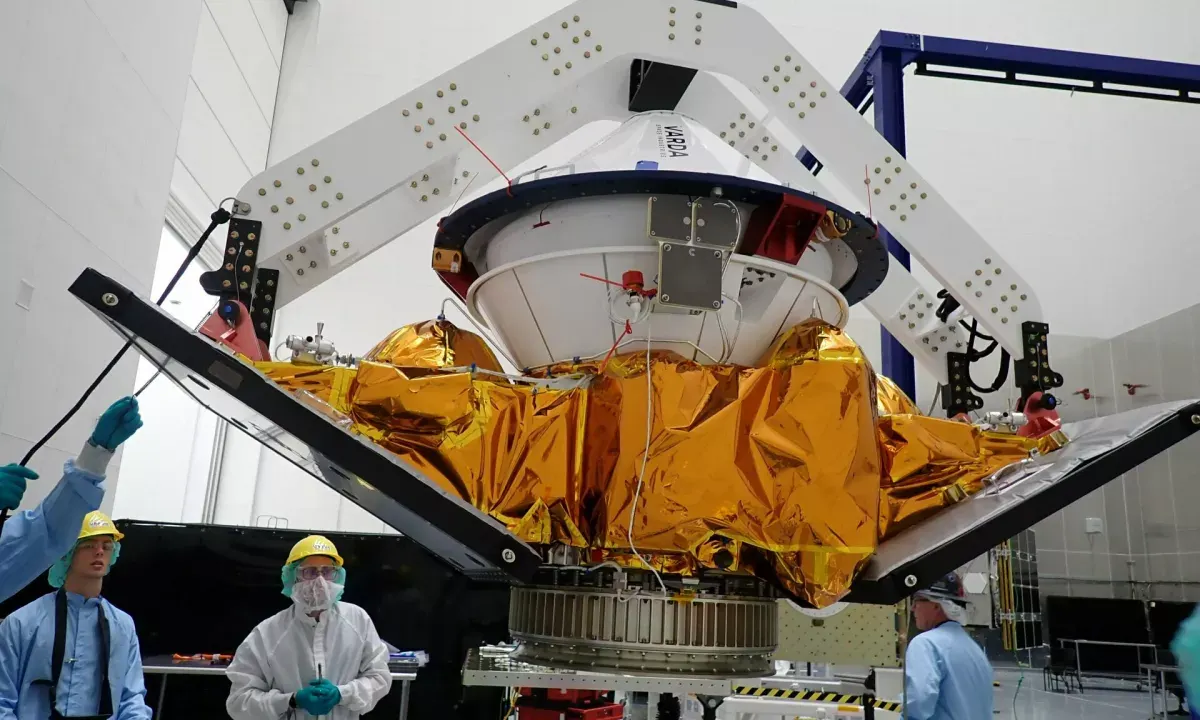
California-based startup Varda Space Industries has deployed three capsules to Earth orbit, operating them simultaneously at an altitude of approximately 480 kilometers, dnevnik.si reported. Two vehicles were launched aboard a single rocket on October 1, followed by a third launch on October 20. The milestone marks the first time a commercial entity has maintained three operational return capsules in orbit at once dnevnik.si
dnevnik.sidnevnik.siOpen source ↗.
One of the capsules, designated W-7, carries pharmaceutical processing hardware to test the crystallization of a candidate cancer therapy known as a protein degrader. The remaining two vehicles are assigned to evaluate navigation systems and thermal protection materials required for atmospheric reentry at hypersonic speeds. Together, the missions are designed to test hardware for orbital pharmaceutical manufacturing and payload recovery.
Microgravity crystallization physics
On Earth, gravitational forces induce particle sedimentation in liquid mixtures, while density variations drive convective fluid flows. According to Dr. Meganne Christian of the UK Satellite Applications Catapult, removing these gravitational influences allows crystals to form in a significantly more uniform and ordered arrangement.
For pharmaceutical developers, crystal geometry, size distribution, and packing directly dictate molecular stability and dissolution rates. The orbital test aims to overcome the poor solubility profile of the protein degrader candidate. In commercial applications, altered crystalline structures may permit formulations currently restricted to intravenous infusion to be administered via simpler subcutaneous injections dnevnik.si
dnevnik.sidnevnik.siOpen source ↗.
Platform scaling and materials research
Varda chief executive Will Bruey stated that increasing the cadence of launches is essential to establishing a commercial fleet of orbital factories. In addition to cancer therapeutics, the company has announced a research partnership with United Therapeutics to process small-molecule formulations for rare pulmonary diseases aboard its W-series orbital platform.
Beyond pharmaceuticals, the physical characteristics of low Earth orbit—notably microgravity and vacuum—present manufacturing advantages for other advanced materials. Research representatives noted that these conditions could reduce crystal defect rates during the production of semiconductors and graphene, potentially yielding structures with fewer performance-degrading flaws than terrestrial equivalents.