General Atomics patents a three-piece welded piston for opposed-piston engines, US 12,747,713
The US patent describes making the piston from a crown, a skirt and an outer ring joined by welds. The document contains no test data.
On 29 September the US Patent and Trademark Office granted General Atomics Aeronautical Systems (GA-ASI) patent US 12,747,713 B2, "Multi-part piston construction for an opposed-piston engine", according to Autonocion autonocion.com
Autonocionautonocion.comOpen source ↗. GA-ASI is based in San Diego and builds Predator unmanned aircraft. The main claim describes a method of making the piston from three parts joined by weld beads; the patent has 16 claims in total.
In the described architecture each cylinder holds two pistons facing each other, each connected to its own crankshaft. The combustion chamber forms between their crowns, there is no cylinder head or valves, and the pistons open and close the ports in the cylinder wall. Fuel is delivered by injectors mounted in the cylinder wall, so the piston acts as the chamber roof, as a valve and as the path for the fuel jet.
Three parts of the piston
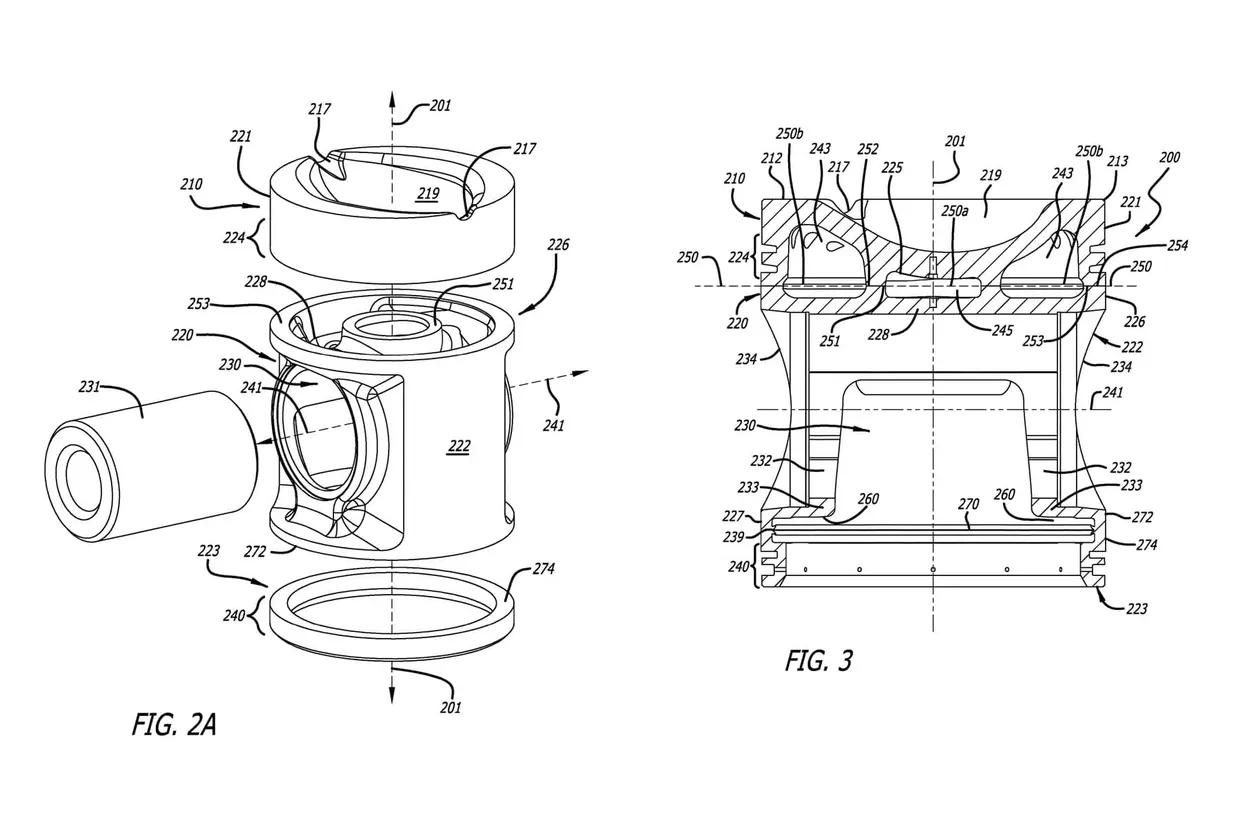
The crown carries the compression ring zone and the face with a bowl and two notches at its rim. According to the description, the notches guide fuel entry. The skirt is the piston body with the wrist pin bore. The third part is an outer ring with the oil ring grooves. Compression rings sit at one end of the piston and oil control rings at the other, with the skirt between them.
Before welding, the crown is oriented relative to the skirt so that the bowl axis forms a predetermined angle with the wrist pin axis. The injectors are fixed in the block, so this orientation can be critical. The examples give 30–35 degrees (32 as a specific case) and 45–55 degrees; one example of 58 degrees falls outside its own range autonocion.com
Autonocionautonocion.comOpen source ↗.
Why three parts, and what is not shown
The description gives three reasons. Splitting off the outer ring avoids undercuts near the wrist pin bosses that would hamper forging. Welding crown to skirt encloses a circular cooling gallery and a central oil chamber. The skirt wall can also be made thinner to reduce mass.
In the preferred process, crown and skirt are forged and the ring is cut from weldable, wear-resistant steel tube. Crown and skirt are joined by hybrid induction welding and the ring by inertia friction welding, followed by heat treatment and machining of the ring grooves. For peak pressures above 200 bar the text proposes forged 4140 steel; below that, microalloyed steel. Threaded or press-fit joints are also mentioned, though the main claim requires welding.
The text contains no bench hours, service life, unit cost or comparison with a one-piece piston. The priority date is a provisional application of 30 March 2017; the granted patent is a continuation filed on 27 June 2023, with Ryan G. MacKenzie as inventor. It was published on 26 October 2023 under Achates Power. On 19 August 2025 GA-ASI announced the purchase of key Achates Power assets, including a patent portfolio autonocion.com
Autonocionautonocion.comOpen source ↗.