University of Würzburg Chemists Synthesize Three Room-Temperature Stable Oxoboranes
Researchers have synthesized three base- and acid-free oxoboranes as crystalline solids stable at room temperature.
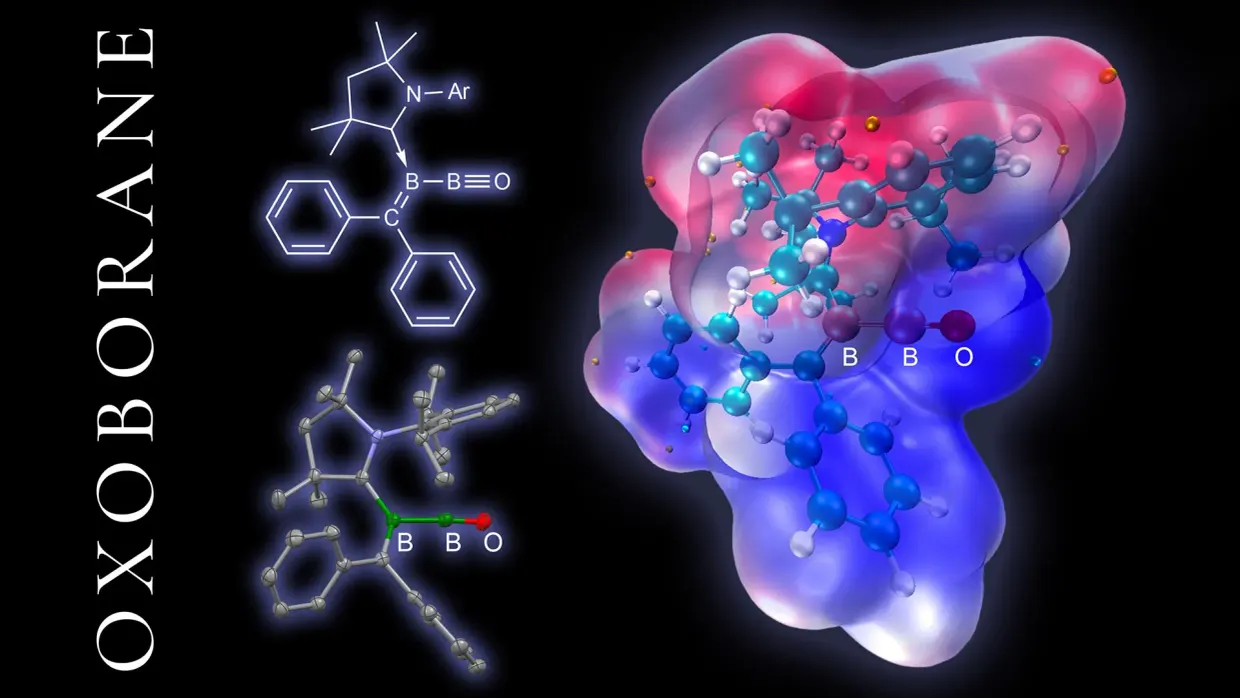
Chemists at the University of Würzburg, in collaboration with researchers from Tezpur University, reported the synthesis and isolation of three stable oxoboranes as crystalline solids at room temperature in a study published in Nature Chemistry nature.com
Nature Chemistrynature.comOpen source ↗. Oxoboranes contain a formal triple bond between a dicoordinate boron atom and a monocoordinate oxygen atom. While documented attempts to synthesize these reactive main-group compounds date back to the early 1960s, prior efforts yielded only gas-phase or matrix-isolated species, chemical-trapping evidence, or derivatives with reduced B-O bond orders.
Synthesis and Reaction Pathway
The isolated base- and acid-free compounds formed during experiments conducted by doctoral students investigating the reactivity of a diboracumulene with standard ketones. Instead of the predicted reaction pathways, the processes unexpectedly generated the target oxoboranes as main products, which precipitated as orange or yellow solids. The authors reported that the procedure represents a straightforward synthetic route starting from simple, accessible substrates.
Structural and Bonding Parameters
Experimental structural analysis revealed that the synthesized oxoboranes feature exceptionally short boron–oxygen bonds measuring between 1.208(4) Å and 1.217(4) Å. Both experimental characterization and quantum-chemical computations conducted by the Tezpur team demonstrated that these linkages represent strong triple bonds, clarifying the underlying electronic mechanism that provides the compounds with unexpected thermodynamic and kinetic stability in the condensed phase.