Rubin Observatory detects two faint Milky Way satellites in preview data
Astronomers analyzed test data from the Rubin Observatory to discover an ultra-faint dwarf galaxy and a dust-shrouded star cluster orbiting the Milky Way.
Astronomers using preview data from the NSF-DOE Vera C. Rubin Observatory in Chile have detected two previously unknown companions of the Milky Way, according to news.yale.edu yale.edu
news.yale.edunews.yale.eduOpen source ↗. The findings were detailed in two papers: one accepted by The Astrophysical Journal Letters with lead author Aashay Pai from the University of Chicago, and another published in Research Notes of the AAS by William Cerny from Yale University.
Ultra-faint satellites
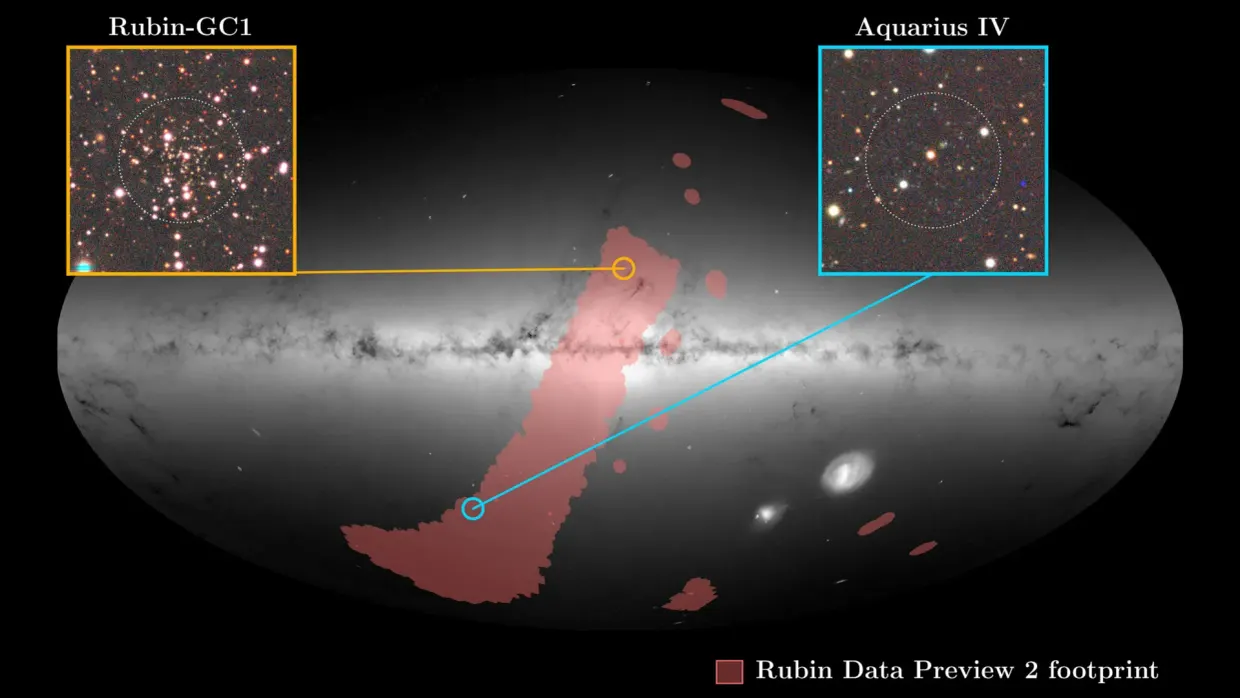
The detected companions consist of an ultra-faint dwarf galaxy and a distant star cluster. The first object, Aquarius IV, is located roughly 355,000 light-years from Earth in the distant outskirts of the galactic halo. The second system, named Rubin-GC1, is a dense cluster of stars positioned on the far side of the Milky Way, concealed behind dense lanes of cosmic dust.
While Aquarius IV is barely visible by eye in the test imagery, automated search algorithms detected it with high confidence. Researchers noted that systems like Aquarius IV contain very few stars relative to larger galaxies and are dominated almost entirely by dark matter, providing empirical constraints for galaxy formation models.
Survey instrumentation
The discoveries emerged from test data collected between April 2025 and January 2026, which covered approximately 7% of the night sky before the official start of operations yale.edu
news.yale.edunews.yale.eduOpen source ↗. Rubin Observatory, located on Cerro Pachón in the Chilean Andes, carries an 8.4-meter Simonyi Survey Telescope fitted with a 3.2-gigapixel digital camera.
The observatory commenced its 10-year Legacy Survey of Space and Time (LSST) in June. Approximately 65 satellite galaxies of the Milky Way are currently known, while theoretical models suggest hundreds of faint companions remain unobserved. The instrument's primary scientific goals include mapping the Milky Way's halo to uncover these hidden substructures.