Fudan University: retrodiction on 51.7 billion rubidium atoms lowers spin noise 1 dB below standard quantum limit
In a preprint, Fudan University researchers cut the conditional variance of both spin components below the standard quantum limit for 1.4 hours, without violating the uncertainty principle.

Researchers at Fudan University (FDU) in Shanghai, led by Junlei Duan, tested retrodiction on an oscillator made of about 51.7 billion rubidium-87 atoms, according to scinexx. The results are so far available as a preprint that has not yet been peer-reviewed. scinexx.de
scinexxscinexx.deOpen source ↗
By retrodiction, the authors mean evaluating a past moment using measurements taken both before and after it. The statement then differs from the prediction limited by the Heisenberg uncertainty relation.
Setup and measurement
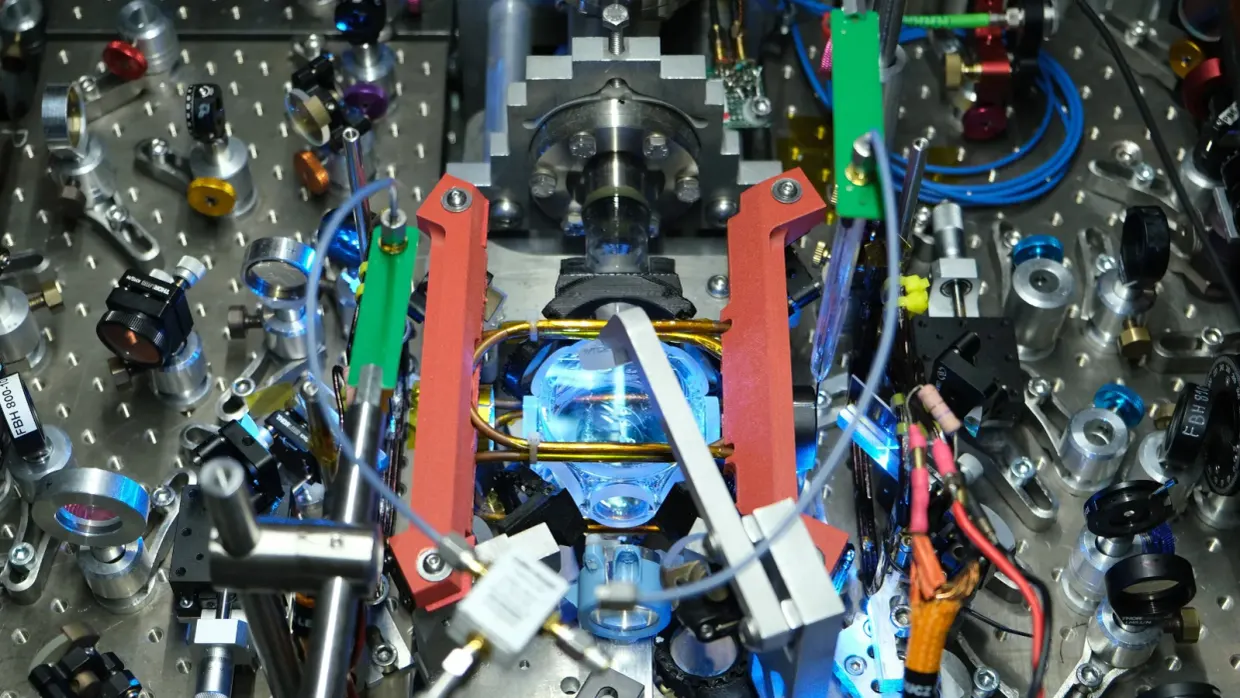
The atoms were held in a coated glass cell, and their spins were largely aligned by optical pumping. A weak measurement laser continuously recorded two mutually perpendicular components of the collective spin, which behave mathematically like the position and momentum of an oscillator. No actual positions or velocities of individual atoms were measured.
The measurement itself disturbs the spin states, an effect called quantum back-action. For each time point the team compared two evaluations: one using only signals recorded up to that point, and one that also included later data, narrowing down the possible results of the weak measurements in hindsight. scinexx.de
scinexxscinexx.deOpen source ↗
Result and limits
The second approach lowered the conditional variance, a measure of the spread of the estimated outcomes, for both spin components simultaneously below the standard quantum limit. The margin was 1.01 ± 0.15 dB, roughly a one-fifth reduction in variance, and it was sustained for 1.4 hours.
The retrodicted noise stayed below the usual limit for other measurement directions formed from the two components as well. According to the paper, earlier experiments had not yet demonstrated this property for all directions.
The effect does not mean that position and momentum are simultaneously sharply defined in a single quantum state. The improved figures describe conditional probabilities computed afterwards from a series of weak measurements. A strong measurement of one component would still be disturbed by back-action on the other. scinexx.de
scinexxscinexx.deOpen source ↗
The later data are not available immediately, so the method is not readily applicable to real-time measurements, but it is applicable to post-hoc analysis of measurement series. Whether it leads to more sensitive quantum sensors has to be shown in further experiments. The result does not constitute a general overcoming of the Heisenberg uncertainty principle.