NASA Twin ESCAPADE Probes to Perform Powered Flybys of Earth on Trajectory to Mars
Two identical spacecraft will execute gravitational slingshot maneuvers with thruster burns to head toward Mars for orbital atmosphere studies.
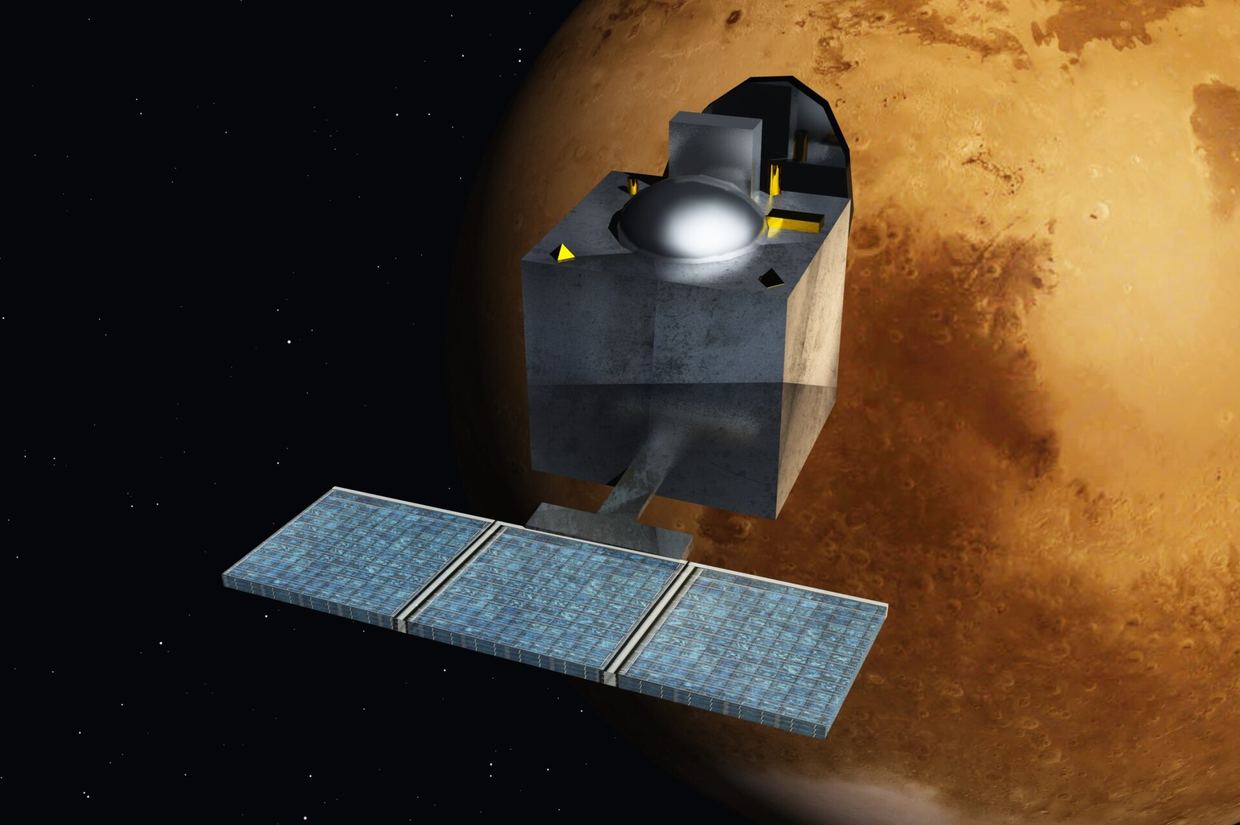
Two NASA spacecraft belonging to the ESCAPADE mission are preparing to execute powered gravity-assist maneuvers around Earth to enter a transfer trajectory toward Mars, reports universetoday.com universetoday.com
universetoday.comuniversetoday.comOpen source ↗. The twin orbiters, named Blue and Red, were placed in an intermediate loitering orbit near the Sun-Earth Lagrange point 2 after missing the primary 26-month launch window. During their closest approach to Earth, the spacecraft will pass at altitudes between 965 and 1,770 kilometers, firing their propulsion systems to achieve the required interplanetary transfer velocity
universetoday.com
universetoday.comuniversetoday.comOpen source ↗.
Trajectory and Gravity-Assist Burns
The trans-Mars injection maneuvers are scheduled individually: the first craft will execute its burn on November 7, followed by the second on November 9 universetoday.com
universetoday.comuniversetoday.comOpen source ↗. Each burn will last approximately nine minutes. The propulsion system will increase the velocity of each vehicle from 10.14 km/s to 10.78 km/s, an acceleration of more than 2,000 km/h, which, when combined with Earth's gravity assist, will inject them onto a transfer path toward Mars
universetoday.com
universetoday.comuniversetoday.comOpen source ↗. Before heading inward for the maneuver, both probes traveled through and gathered observational data on Earth's magnetotail
universetoday.com
universetoday.comuniversetoday.comOpen source ↗.
Dual Orbital Mission at Mars
Upon reaching Mars, ESCAPADE will become the first mission to operate spacecraft in a coordinated formation around the planet universetoday.com
universetoday.comuniversetoday.comOpen source ↗. During Science Phase A, which will run for six months, the probes will follow identical orbits at variable distances in an arrangement designated "String of Pearls." This simultaneous dual-point measurement architecture allows researchers to differentiate between spatial and temporal variations in solar wind interactions with remnant crustal magnetic fields
universetoday.com
universetoday.comuniversetoday.comOpen source ↗. In Science Phase B, spanning five months, the orbiters will separate, with Blue lowering its altitude to approximately 7,000 km while Red elevates to 10,000 km to collect complementary data
universetoday.com
universetoday.comuniversetoday.comOpen source ↗.