3D printing yields a metre-tall single crystal of Ti-6Al-4V titanium alloy in a laboratory demonstration
Authors grew a single crystal a metre tall and a centimetre in diameter using alternating and pulsed heat input. Its creep resistance is an order of magnitude above the grain-size prediction.
Researchers have reported a free-form additive manufacturing method that produces single-crystal Ti-6Al-4V alloy a metre tall and a centimetre in diameter. The paper is available via doi.org. nature.com
doi.orgnature.comOpen source ↗ The method uses alternating and pulsed heat inputs to govern and direct the growth of the crystal.
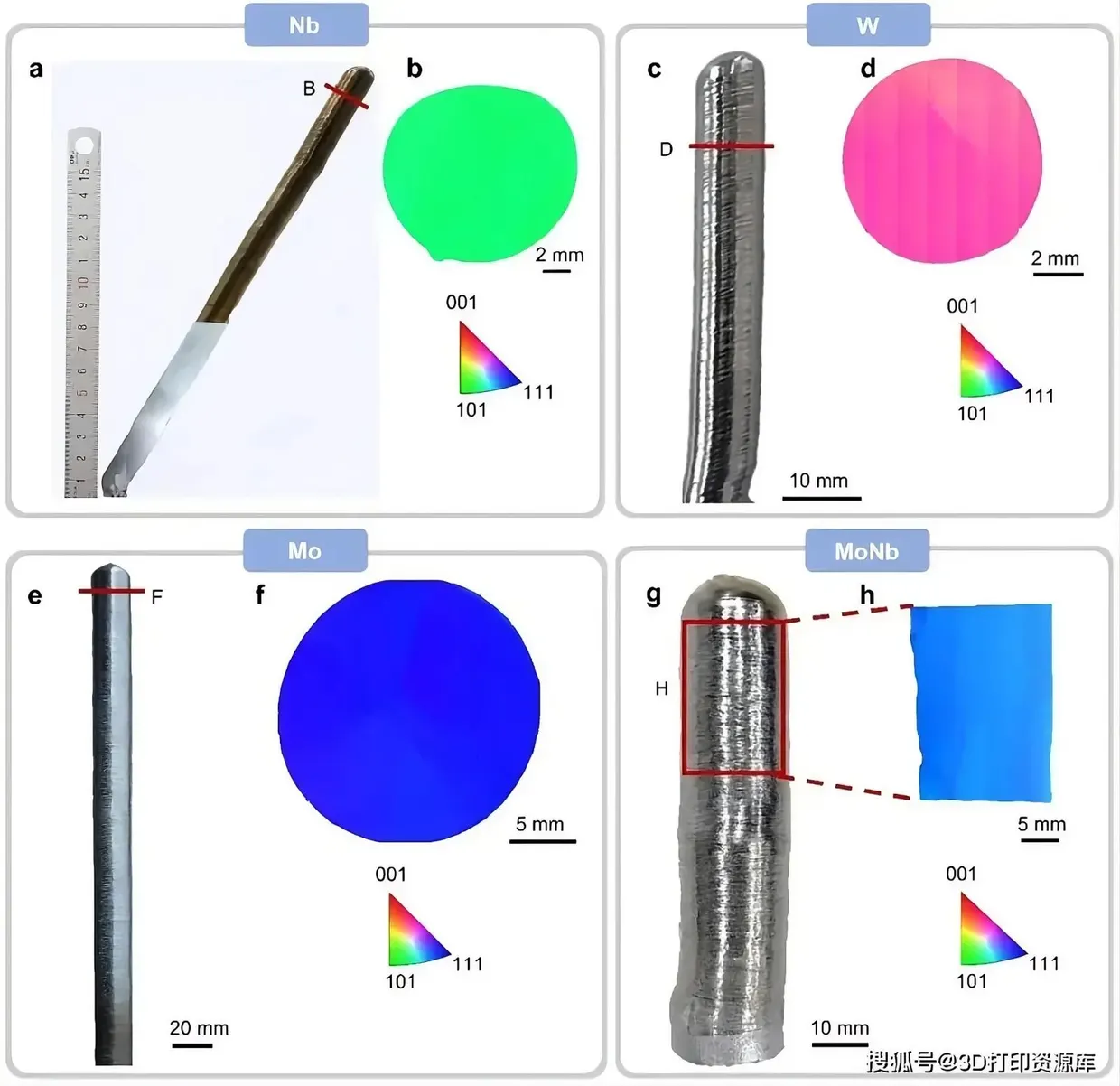
The same approach was used to print single crystals of tungsten, molybdenum, niobium and MoNb alloys. The work is a laboratory demonstration of the method.
Crystal growth under cyclic heating
Single-crystal materials are needed for high-performance applications, but conventional manufacturing of them depends on strict quasi-steady thermal conditions. Additive manufacturing involves intense cyclic thermal fluctuations, which conflicts with this requirement. Until now this has prevented 3D printing of large or architected single crystals.
The authors say that carefully controlled alternating and pulsed heat inputs resolve this contradiction. nature.com
doi.orgnature.comOpen source ↗ They also report, to their knowledge, the first single-crystal lattice structures with complex zigzag ligaments. According to the authors, the method effectively removes theoretical size constraints for single-crystal components. Simulations in the study were performed with the commercial software FLOW-3D and ABAQUS.
Creep resistance and refractory metals
The bulk single-crystal Ti-6Al-4V showed an order-of-magnitude increase in creep resistance over standard grain-size scaling predictions. The authors attribute this to two factors acting together. One is the absence of grain boundaries. The other is a hierarchical α/β architecture induced by additive manufacturing, which regulates dislocation density, mobility and void evolution.
Tungsten, molybdenum and niobium are refractory metals that are hard to process. The authors report that single crystals of W, Mo, Nb and MoNb alloys were printed with the same technique. In their words, this expands the accessible materials library and makes possible complex geometries that classical methods could not produce.