UC San Diego: stimulating 20 motor cortex neurons in mice triggers a learned lever press
Light stimulation of about 20 early-onset neurons in mouse motor cortex evoked the learned activity pattern and, in many trials, the trained movement.
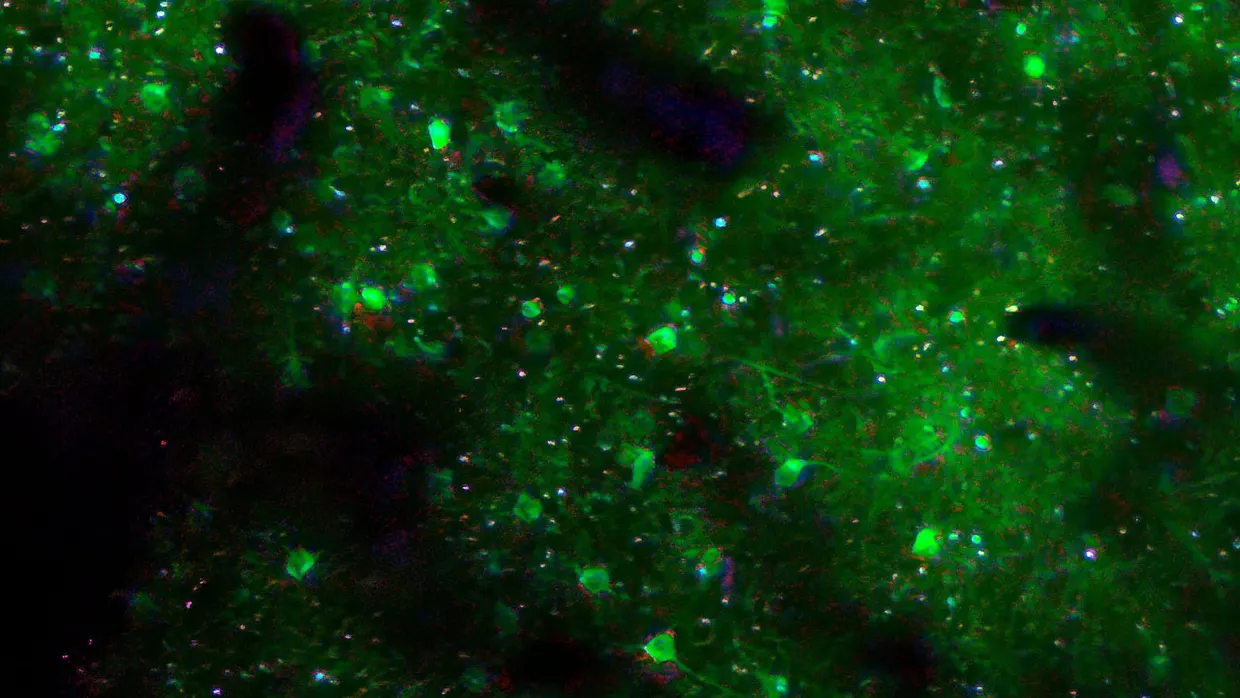
Neurobiologists at the University of California San Diego, with Takaki Komiyama as senior author, report in Nature that brief synchronous optogenetic stimulation of about 20 neurons in layer 2/3 of mouse primary motor cortex triggered the learned activity pattern and, in many trials, the learned movement itself nature.com
Naturenature.comOpen source ↗. Graduate student Qiyu Chen led the work. The mice performed a skilled lever-pressing task, and the team combined two-photon calcium imaging with holographic stimulation of functionally defined neuron groups.
Task and method
Each mouse learned to grab a lever and, after a sound, push it and hold it for one second to receive a drop of water. After two weeks of daily practice the animals pressed the same way each time, and the team recorded 14 of them. The neurons carried both a calcium indicator and a light-sensitive protein. About 550 neurons per session were imaged at three depths, and a holographic laser could target chosen cells.
Across 27 sessions and 14,779 neurons, about 30 percent of cells increased activity during a press and about 16 percent decreased. Roughly 13 percent of neurons in a session became active before the lever began to move; the authors called them early-onset neurons.
In 30 percent of randomly chosen trials the sound was replaced by a 3-millisecond flash of light hitting about 20 early-onset neurons at once, and no water was given. The mice pressed far more often than in trials with neither sound nor light. About half of the light-triggered presses had a correlation above 0.5 with the trained press, against a median of 0.785 for voluntary presses and 0.455 for light-triggered ones. Neurons that normally rose or fell during a voluntary press changed the same way after the flash nature.com
Naturenature.comOpen source ↗.
Controls and limits
Stimulating about 20 late-onset neurons, whose activity begins after the press has started (about 14 percent of cells), produced presses in far fewer trials. Those presses were less similar to the trained one, and fewer surrounding neurons were recruited. In mice not engaged in the task, stimulation failed to produce movements or the learned activity.
In some trials the stimulation evoked the learned activity without a movement, which indicates that the activity can arise internally rather than only reflect movement. Variability in the induced movements correlated with variability in the population response, and both were predicted by the state of motor cortex activity in the half second before the flash. A decoder trained on 80 percent of voluntary trials reconstructed the lever path on held-out trials, and did so even better on light-triggered ones.
The authors note the limits. The work was done in mice, in one layer of one brain region, in the first weeks of expertise. Earlier work from the same lab found that months of extra practice can make a skill independent of motor cortex. The data cannot rule out completion of the pattern through loops to deeper structures such as the thalamus, and the flash produced faithful presses only about half the time. The lab's next step is to map how early-onset cells connect to the neurons they recruit.