Jumping spider Portia fimbriata shows REM-like sleep with raised arousal threshold and sleep rebound
Behavioral experiments on the jumping spider Portia fimbriata show sleep with a REM-like substate, raised arousal threshold and rebound after disruption, the authors report.
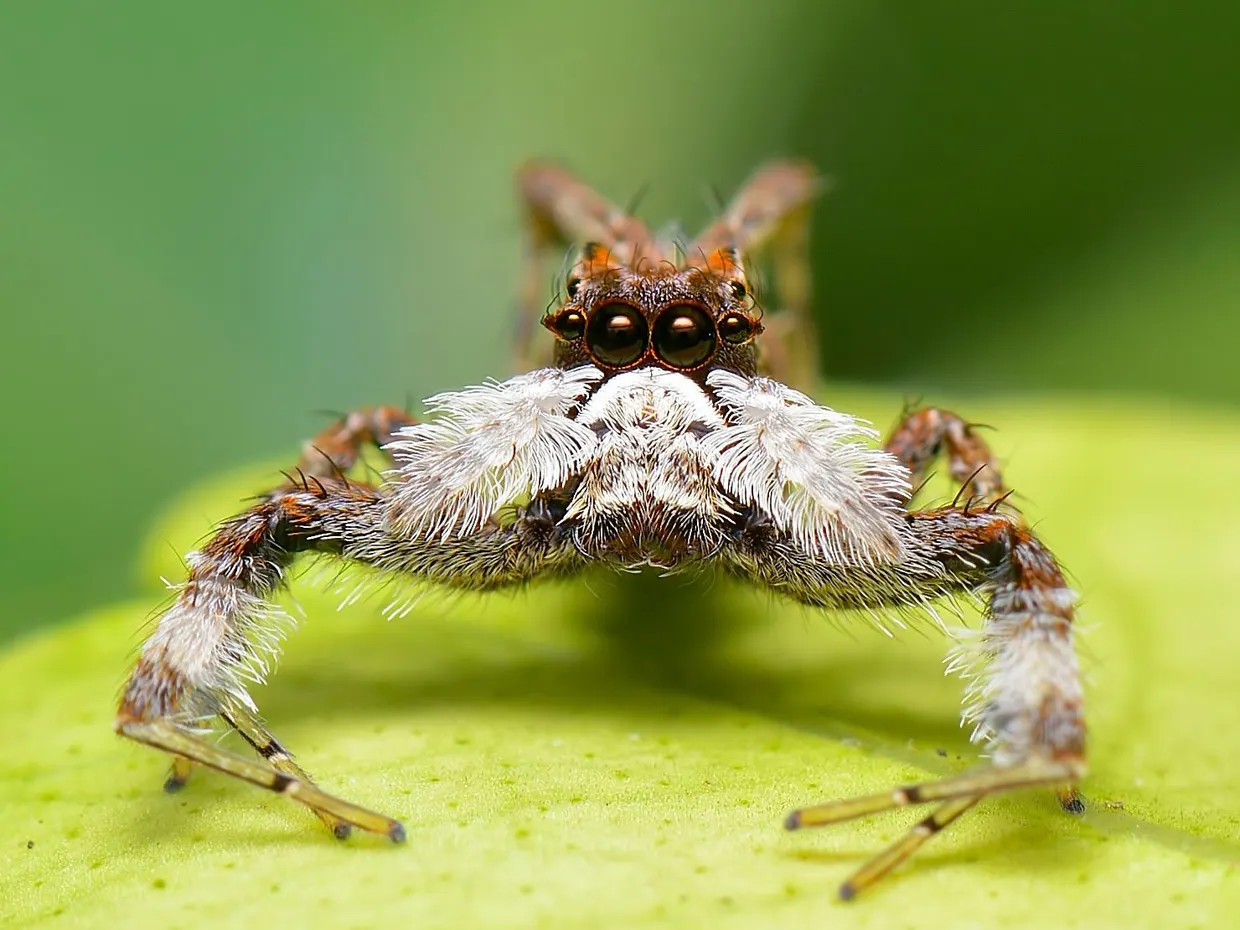
Biologists from the University of Bonn studied sleep in the jumping spider Portia fimbriata (family Salticidae), a small Australian species that hunts other spiders. The results appear in Proceedings of the National Academy of Sciences. The authors conclude that the behavior they observed is behavioral sleep and that it includes an REM-like substate in a terrestrial invertebrate pnas.org
Proceedings of the National Academy of Sciencespnas.orgOpen source ↗.
Sleep research is strongly biased toward vertebrates, and studies are scarce or absent in most invertebrate lineages. An earlier report of REM-like behavior in a jumping spider described unexpected parallels to sleep in vertebrates. Experimental evidence that such behavioral indicators truly represent sleep in spiders was still lacking.
Activity rhythm and sleep structure
The researchers filmed the spiders' nights. They describe diurnal activity and a free-running circadian rhythm, meaning a cycle that persists without external time cues. The sleep architecture proved robust, with two clearly different periods. In one the spider stays almost motionless, in the other its legs twitch and its eyes move rapidly, which resembles the REM phase of human sleep. The REM-like behaviors occurred regularly.
Arousal threshold and rebound
Immobility alone does not prove sleep, so the team tested how the spiders respond to stimuli. They played small sounds and observed the reaction. Arousal thresholds were elevated during the REM-like states pnas.org
Proceedings of the National Academy of Sciencespnas.orgOpen source ↗.
In a second experiment the authors prevented some spiders from sleeping normally. After the disruption the animals showed rebound effects: they spent more time asleep, as if recovering lost sleep. Together with the other measurements, this is the basis for the authors' conclusion that the behavior is sleep rather than simple quiet.
What the data do not show
The study does not show that spiders dream. The leg and eye movements resemble those seen in human REM sleep, but what a spider experiences in this phase is unknown, and brain activity was not measured.
The authors say the results contribute to fundamental questions about the evolution and function of sleep across animals. Studying more species could show whether such phases of rest appeared early in animal evolution.