Seismic data show crust of Kenya's Turkana Rift thinned to about 13 km along its axis
Reflection seismic and borehole data indicate the Turkana Rift is in the necking phase, a stage not previously identified in an active continental rift, the authors report.
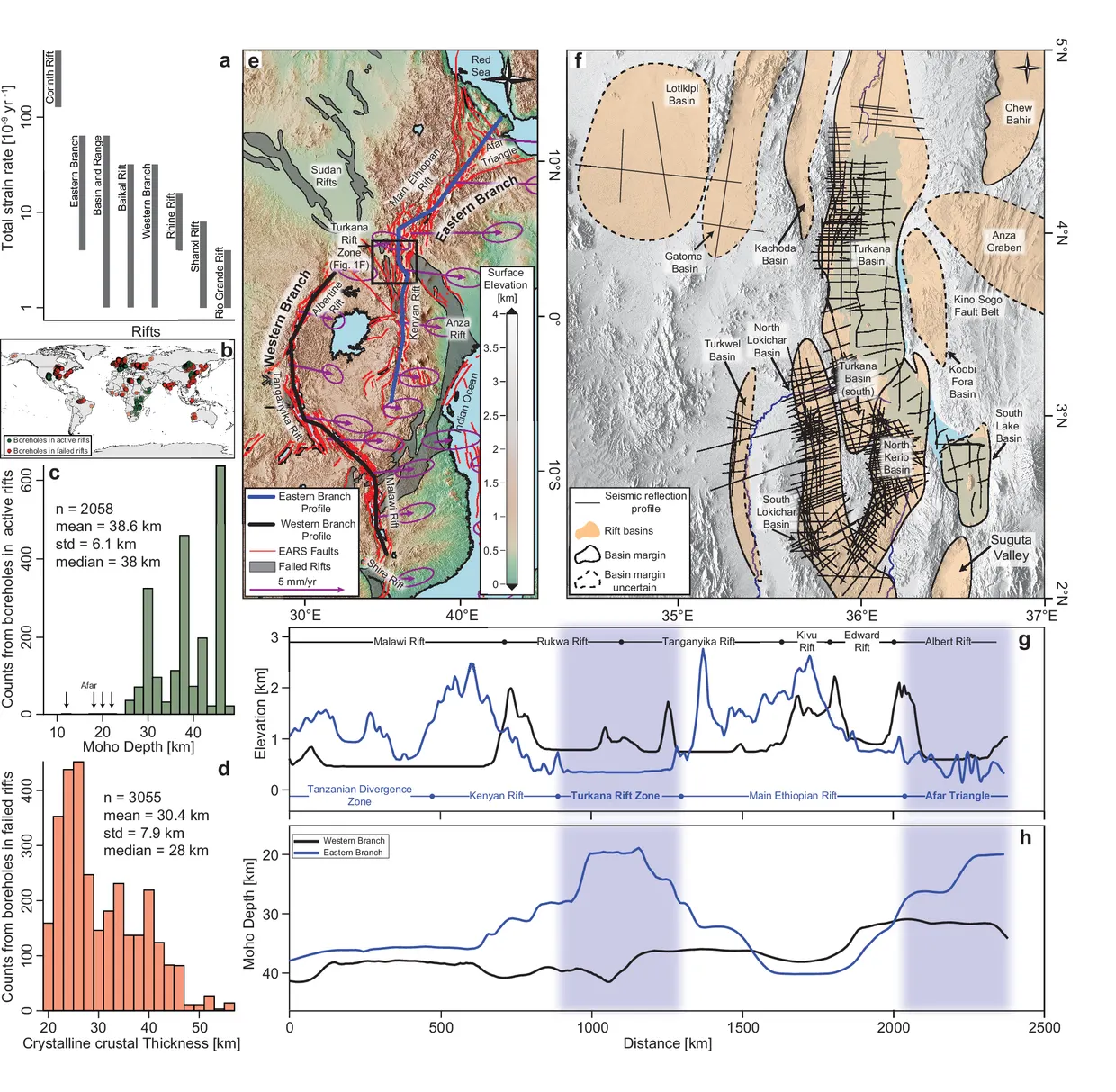
Researchers using high-resolution seismic reflection and borehole data report that the crystalline crust beneath the axis of the Turkana Rift Zone in Kenya has thinned to about 13 km, according to a study on nature.com. nature.com
nature.comnature.comOpen source ↗ The authors conclude that the rift is undergoing crustal necking, and constrain its onset to about 4 million years ago.
Necking as a stage of rifting
The authors describe rift maturation as a sequence of stretching, necking and oceanization. During stretching, strain is spread across border and intra-rift faults and the crust thins only slightly. Necking begins when deformation localizes along the rift axis and reduces the crystalline crust to 15–10 km. Oceanization follows, when extension is accommodated by magmatic accretion and mantle exhumation, marking the start of seafloor spreading. Few continental rifts have reached it; the Afar Rift and the Red Sea are among them.
In most active continental rifts, the modeled total strain rate derived from geodetic data is below 65 × 10⁻⁹ yr⁻¹, with the exception of the Corinth Rift. Together with a Moho deeper than 20 km, this suggests that most active rifts are still in the stretching phase. The crystalline crust of many failed intracontinental rifts is estimated at over 20 km, which the authors read as evidence that ancient rifts that reached necking went on to break up. Until now, no active continental rift had been identified as undergoing necking.
Turkana data
The Turkana Rift Zone has the shallowest Moho in the interior of the slowly stretching East African Rift System. The authors built isopach maps of key horizons from seismic reflection and borehole datasets and combined them with field observations. nature.com
nature.comnature.comOpen source ↗ The rift floor is low and the Moho shallow, similar to the Afar Triangle, which is in the most mature phase of rifting in the system and is undergoing incipient oceanization. According to the authors, Turkana's crystalline crustal thickness approaches that of Afar.
One of the mapped horizons is the Gombe Series, which erupted about 4 million years ago and has outcrop thicknesses of up to 100 m. The authors state that necking facilitated the accumulation of Turkana's fossil record of human evolution. They conclude that the identification of necking in the East African Rift System indicates that eastern Africa is primed for continental breakup.