ZTF recorded a record black hole flare of 10 trillion suns, likely from a star over 30 solar masses
Astronomers report the most powerful and most distant flare from a supermassive black hole. The likeliest cause is a tidal disruption of a star of at least 30 solar masses.
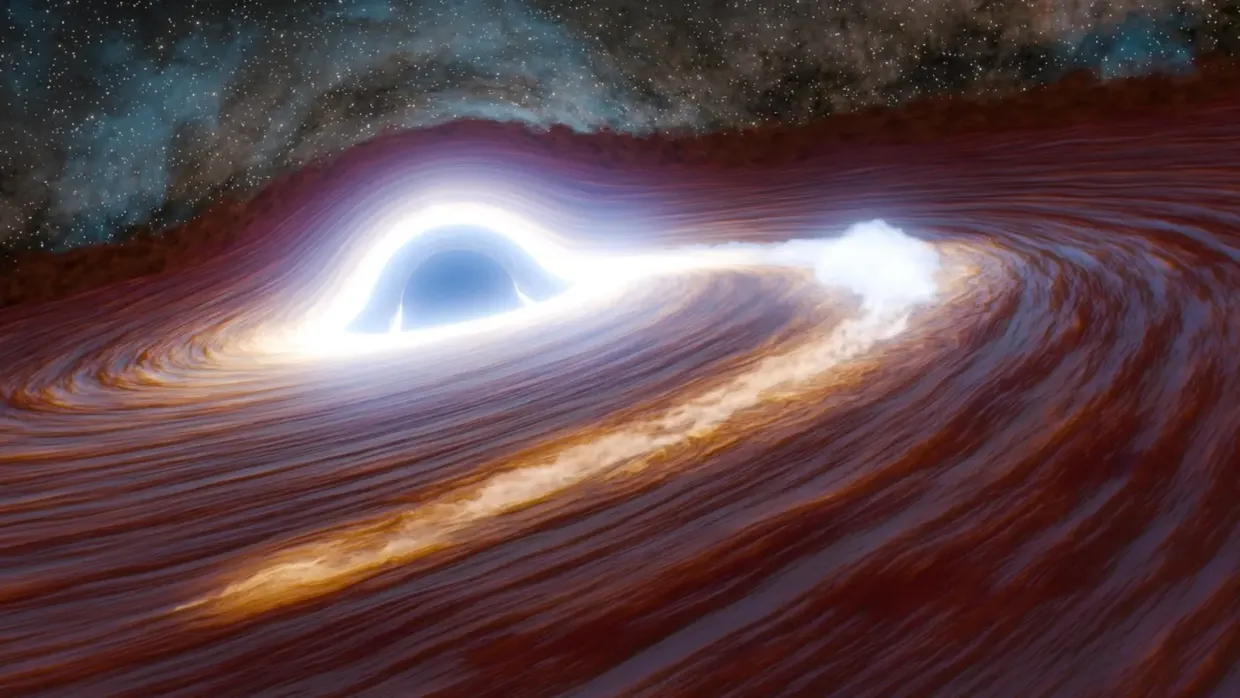
Researchers led by Caltech have described the most powerful and most distant flare of energy ever recorded from a supermassive black hole, according to caltech.edu. The report appeared in Nature Astronomy. The object was first observed in 2018 by the Zwicky Transient Facility (ZTF) at Caltech's Palomar Observatory and by the Catalina Real-Time Transient Survey, both funded by the US National Science Foundation. caltech.edu
caltech.educaltech.eduOpen source ↗
The flare brightened by a factor of 40 over a period of months. At its peak it was 30 times more luminous than any previous black hole flare, and it shone with the light of 10 trillion suns.
The source, J2245+3743, is an active galactic nucleus (AGN), a black hole that is feeding on surrounding material. Its mass is estimated at 500 million solar masses, and it lies 10 billion light-years away. The flare is fading, and astronomers continue to monitor it.
Because of cosmological time dilation, events there unfold more slowly than they do for us. Lead author Matthew Graham said that seven years on Earth correspond to two years at the source, so the event plays back at quarter speed. caltech.edu
caltech.educaltech.eduOpen source ↗
Tidal disruption as the likeliest cause
The authors examined a list of possible explanations and concluded that the most likely is a tidal disruption event (TDE). In a TDE, the gravity of a supermassive black hole shears a star that comes too close, and the star is consumed gradually as it spirals in. If this is the case, the star had a mass of at least 30 Suns, by the team's estimate.
The flare is still going, which suggests the star has not been fully devoured. Graham compared it to a fish only halfway down the whale's gullet. Co-author K. E. Saavik Ford said that supernovae are not bright enough to account for the flare.
The previous record candidate, nicknamed Scary Barbie (ZTF20abrbeie), was 30 times weaker. Its star is estimated at between three and 10 solar masses. Most of the roughly 100 TDEs seen to date do not occur around AGN, whose own feeding activity can mask TDE bursts. This flare was large enough to be seen easily. caltech.edu
caltech.educaltech.eduOpen source ↗
Stars this massive are rare. Ford said the team thinks stars within an AGN disk can grow larger, because matter from the disk is dumped onto them.
How the brightness was verified
In 2018 the team took a spectrum with the 200-inch Hale Telescope at Palomar, and it showed nothing unusual. In 2023 they noticed that the flare was decaying more slowly than expected. A second spectrum from the W. M. Keck Observatory in Hawai‘i indicated the extreme brightness of the object.
The team also had to check whether the light was beamed toward Earth rather than emitted in all directions. Data from NASA's former WISE mission helped rule this out. After other scenarios were excluded as well, the researchers concluded that J2245+3743 is the brightest black hole flare ever recorded. caltech.edu
caltech.educaltech.eduOpen source ↗
Ford said that the energy released since observations began equals converting the entire Sun to energy by E = mc2. The researchers note that finding such an event suggests similar ones are likely taking place elsewhere in the cosmos.