UCL team describes Invictibellatrix amberina, a megaraptoran dinosaur from the Isle of Wight
A single braincase from the Wessex Formation, held in a London museum since 1924, represents a new megaraptoran. The group is now added to Early Cretaceous European theropods.
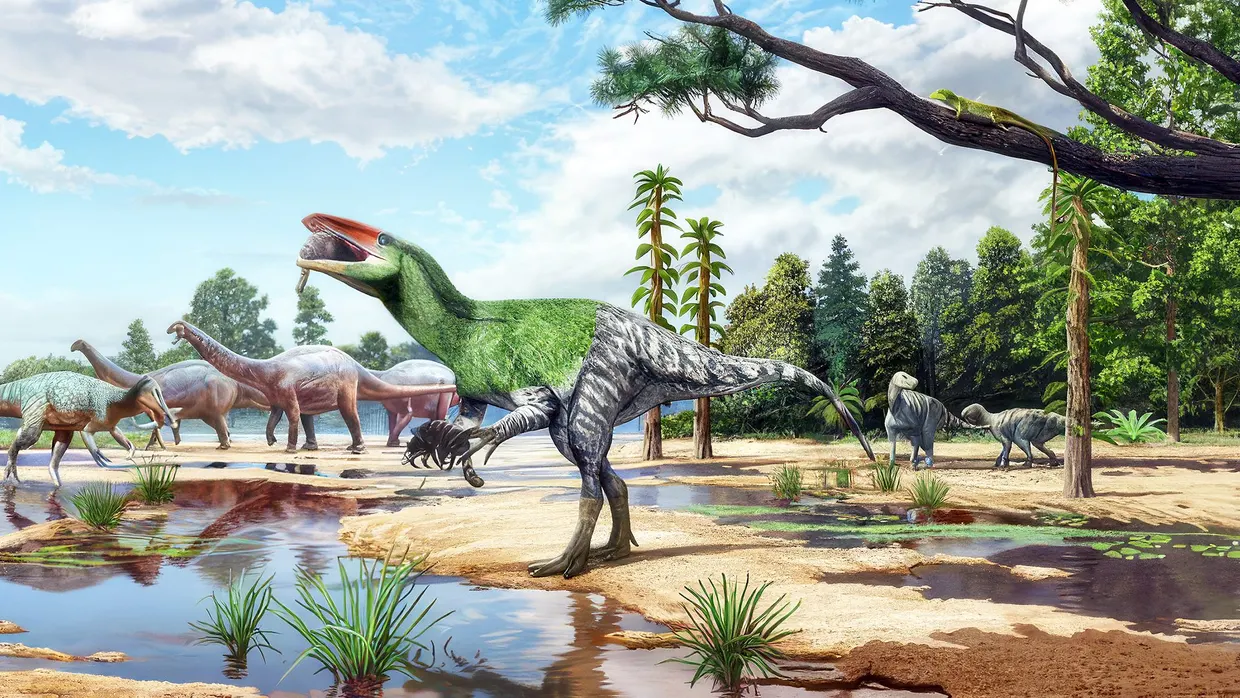
A team led by Cassius Morrison of UCL Earth Sciences, with colleagues from the Natural History Museum in London and the University of Bristol, has described a new theropod dinosaur, Invictibellatrix amberina. It is known from one braincase from the Isle of Wight, UK. The study was published in Royal Society Open Science. doi.org
Royal Society Open Sciencedoi.orgOpen source ↗ The specimen comes from the Barremian (Lower Cretaceous) Wessex Formation, where theropod remains are rare and often fragmentary.
The Natural History Museum bought the braincase in May 1924 from the amateur collector Reginald Walter Hooley. It was picked up at the foot of a cliff at Sudmoor Point, on the island's southwest coast. Surf had worn its surfaces, and most of the rest of the skull is missing. Morrison said he came across it while checking British theropod skulls for semi-aquatic adaptations for his PhD thesis. By his count, only about five theropod braincases are known from the UK.
Anatomy and classification
The team scanned the fossil with X-rays and built 3D models of the bone and of the cavity that held the brain. They then compared both with other theropods. A sub-circular occipital condyle, a sub-oval foramen magnum and a sagittal nuchal crest place the animal in Megaraptora. Phylogenetic analysis recovered it as an early-diverging member of this clade, within a paraphyletic array of Eurasian taxa, and distantly related to all theropods previously named from the Wessex Formation.
Two analyses, one built on 1,759 anatomical characters and the other on 356, both placed the fossil among megaraptorans. The skull bones are fused, which suggests an adult or near-adult. The authors argue that neurocranial characters give essential data for theropod phylogeny, although they make up only about 4 percent of the characters in the largest datasets.
The braincase is about the size of one from a tyrannosaur relative weighing 200 to 300 kg. From its closest relatives, Morrison estimated a body length of roughly 3 to 4 m and a height of 1.5 m.
Distribution of megaraptorans
A biogeographical analysis including the new genus suggests that non-megaraptorid megaraptorans likely had a cosmopolitan distribution in the Early Cretaceous. doi.org
Royal Society Open Sciencedoi.orgOpen source ↗ The absence of megaraptorans in the Late Cretaceous of Laurasia is, according to the authors, best explained by regional extinction. In the result the team prefers, Invictibellatrix descended from an Asian population that reached Europe about 130 million years ago, and the group then spread through Africa.
The authors note limits. The two analyses disagree about where the ancestors of the species came from, and the preferred answer rests on the dataset with more megaraptorans. The species is known from a single worn piece of skull. Early Cretaceous European coelurosaurian diversity now includes tyrannosauroids, maniraptoriforms and megaraptorans.