Wijk bij Duurstede: road works expose a 3.20 m ship frame in the former port of Dorestad
Dutch archaeologists recovered a timber 30 cm thick that may be a ship's rib. Tree-ring dating is pending, and its origin remains open.
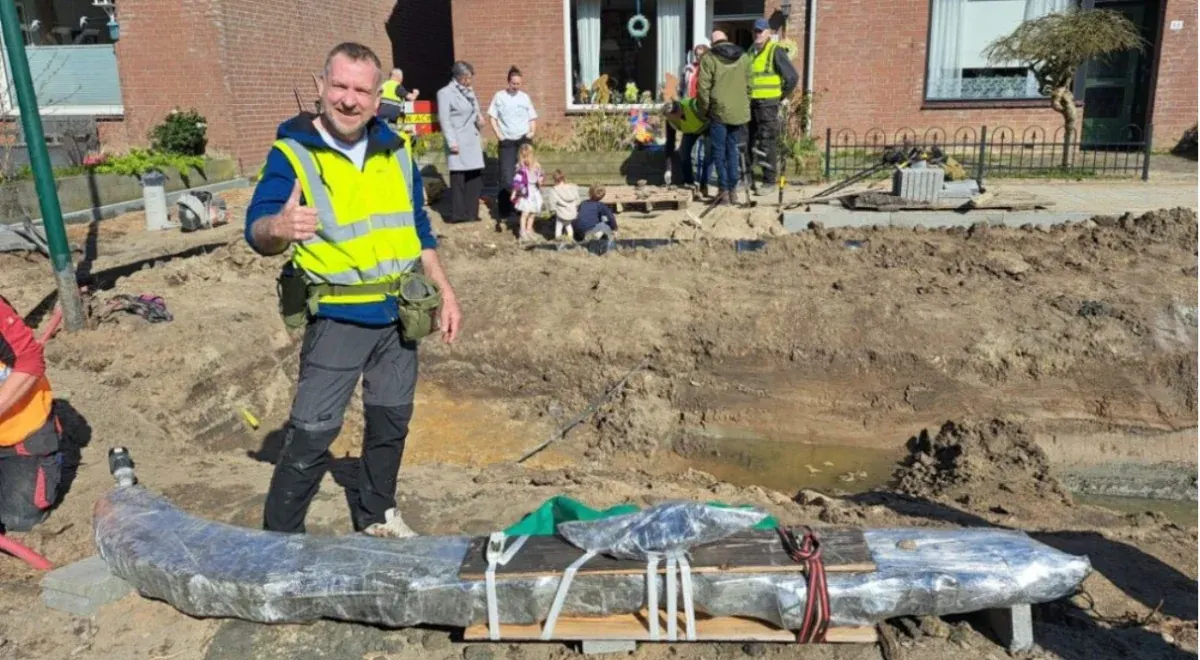
On 21 March 2026, during road works on the Promenade in Wijk bij Duurstede in the Netherlands, workers exposed a worked timber about 3.20 metres long and 30 centimetres thick, according to science-et-vie.com science-et-vie.com
science-et-vie.comscience-et-vie.comOpen source ↗. The street had been opened to replace sewers and build a wadi, a structure that absorbs rainwater. The site corresponds to Dorestad, a former trading town.
What was found and how it is handled
Danny van Basten, an amateur from the ArcheoTeam Wijk bij Duurstede group, noticed a large worked piece of wood protruding from the ground and alerted the municipality. Specialists from Museum Dorestad and the Stichting Beheer Vikingschip were then called to the site. The first examination showed notches and tool marks, and a shape that suggests a spant, a frame or "rib" of a hull, rather than a plain beam. Shipbuilder Kees Sterreburg, interviewed by the Dutch broadcaster NOS, said the form, the cuts and the woodwork point in that direction.
The municipality states that no comparable remains had previously been identified in the town. Municipal archaeologist Anne de Hoop is coordinating a standard protocol: careful extraction, immediate packing, controlled storage and gradual cleaning. Old wood can crack or deform if it dries abruptly. According to de Hoop, the beam will be cleaned and its growth rings analysed to give a more precise age.
Dating hypotheses
Between the seventh and ninth centuries Dorestad connected the Frankish world, the Rhine river networks and North Sea routes, and ceramics, textiles and metals passed through it science-et-vie.com
science-et-vie.comscience-et-vie.comOpen source ↗. One hypothesis places the timber in the Carolingian period, roughly 700 to 800 or 750 to 900. It rests on the position of the piece, its manufacturing features and pottery fragments found around it. That period coincides with Dorestad's contacts with Scandinavians, so a Viking link is possible but not confirmed.
De Hoop does not rule out another option: a cog, a type of merchant ship used around the thirteenth century, or about 1300. That would place the find in a later phase of North European trade. The key step is dendrochronology, the study of tree rings. It can often date when the tree was felled, provided regional reference series are sufficient, and it may indicate where the timber came from. Museum Dorestad has said it wants to exhibit the piece after the analyses.