AncST tool finds genome synteny without annotations, tested on 16 insect genomes
The AncST algorithm finds syntenic DNA without gene annotations and recovers more of it between closely related genomes, while annotation-based methods stay better for distant species.
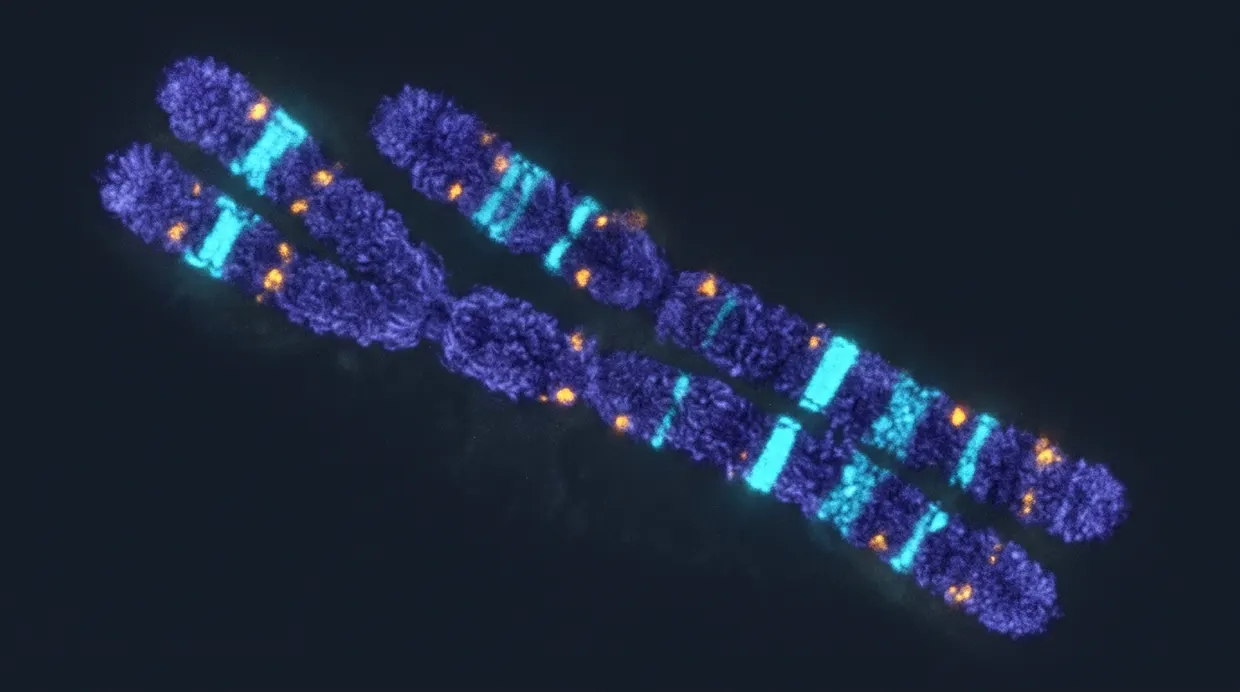
A study in Algorithms for Molecular Biology presents AncST, an approach that detects synteny, the conservation of gene order, between genomes without gene annotations. The authors tested it on 16 insect genomes covering Diptera, Lepidoptera and Coleoptera biomedcentral.com
Algorithms for Molecular Biologybiomedcentral.comOpen source ↗. Current tools such as DAGchainer and MCScanX take genome annotations as input, which limits synteny detection to protein-coding genes.
How the anchors are chosen
The method looks for "sufficiently unique" DNA sequences that serve as unambiguous anchors. A string counts as sufficiently unique if its distance to all other non-overlapping subsequences in the same genome exceeds a set threshold. Anchor candidates are computed for each genome independently, so complete pairwise alignments of whole genomes are not needed.
The first stage uses k-mer statistics, with a default k-mer length of 13. Only windows in the 15th percentile of aggregated k-mer frequencies are kept, which removes highly repetitive sequences. The authors also tested k-mer lengths of 15 and 21. The second stage compares the candidates with the same genome by sequence similarity to verify uniqueness and assigns each candidate a score. A match between two genomes counts as an anchor match when the distance between the segments is less than half the minimum uniqueness threshold of either genome.
Results and limits
The team used MCScanX to extract syntenic regions from AncST anchors and from standard ORF annotations. Between closely related genomes the annotation-free approach recovered significantly more syntenic DNA. In Drosophila melanogaster, AncST anchors covered about 86% of the genomic positions of annotated ORFs, while the annotated ORFs covered only about 20% of the anchors biomedcentral.com
Algorithms for Molecular Biologybiomedcentral.comOpen source ↗.
For more distantly related species the annotation-based approach performed better, because amino acid sequences can detect homology where nucleic acid alignments become insensitive. According to the authors, AncST fails at very large evolutionary distances. In a Hox cluster example, the anchors revealed a shift in the order of two Hox clusters between Drosophila melanogaster and Drosophila yakuba, which to the authors' knowledge had not been noticed before.
Computing anchor candidates and pairwise matches for the 16 genomes took less than 16 hours on a cluster with 160 cores. The authors name two limitations: recently duplicated sequences that have not yet diverged may violate the uniqueness assumption, and k-mer statistics may overlook some potential anchors. A prototype of the pipeline is available online with precomputed anchors for several sets of species.