Heliosphere model with magnetic field dissipation brings calculations closer to Voyager data
Researchers from IKI RAS, HSE and Boston University added magnetic field decay to a heliosphere model; the results now match Voyager measurements better.
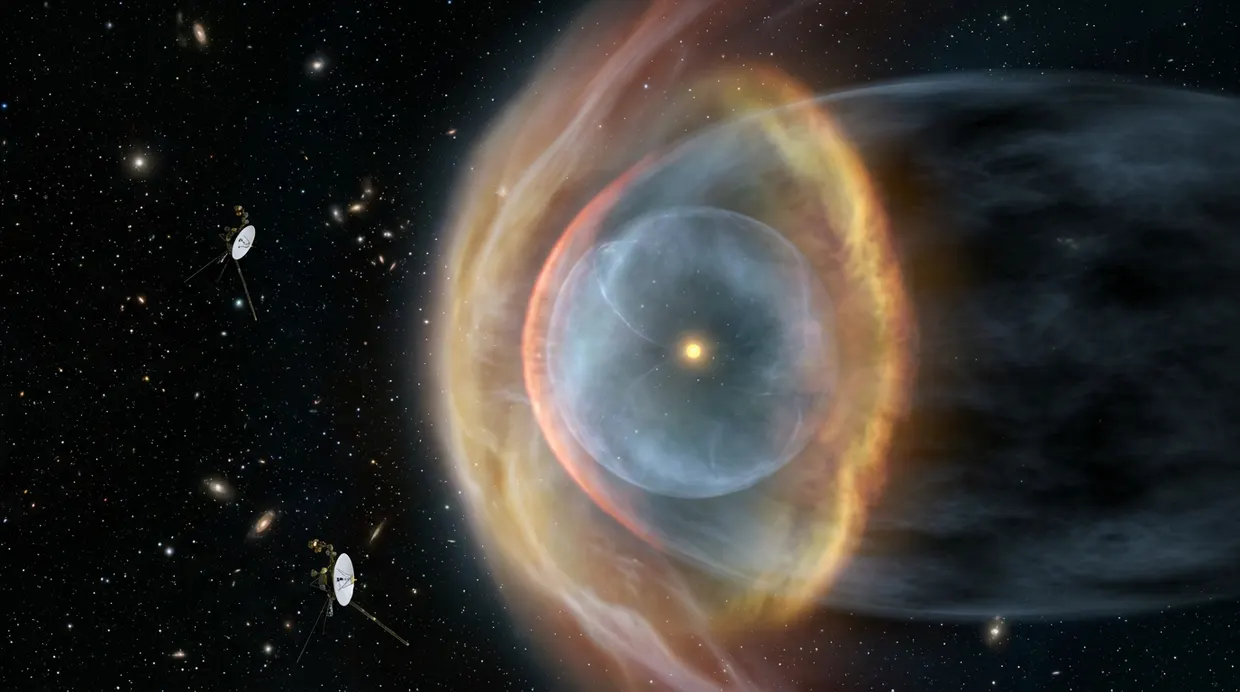
Researchers from the Space Research Institute of the Russian Academy of Sciences (IKI RAS), HSE University and Boston University improved a global heliosphere model by adding a mechanism for magnetic energy dissipation. According to «Поиск», this brought the calculations into better agreement with measurements by NASA's Voyager 1 and Voyager 2 poisknews.ru
Поискpoisknews.ruOpen source ↗. The work was published in Advances in Space Research.
Where classical models disagree with Voyager
At about 80–90 au from the Sun, the supersonic solar wind is slowed at the heliospheric termination shock. Beyond it lies the inner heliosheath, a region of compressed and heated plasma that ends at the heliopause. The Voyagers crossed the shock at 94 and 84 au and the heliopause in 2012 and 2018 at 122 and 119 au, respectively.
Classical models, in which the field is frozen into the plasma, predict a magnetic "wall" ahead of the heliopause and a sharp drop in plasma density. The Voyager instruments show a smooth growth of the field and no plasma depletion. Some models treat the field as having a single polarity and so forbid its dissipation. Others include the current sheet but lose field through limited grid resolution, which is numerical rather than physical dissipation.
What was added and what changed
The authors added a phenomenological term to the field evolution equation: in the inner heliosheath the field slowly decays with a characteristic time τ, and the lost magnetic energy goes into plasma heat. The value of τ was chosen by comparison with Voyager data; about six years fit best poisknews.ru
Поискpoisknews.ruOpen source ↗.
According to the authors, magnetic pressure in the layer decreases and its growth pattern is close to what the magnetometers of both spacecraft measured. Plasma density ahead of the heliopause grows smoothly, as in Voyager 2 data. The shock moves away from the Sun by about 5 au, and the inner heliosheath becomes thinner by about 3 au.
Some problems remain. The model still predicts a thicker heliosheath than observed, and the calculated plasma speed differs noticeably from Voyager 2 measurements. The model assumes energy is dissipated uniformly across the heliosheath with a single timescale. The authors plan to account for the spacing between folds of the heliospheric current sheet and for changes in field topology caused by reconnection.