Periderm in sturgeon and axolotl embryos does not reach pharyngeal endoderm where teeth form
Lineage tracing in sterlet sturgeon and axolotl embryos shows limited periderm expansion into the mouth and pouches, as in zebrafish. The authors call it an ancestral osteichthyan trait.
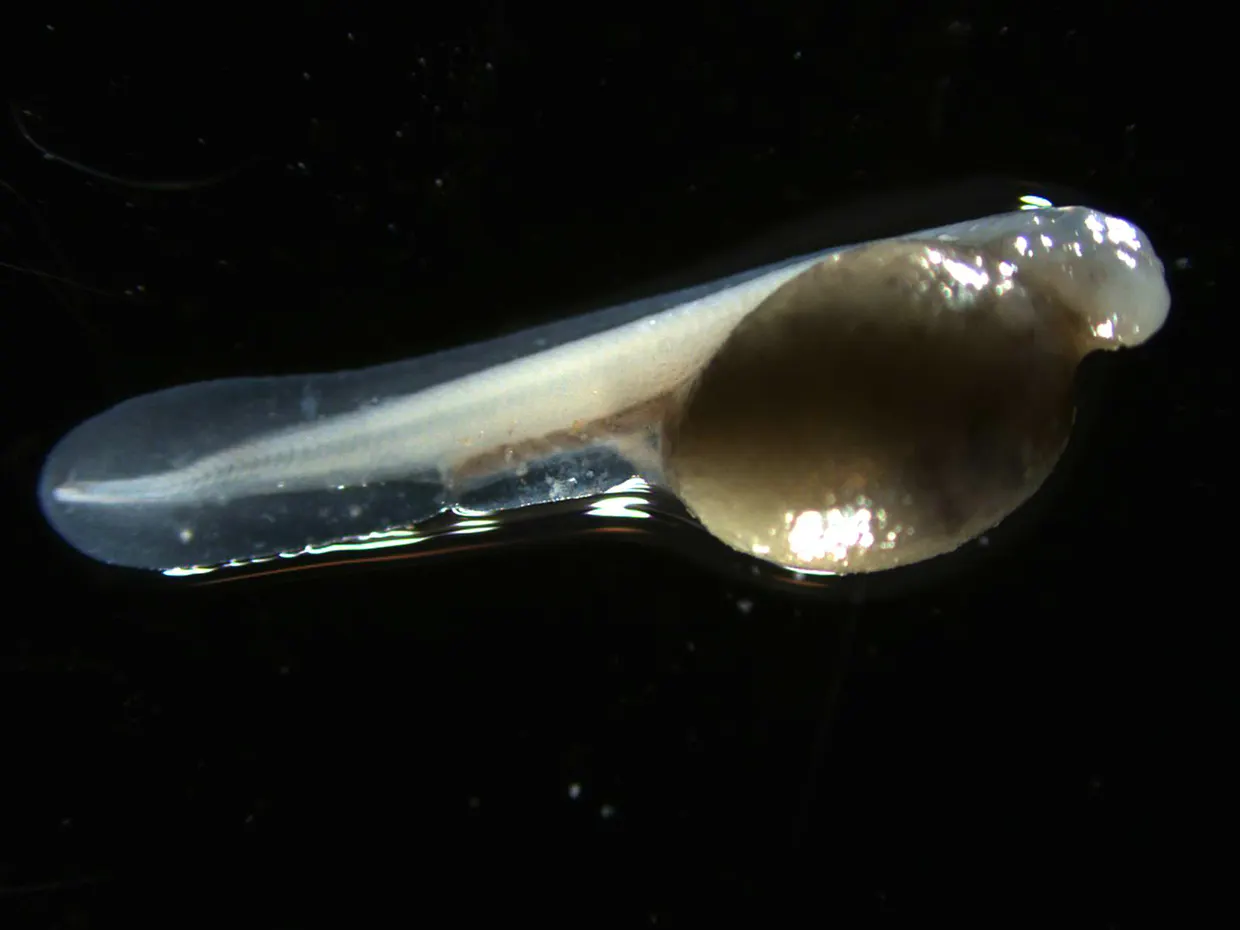
Researchers traced the outer ectodermal layer, the periderm, in embryos of the sterlet sturgeon (Acipenser ruthenus) and the axolotl (Ambystoma mexicanum). The results are published in EvoDevo. In both species the periderm advances only into the distal parts of the opening pharyngeal pouches and the margins of the mouth. It does not reach the medial pharyngeal endoderm, where pharyngeal teeth are located. biomedcentral.com
EvoDevobiomedcentral.comOpen source ↗
Why zebrafish data were not enough
Earlier work on zebrafish (Danio rerio) showed the same restriction, but zebrafish embryos are highly derived. They have meroblastic cleavage, no blastocoel, and epibolic gastrulation without an archenteron or blastopore. It remained unclear whether the restricted periderm was a teleost-specific character.
The authors therefore chose two species with more primitive development. The sturgeon is a non-teleost actinopterygian with oral and pharyngeal teeth. The axolotl is a sarcopterygian with oral teeth and no pharyngeal teeth. Both undergo holoblastic cleavage, form a blastocoel, gastrulate by involution and develop an archenteron.
Lineage tracing and results
In sturgeon, a stratified ectoderm is established by the end of gastrulation. It has at least a basal layer and a surface layer that can be homologized to a periderm. Stratification is clear after neural tube closure at stage 23, and by stage 28 the ectoderm forms an organized bilayer. biomedcentral.com
EvoDevobiomedcentral.comOpen source ↗
To follow the periderm in living embryos, the team soaked decapsulated sturgeon embryos for four hours in a 1:1000 dilution of the fluorescent tracer CDCFDA. The dye labeled the outer layer only, and the signal persisted for up to eighteen days. Axolotl embryos at stages 29, 30 and 33 were labeled in a similar way and traced up to stages 38 and 39.
In sturgeon, the mouth opens at stage 37 and the epithelial bridge to the foregut perforates at stage 38. Labeled periderm cells moved inwards along the external cleft of pouch 2 but stayed at the distal margins of the pouches. In the axolotl the pattern was the same, and oral teeth develop long before the mouth opens.
The authors conclude that periderm behavior does not correlate with the presence or absence of oral or pharyngeal teeth. Tooth induction may instead depend on an "ectodermalized" endoderm. They propose that the periderm helps lumenize the pouches to create an open gill slit. biomedcentral.com
EvoDevobiomedcentral.comOpen source ↗