Multicentre study of 234 patients: ultrasound sensitivity 86.09% extracranial vs 62.50% vertebrobasilar
In a retrospective multicentre study, cervical duplex ultrasound detected vulnerable carotid plaque more sensitively than CTA, while transcranial Doppler performed lower in intracranial segments.
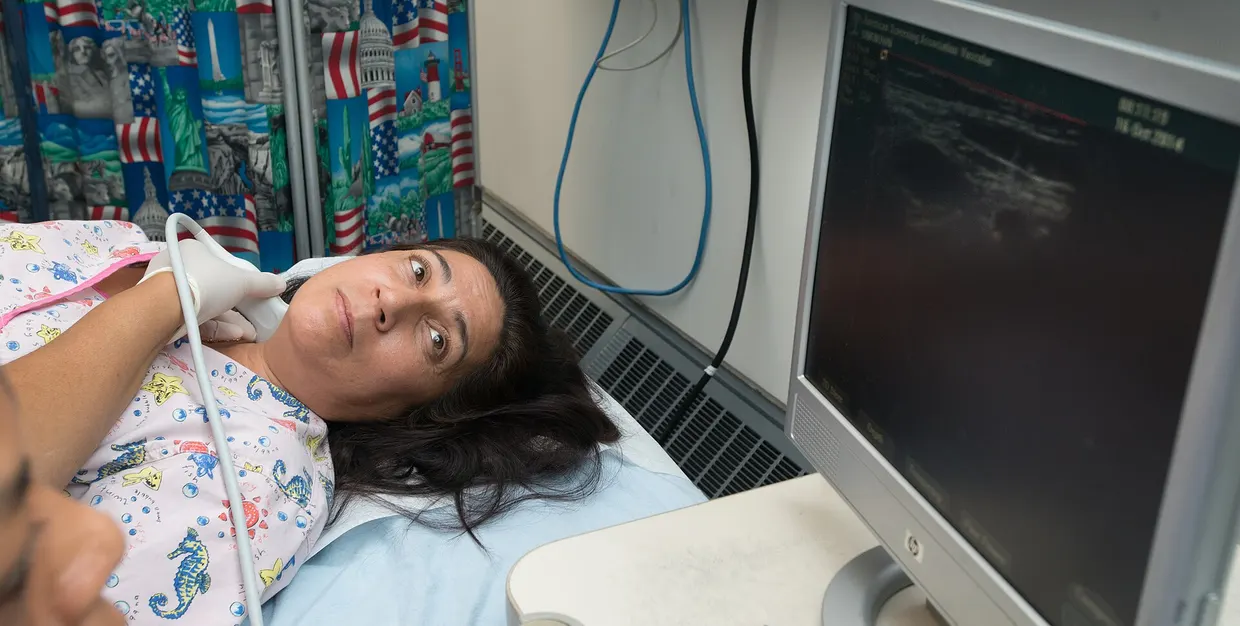
A retrospective multicentre study published in Frontiers in Neurology compared territory-specific ultrasound techniques with digital subtraction angiography (DSA) and computed tomography angiography (CTA) in cervicocerebral arterial stenosis. It included 234 patients examined between January 2022 and January 2025, who contributed 620 evaluable arterial segments frontiersin.org
Frontiers in Neurologyfrontiersin.orgOpen source ↗. Each patient had an ultrasound-based assessment, CTA and DSA.
Stenosis detection by territory
DSA served as the reference standard for moderate-to-severe stenosis, defined as 50% or greater narrowing. Across all 620 segments, ultrasound assessment showed a sensitivity of 79.56% and a specificity of 81.79%. Agreement with DSA was moderate, with a kappa of 0.61.
Performance differed by territory. For extracranial segments assessed by cervical duplex ultrasound (CDU), sensitivity was 86.09%, specificity 85.20% and kappa 0.71. For intracranial vertebrobasilar segments assessed by transcranial Doppler-based ultrasonography, the corresponding values were 62.50%, 75.47% and 0.38. The authors describe these figures as point estimates.
Carotid plaque vulnerability
A separate analysis covered 56 patients with matched carotid endarterectomy specimens. Here histopathology was the reference standard for plaque vulnerability frontiersin.org
Frontiers in Neurologyfrontiersin.orgOpen source ↗. CDU showed a sensitivity of 86.84%, a specificity of 77.78% and an accuracy of 83.93%.
The corresponding CTA estimates were a sensitivity of 31.58%, a specificity of 100.00% and an accuracy of 53.57%. The authors note that the higher CDU sensitivity relative to routine CTA was observed in this selected endarterectomy cohort.
The authors report that CDU performed reliably for extracranial stenosis. Transcranial Doppler-based ultrasonography provided additional haemodynamic information for intracranial vertebrobasilar disease despite its lower diagnostic performance. They conclude that the findings support territory-appropriate ultrasound as one component of multimodal imaging, not as a replacement for CTA or DSA.