Hannover team prints PCL vascular graft scaffold with artery-like mechanics, endothelialized in vitro
A 3D-printed PCL–fibrin tube carried a flow-aligned endothelial layer after 7 days of pulsatile culture in vitro. Around 75% of synthetic grafts under 6 mm fail within 3 years.
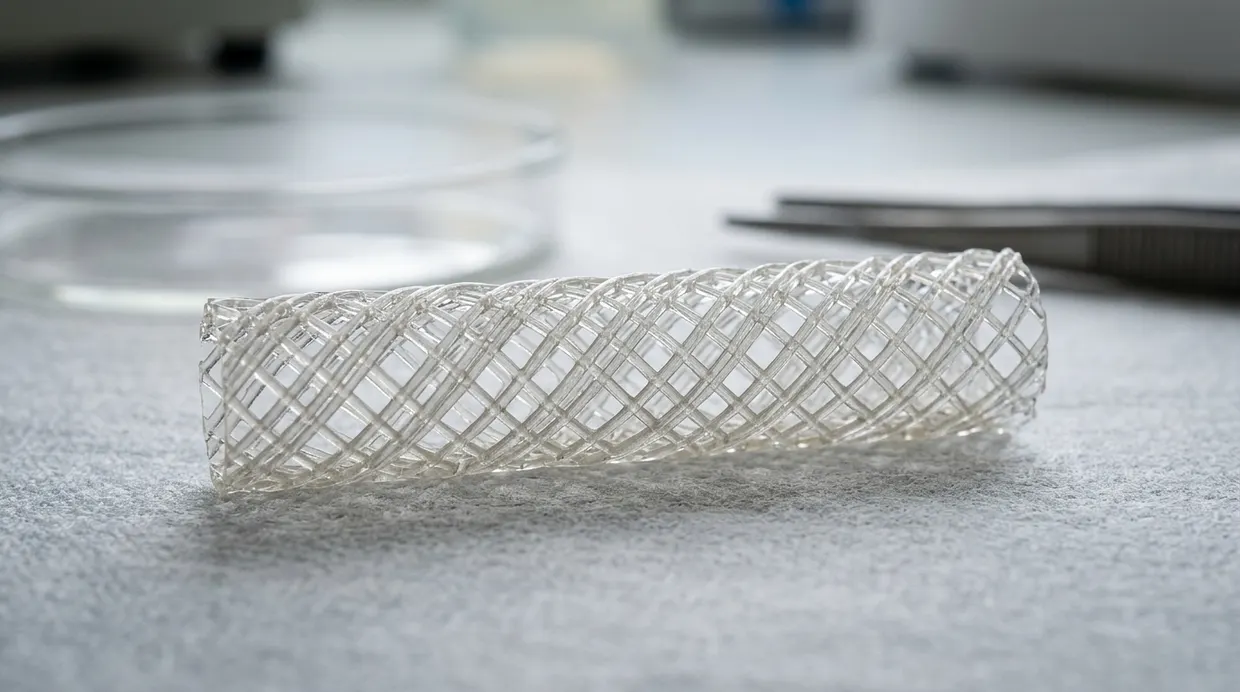
Researchers from Leibniz University Hannover and Hannover Medical School, with colleagues in Hildesheim, described a framework for a customizable 3D-printed tubular scaffold made of poly-ε-caprolactone (PCL) for small-diameter vascular grafts. The work was published in Frontiers in Bioengineering and Biotechnology on 13 November 2026 (doi.org) frontiersin.org
doi.orgfrontiersin.orgOpen source ↗. The scaffold was combined with fibrin, seeded with endothelial cells and cultured for 7 days under pulsatile flow with shear stress of up to 20 dyn·cm⁻². All results come from laboratory experiments; the graft was not implanted.
Clinical problem
The authors note that about 75% of synthetic conduits with a diameter below 6 mm fail within 3 years, mostly because they lack a luminal endothelial cell layer. This leads to thrombosis, calcification and intimal hyperplasia. Dacron and ePTFE grafts are also stiffer than native arteries, and a mechanical mismatch between graft and vessel can cause complications.
Scaffold geometry and mechanics
The scaffold was printed by melt electrowriting, and its geometry was tuned by varying winding angle, fiber diameter and fiber distance. The final design had a fiber diameter of 128 μm, a winding angle of 52.5° and a fiber distance of 500 µm. A fibrin compression molding technique was adapted to make the structure leak-free and suitable for cell adhesion.
The PCL scaffold printed with long-chain PCL had a radial Young's modulus of 1.12 ± 0.35 MPa and a radial tensile strength of 3.89 ± 0.81 MPa. The authors describe these values as similar to native arteries, for which they cite 2.45 ± 0.79 MPa frontiersin.org
doi.orgfrontiersin.orgOpen source ↗. The fibrin-PCL scaffold showed a burst pressure of 1,600.4 ± 502.85 mmHg and a suture strength of 1.62 ± 0.29 N. Its longitudinal tensile strength was 1.07 ± 0.22 MPa, similar to native arteries, while its radial tensile strength was lower at 0.80 ± 0.20 MPa.
Endothelialization under flow
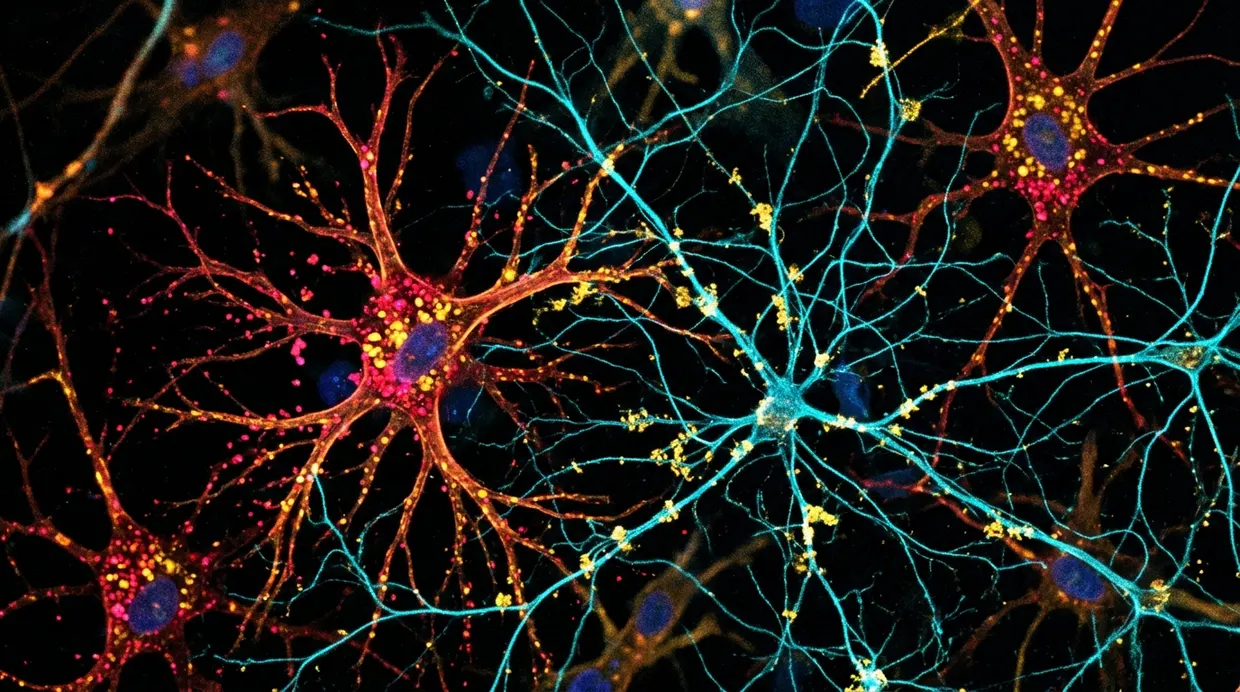
After 7 days of pulsatile dynamic culture at 20 dyn·cm⁻², the endothelial cells covered the graft and aligned with the direction of flow. The cultivated graft retained a radial Young's modulus of 3.03 MPa and a radial tensile strength of 1.56 MPa. According to the authors, this is the first demonstration of an endothelialized graft with mechanical properties similar to those of native arteries.