Model projects 58–72% fewer copepods on Northwest European Shelf by 2050 under RCP8.5
A model trained on Continuous Plankton Recorder data projects 84–93% declines in small copepods and Calanus by 2100 under RCP8.5. Fish and seabirds feed on them.
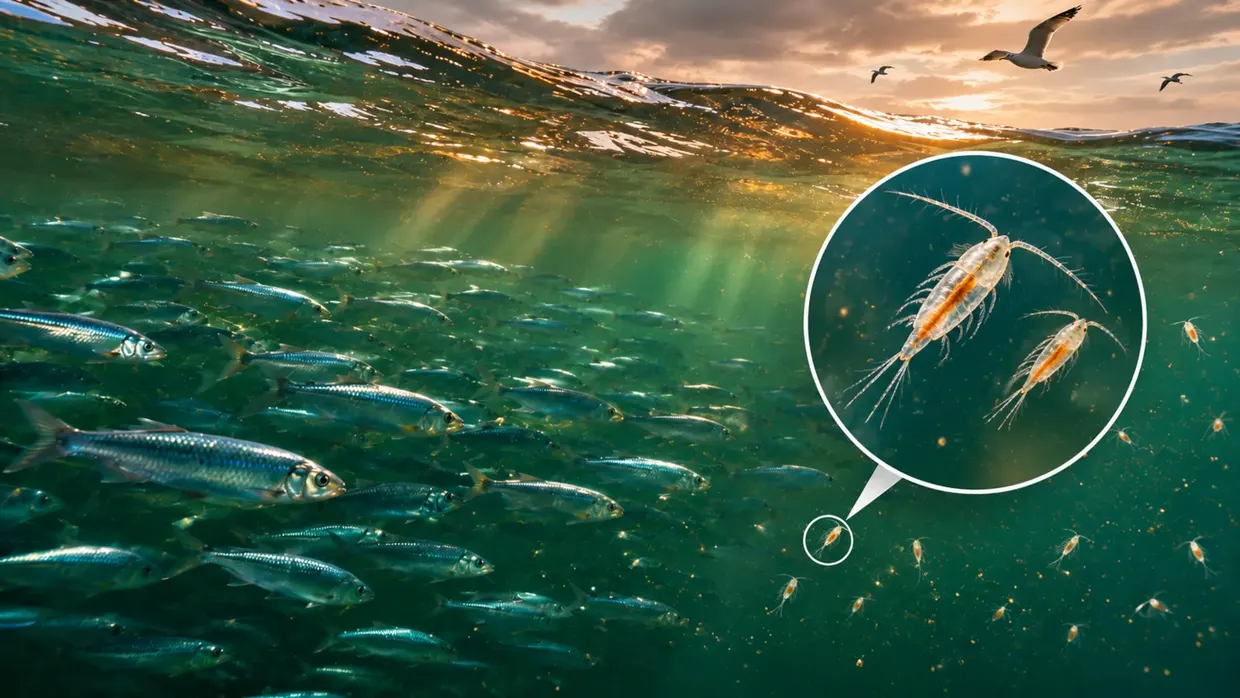
A regional model of key zooplankton on the Northwest European Shelf projects large declines in copepod abundance under the high-emissions scenario RCP8.5, according to a study published on nature.com. The ensemble mean decline for small copepods and large Calanus is 58–72% by 2050 and 84–93% by 2100 nature.com
nature.comnature.comOpen source ↗. The study area covers the North Sea, the Irish Sea, the English Channel and adjacent waters.
The authors, from the University of Strathclyde, report that zooplankton abundance in the Northeast Atlantic has declined over the past 60 years.
How the model was built
The model was trained on Continuous Plankton Recorder observations and driven by past ocean conditions. It covers small copepods, treated in aggregate, and the two dominant large calanoid species, Calanus finmarchicus and Calanus helgolandicus. The Calanus species were modelled separately because of their distinct spatial and ecological niches.
The model was applied to an ensemble of regional climate projections. According to the scinexx summary, these consist of three simulations on a grid of about seven kilometres. The authors argue that regional downscaling is needed because global Earth System Models represent coastal and shelf seas poorly. A global trait-based model had earlier shown 7–16% declines in global mean zooplankton by the end of the century nature.com
nature.comnature.comOpen source ↗.
Drivers and regional differences
The projected declines are primarily driven by rising temperature and falling salinity and nutrient concentrations. These changes shift conditions away from the species' environmental niches and water mass associations.
The projections are not geographically uniform, and the authors report evidence of regional refugia. Scinexx adds that in the southern North Sea, the English Channel and the Irish Sea, some groups could decline less. It also reports that C. finmarchicus, a species of cool waters, would be affected most.
Calanus copepods are lipid-rich and are the main prey of sandeel, sprat, herring, mackerel and blue whiting nature.com
nature.comnature.comOpen source ↗. The authors state that impacts on food webs would be severe unless alternative zooplankton assemblages emerged to support existing planktivorous fish and their predators.