Bazaruto Archipelago: submerged peat reefs aged 300–5,000 years host diverse marine life without corals
Radiocarbon dating shows relict coastal peat in Mozambique's shallow waters, submerged by rising seas, now serves as reef substrate with fauna comparable in richness to coral reefs.
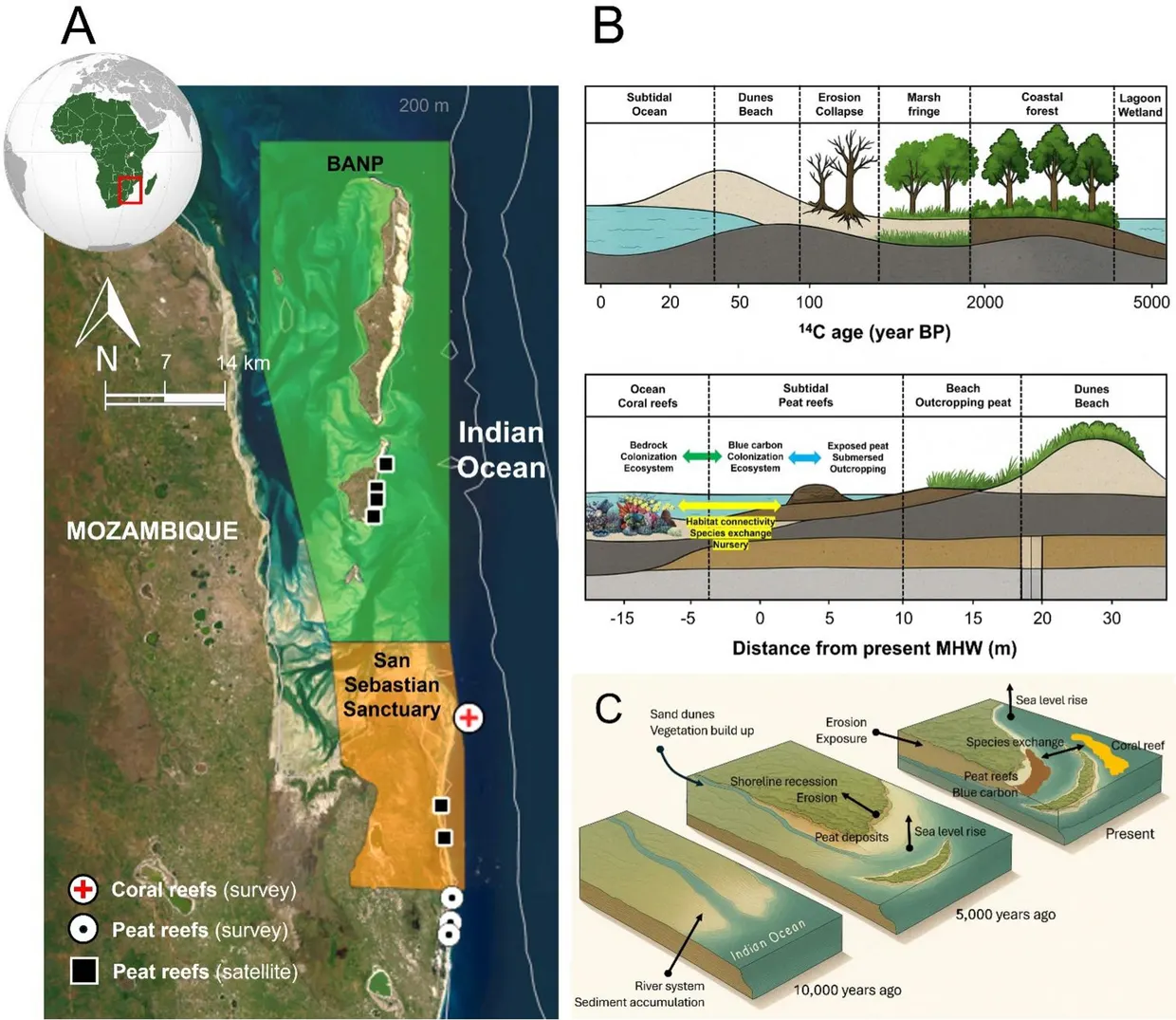
Researchers report on nature.com the discovery of submerged tropical peat reefs in the shallow coastal waters of the Bazaruto Archipelago, Mozambique, in the Western Indian Ocean nature.com
nature.comnature.comOpen source ↗. The reefs are remnants of ancient coastal peat swamps and forests that were flooded by rising seas and now function as seabed habitat. According to the authors, this is the first study of the ecology of a tropical peat reef system.
Age and carbon content of the peat
Radiocarbon (14C) dating gave ages from about 300 to about 5,000 years BP, which points to a mid- to late-Holocene origin. Sampled peat contains up to 40% organic carbon by dry weight, and δ12C values around −27‰ indicate a predominantly terrestrial plant origin. The authors stress that this describes the peat substrate and is not a quantified carbon stock for the habitat as a whole or per unit area.
The conceptual model in the paper describes the following sequence. About 10,000 years ago, river sediments formed extensive coastal plains and dune fields. Around 5,000 years ago, rising sea level caused the shoreline to retreat, forests to be submerged and peat to be deposited. All field surveys were conducted outside marine protected areas, and some peat features were identified from satellite imagery only.
Marine life on peat compared with coral reefs
Peat reefs are shallower than the adjacent hard scleractinian coral reefs and vary more in physicochemical, environmental and physical properties nature.com
nature.comnature.comOpen source ↗. Biodiversity surveys used benthic quadrats and transects for invertebrates, small fish and megafauna. They showed that peat reefs support a distinctive assemblage of marine life, significantly different from that of nearby coral reefs.
The peat is colonised by diverse sessile and mobile invertebrates. These provide structural complexity for fish communities and nursery habitat, with richness comparable to coral reef ecosystems. The communities also overlap, with 41 and 44 shared species in the small-fish and megafauna surveys, even though habitat composition differs markedly.
The peat reefs host no living corals. Instead, seagrass, macroalgae and sponges use the peat as substrate, forming a carbon-rich system with a detritus-based food web. The authors call for including such relict ecosystems in coastal habitat mapping, conservation frameworks and assessments of legacy coastal carbon.