Karolinska Institute maps three phases of brain activity behind body ownership using MEG
In a rubber hand illusion experiment, magnetoencephalography showed that ownership of the left arm builds up in three phases, the first starting before touch.
Researchers at the Karolinska Institute used magnetoencephalography (MEG) to trace the time course of brain activity underlying the sense of ownership of the left arm, according to a paper in Nature Communications on nature.com nature.com
nature.comnature.comOpen source ↗. They identified three phases of activity patterns specific to ownership. The work was led by Henrik Ehrsson and Daniel Lundqvist.
Experiment design
Earlier studies relied mainly on fMRI or lesion mapping. The authors note that fMRI averages neural activity over seconds and gives a static view of the process. MEG offers finer temporal resolution.
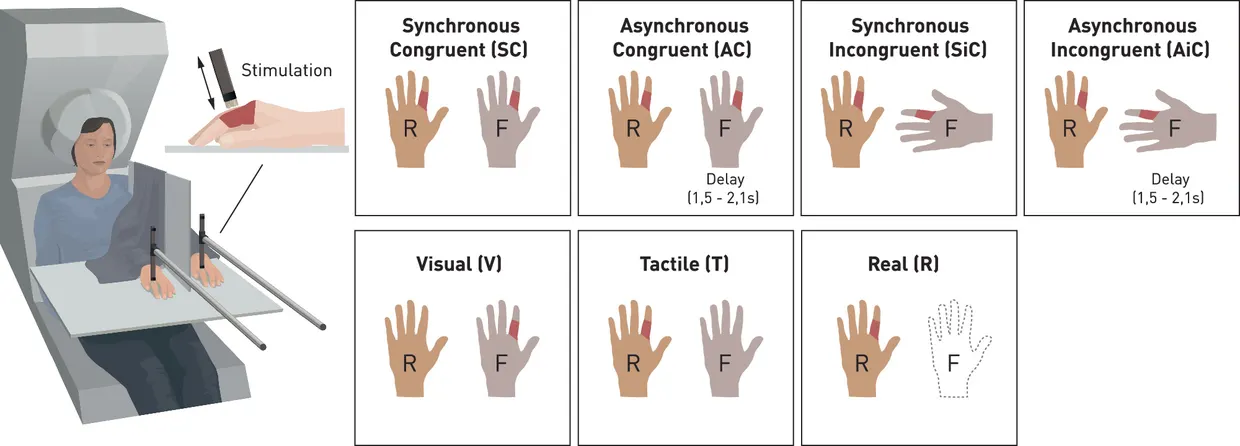
The team combined MEG with robotically controlled visuotactile stimulation and multivariate analysis. They compared the rubber hand illusion, a real hand condition and several control conditions. The experiment involved 45 healthy volunteers. Two robotic arms touched the rubber hand in view and the participant's real left hand hidden behind a screen. Data from the 28 participants who showed a clear illusion were analyzed.
Three phases of activity
The first phase consists of anticipatory patterns in the medial frontal cortex, right posterior parietal cortex and right posterior cerebellum. They appear before tactile stimulation nature.com
nature.comnature.comOpen source ↗.
The second phase, at 116–156 ms after stimulus, shows multisensory integration patterns in right dorsal and ventral premotor cortex, right posterior parietal cortex and anterior cerebellum. The third phase, at 184–232 ms, involves bilateral insular and left hemisphere patterns.
The authors describe the result as a whole-brain, time-resolved map of activity underlying body ownership. According to Lundqvist, activity before touch indicates that the brain's expectations about future sensations are closely linked to the conscious perception of the body as one's own.
Link to stroke lesions
The paper recalls that stroke lesions, particularly in the right hemisphere, can disrupt ownership of a limb, usually the left arm nature.com
nature.comnature.comOpen source ↗. The researchers note that activity in the first two phases was observed almost exclusively in the right hemisphere, and suggest this may be related. This was not tested in patients. Ehrsson said the group plans to work with stroke specialists to study the phenomenon directly in patients and to compare activity patterns for the left and right hands.