Brown University: spectra show σ-π mixing in the carbon-bismuth triple bond of the CBi− anion
Chemists at Brown University used cryogenic photoelectron spectroscopy on the CBi− anion and found that spin–orbit coupling blurs the sigma/pi split in a triple bond with bismuth.
Chemists at Brown University have obtained direct experimental evidence that relativistic effects change the σ-π bonding framework in a triple bond with a heavy element, according to a paper published in Science on 9 July 2026. The team studied the CBi− anion, which contains a carbon–bismuth triple bond, using high-resolution cryogenic photoelectron spectroscopy together with relativistic four-component Dirac-Coulomb coupled-cluster calculations. science.org
Sciencescience.orgOpen source ↗ The corresponding author is Lai-Sheng Wang; the experiments were carried out with doctoral students Deniz Kahraman and Jie Hui.
What the textbook model says
In the conventional description, a triple bond between main-group elements consists of one σ bond, formed by overlap along the internuclear axis, and two π bonds, whose electron density lies to either side of that axis. This picture works for many bonds of lighter elements. The CBi− anion is isovalent to the well-known CN− ion, so the same σ + 2π arrangement would be expected.
In heavy atoms, the strong nuclear charge drives some electrons to speeds at which relativistic effects matter, and spin–orbit coupling, which links an electron's spin to its orbital motion, becomes stronger. As a result, σ and π orbitals mix, and the only good quantum number left is the projection of total angular momentum, ω. Wang noted that the idea of relativity being important in heavy elements has existed since the 1970s, but direct experimental evidence of its effect on the σ-π framework had been lacking.
What the experiment showed
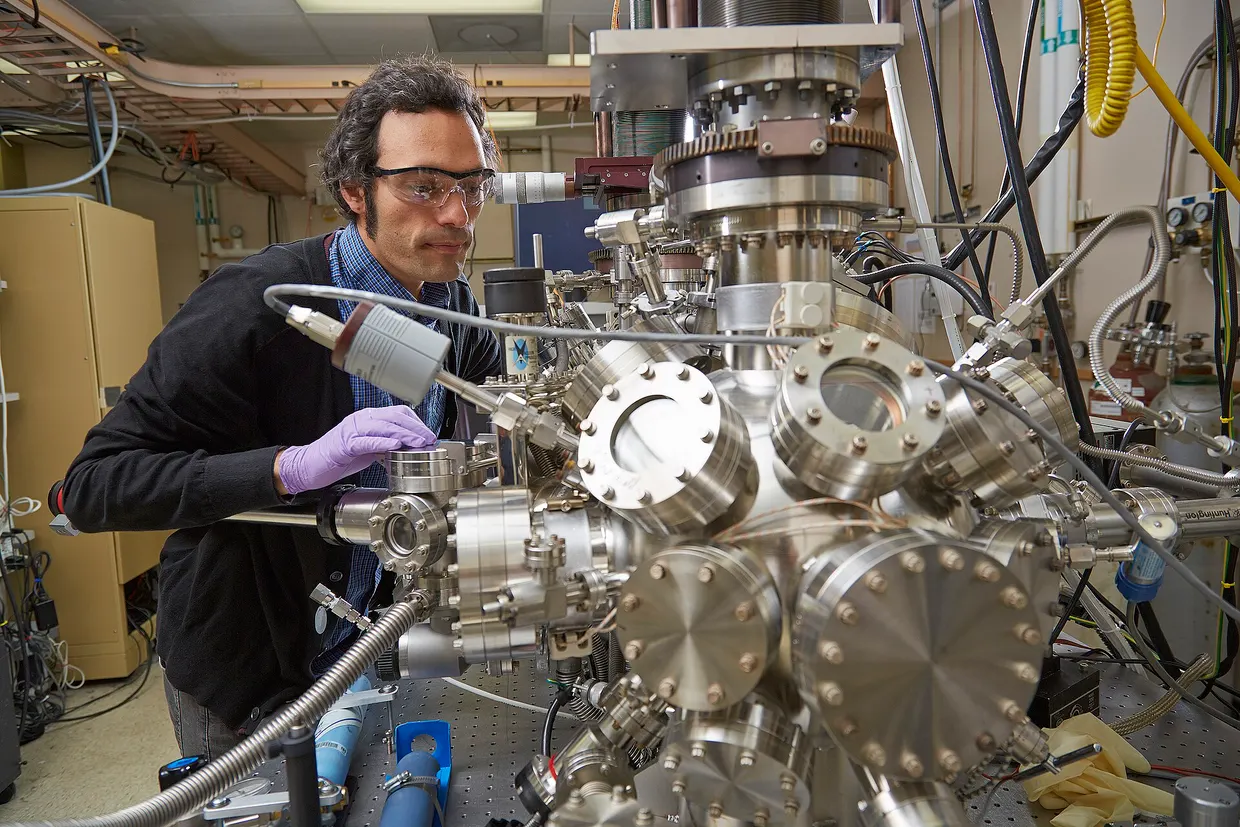
The researchers produced molecules containing carbon and bismuth and cooled them to temperatures near absolute zero. Photoelectron spectroscopy then ejected electrons with light and measured their energies, which show how strongly the electrons were bound. science.org
Sciencescience.orgOpen source ↗
The spectra and calculations did not fit the σ + 2π picture. According to the authors, the traditional triple-bond description collapses into a pure π-like state with |ω| = 3/2 and two |ω| = 1/2 Kramers pairs that contain substantial σ/π mixing. In Wang's words, there are still three bonds, but strictly speaking there is no longer a separate sigma or pi bond.
Bismuth is also being studied as an alternative to toxic lead in solar cells and in quantum materials. The measurements in this work concern an isolated anion in a spectrometer. The paper is titled "Relativistic collapse of the classical triple bond in the CBi− molecular ion."