Honey bee stinger works as a double-piston micro-pump, high-speed video and micro-CT show
Researchers filmed detached honey bee stingers and found two lancets with deformable valves sliding in antiphase, pumping venom continuously in a compact, autonomous unit.
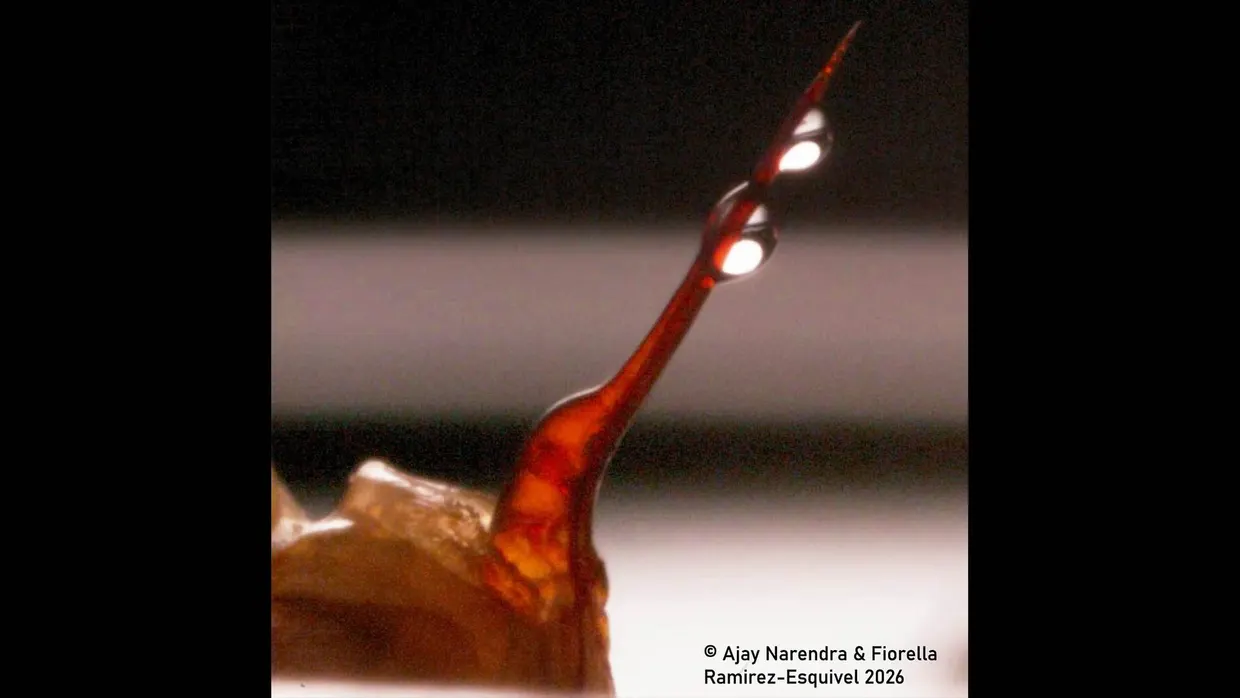
Fiorella Ramirez-Esquivel of Macquarie University in Sydney and colleagues have described how the stinger of the honey bee Apis mellifera keeps pumping venom after it separates from the body of the bee. The work was published in Proceedings of the National Academy of Sciences. The team recorded high-speed video of active, detached stingers and combined it with three-dimensional reconstruction based on micro computed tomography. pnas.org
Proceedings of the National Academy of Sciencespnas.orgOpen source ↗
Most stinging animals deliver venom by contracting muscles around a venom reservoir. Worker honey bees use a different strategy: the stinger can autotomize, that is, detach and continue to sting independently. Anatomical descriptions of the structure have existed for more than a century, but the mechanics of venom pumping remained unresolved because they are hard to observe in action.
Two lancets, two valves
The authors report that the stinger functions as a double-piston micro-pump. Two lancets slide in antiphase within a bulb chamber, and each lancet carries a deformable valve. During the downstroke a valve forms a seal, and during the upstroke it collapses. This allows pressure to build for pumping while potentially limiting backflow as the chamber refills.
The inverted tear-drop shape of the bulb lets the chamber refill even while pumping continues. According to the authors, the double-piston layout adds considerable design complexity but gives continuous venom delivery in a compact, autonomous unit. The study also presents evidence of an axial piston pump in a biological system. pnas.org
Proceedings of the National Academy of Sciencespnas.orgOpen source ↗
Scaled model and open questions
To examine valve deformation and flow, the researchers built a dynamically scaled physical model of the bulb chamber. It confirmed key features of the pumping cycle, and the authors propose mechanisms for how the valves change shape.
Several points remain open. Venom flow inside the chamber was not observed directly, so the refill space is inferred from valve shapes and timing. It is not known whether the collapsed valve fully prevents venom from being drawn back, and the way the two valves pass each other is not settled. The authors also did not measure the valve material, and all stingers were filmed in a clear gel rather than in living skin.
The authors say the findings improve understanding of venom pumping in honey bees and other Hymenoptera and may inspire the design of microfluidic pumping devices. pnas.org
Proceedings of the National Academy of Sciencespnas.orgOpen source ↗