JWST detects forbidden rotational lines of H3+ for the first time, in the HH 168 shock
JWST/MIRI recorded 26 lines of the pure rotational spectrum of H3+ toward HH 168, unseen before in a lab or in space. They give a new probe of ionization in shocked gas.
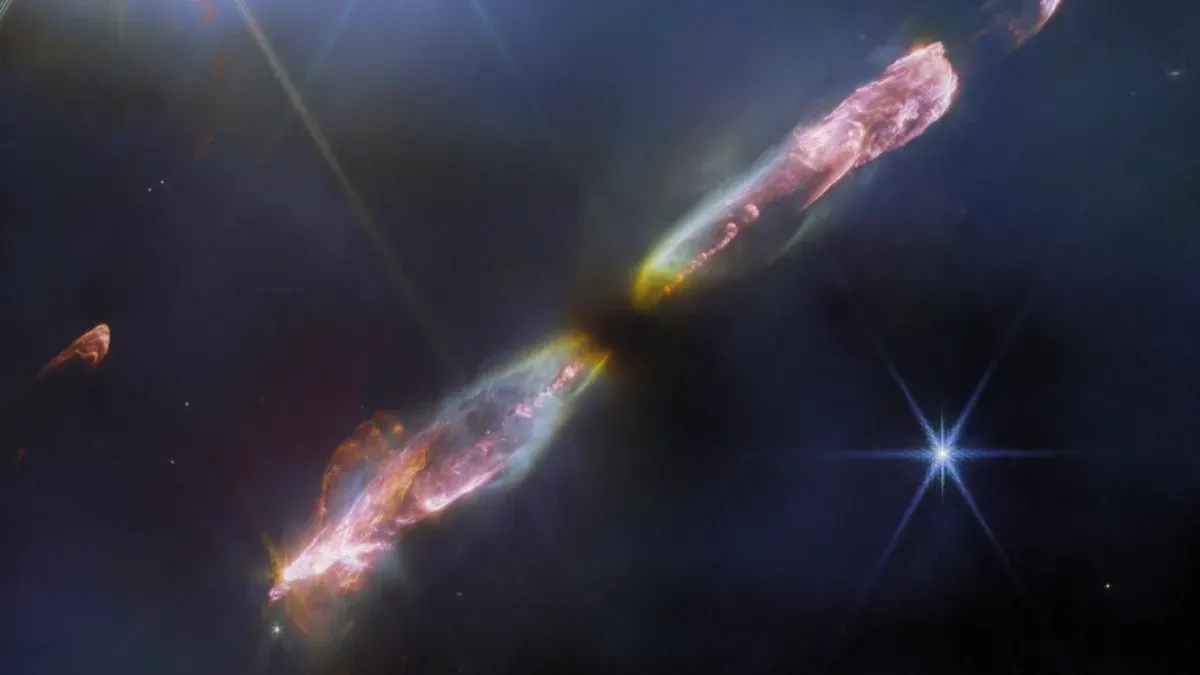
A team using the MIRI instrument of the James Webb Space Telescope has detected the pure rotational spectrum of the H3+ ion toward the Herbig-Haro object HH 168 in Cepheus A West, according to a paper on arXiv (Cornell University) arxiv.org
arXiv (Cornell University)arxiv.orgOpen source ↗. Twenty-six lines exceed 5 σ in one or both of two observed fields. The strongest is the (J,K) = (5,0) → (4,3) transition at 16.325 μm. The work was led by David Neufeld of Johns Hopkins University.
Why this spectrum was missing
H3+ is a cornerstone of interstellar ion-molecule chemistry. Its vibrational transitions have long been observed in absorption along many interstellar sight lines and in emission from the upper atmospheres of the giant planets. The pure rotational spectrum, however, consists only of "forbidden" transitions made possible by centrifugal distortion. It had not been observed in the laboratory or in any astronomical source.
The ion is an equilateral triangle of three hydrogen nuclei and has no permanent dipole moment. In 1986, Fu-Shih Pan and Takeshi Oka of the University of Chicago calculated that rotation slightly distorts this shape and creates a tiny dipole, allowing very weak emission. HH 168 is a region where jets from a young star shock the surrounding molecular gas and heat it.
What the lines show
The H3+ lines share the velocity and spatial distribution of the hot shocked H2, not of the ionized gas arxiv.org
arXiv (Cornell University)arxiv.orgOpen source ↗. A rotation diagram gives a rotational temperature of about 730 K. The level populations, though, are not thermal and are best explained by subthermal excitation in gas hotter than 2000 K.
The authors compared the data with models of shocks propagating into mildly irradiated molecular gas. Constrained by the H2 rotational lines, a dissociative J-type shock predicts H3+ emission within a factor of about 1.5 of that observed. A nondissociative C-type shock fits the H2 lines better but underpredicts the H3+ emission by a factor of 5–6. The authors note that the excitation of H3+ by energetic collisions is poorly known.
Archival MIRI data show the same forbidden rotational spectrum of H3+ in the HH 211 bow shock. According to the authors, the H3+ lines provide a new probe of ionization in shocked molecular gas.