Four-cohort study of 844,108 adults: Lancet obesity framework vs BMI-only classification
Adding waist circumference and waist-to-height ratio raised obesity prevalence by 3.3–7.4% across cohorts; clinical obesity carried a mortality hazard ratio of 1.69.
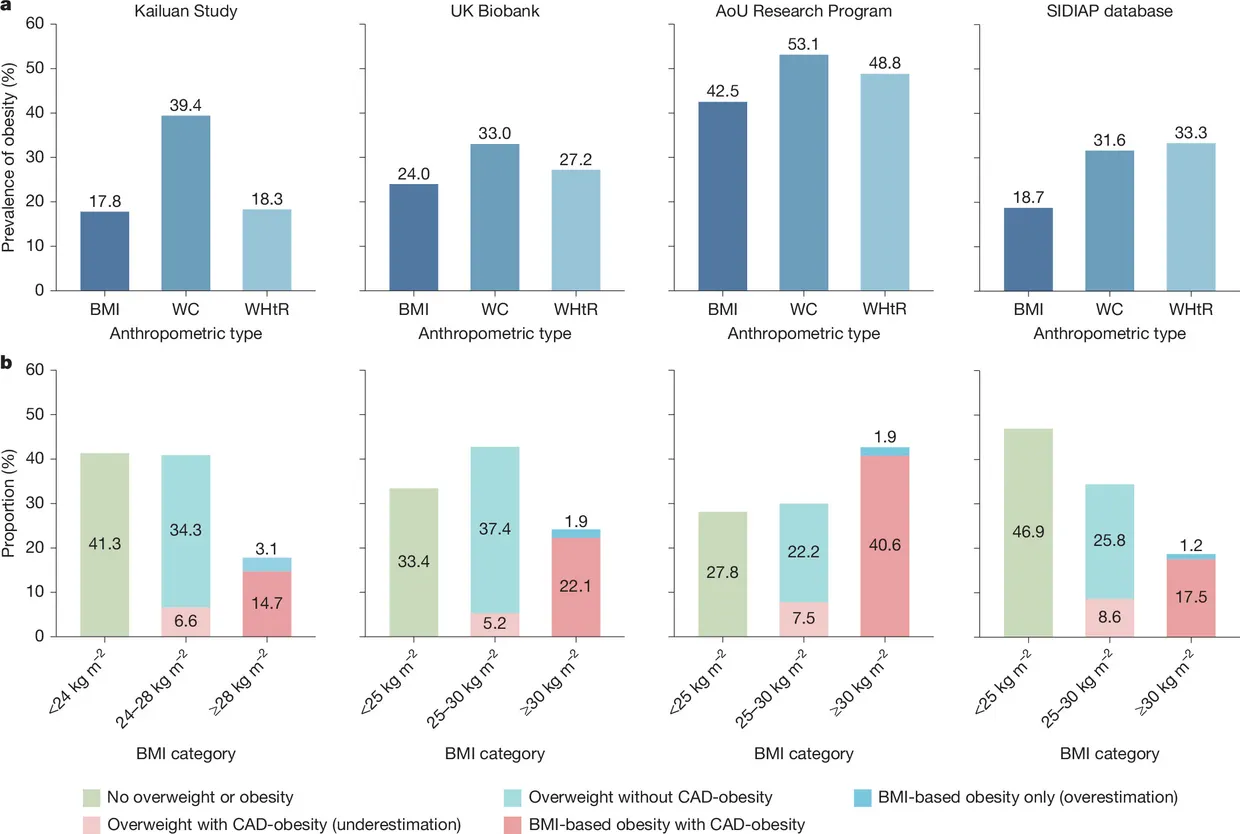
A study reported on nature.com compared the 2025 Lancet Commission obesity framework with conventional BMI-based classification. The analysis used prevalence, incidence and mortality data from 844,108 adults in four cohorts: the Kailuan Study in China (137,795), the UK Biobank (436,203), the All of Us Research Program in the USA (218,841) and the SIDIAP database in Spain (51,269) nature.com
nature.comnature.comOpen source ↗.
The Commission distinguishes clinical obesity, defined by adiposity-related organ dysfunction, from preclinical obesity, defined by excess adiposity with preserved function. It also recommends confirming obesity with measures beyond BMI, such as waist circumference and waist-to-height ratio.
Reclassification relative to BMI
According to the authors, BMI alone overestimated obesity in 1.2–3.1% of participants and underestimated it in 5.2–8.6%, depending on the cohort. Overestimation was 3.1% in Kailuan, 1.9% in the UK Biobank, 1.9% in All of Us and 1.2% in SIDIAP. Among people with BMI-defined overweight, 6.6%, 5.2%, 7.5% and 8.6% respectively met both waist criteria for obesity-level adiposity.
With the combined anthropometric definition, overall prevalence rose from 17.8% to 21.3% in Kailuan, from 24.0% to 27.3% in the UK Biobank, from 42.5% to 48.1% in All of Us and from 18.7% to 26.1% in SIDIAP. The net increase was 3.5% in China, 3.3% in the UK, 5.6% in the USA and 7.4% in Spain nature.com
nature.comnature.comOpen source ↗.
Clinical and preclinical obesity, and mortality
Clinical obesity was defined as obesity by the combined definition plus at least one of 18 adult criteria for organ dysfunction or limitation of daily activities, adapted to the variables available in each cohort. It made up 22.7–31.3% of all obesity, with a population prevalence of 5.6–10.9%. The authors note that not all organ dysfunction coexisting with obesity can be attributed to it.
Over 10 years, 77.4–91.3% of people with preclinical obesity at baseline did not progress to clinical obesity. Higher mortality was associated with the combined anthropometric definition but not with BMI-only obesity. All-cause mortality was substantially higher in clinical obesity (hazard ratio 1.69, 95% confidence interval 1.64–1.73) than in preclinical obesity (1.19, 1.14–1.24). The authors conclude that the findings support adopting the Commission's diagnostic framework.