Padua study: paired climbing plants move faster, and seven volatile signals rise before peak speed
Researchers at the University of Padua found that climbing plants grown with a neighbor explore more space, and that their movement is linked in time to volatile emissions.
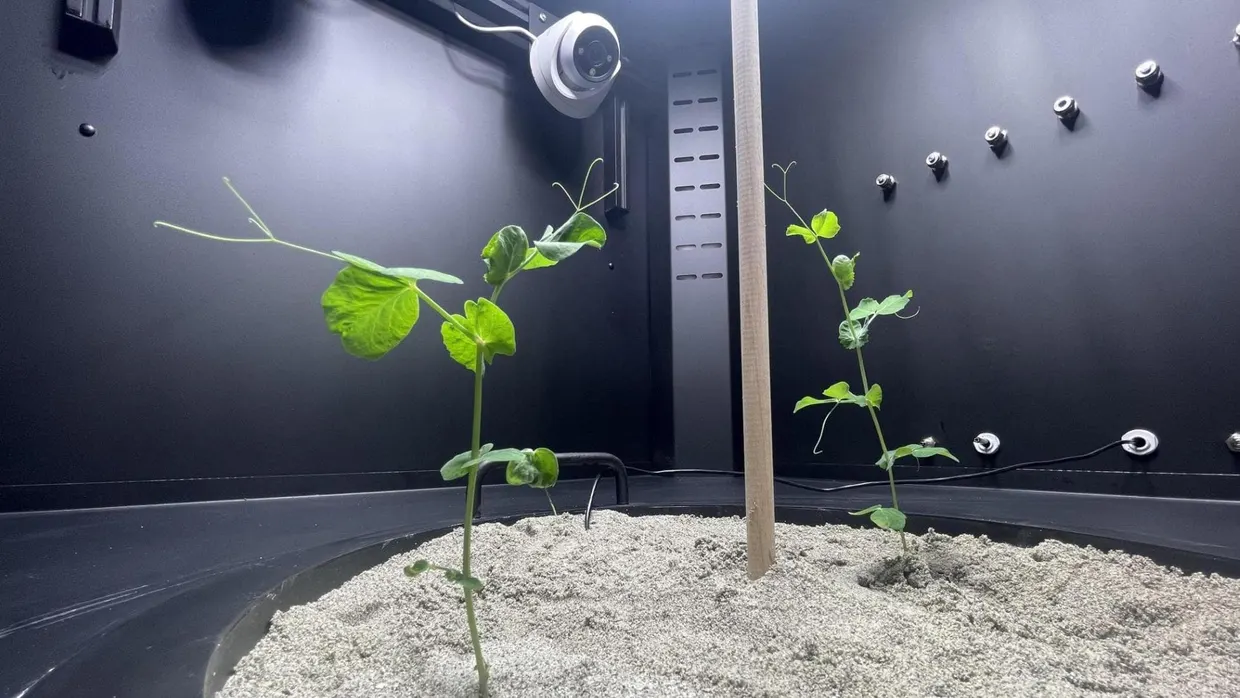
Researchers at the Department of General Psychology of the University of Padua reported that climbing plants grown in pairs move differently from those grown alone, according to Le Scienze. The work was published in Current Biology within the ROOMors project, which studies how organisms without a nervous system move. lescienze.it
Le Scienzelescienze.itOpen source ↗
Movement of plants grown in pairs
Climbing plants such as the pea do not stay still: they stretch and explore the surrounding space in search of a support to cling to. Plants grown in pairs moved faster and explored a larger area than plants grown alone.
They also coordinated the timing of their movements better and grew faster. Their upper leaves contained more chlorophyll, the green pigment that captures sunlight.
Volatile signals and measurement methods
Plants release volatile chemicals into the air. The researchers found that seven of these signals rise briefly shortly before the plant reaches its maximum speed. lescienze.it
Le Scienzelescienze.itOpen source ↗
This happened only when another plant was nearby. In plants grown alone, the link between movement and chemistry did not appear.
The team combined two tools. 3D kinematic analysis was used to reconstruct the movement trajectories of the plants. A time-of-flight mass spectrometer measured the emitted compounds in real time throughout the experiment.
First author Bianca Bonato said that the presence of another plant does not only influence growth but also changes the dynamics of movement and their relation to the chemical signals emitted into the environment. Research coordinator Umberto Castiello said that if organisms without a nervous system can modify, synchronize and coordinate their behavior in the presence of others, the origins and boundaries of social phenomena may need to be reconsidered. lescienze.it
Le Scienzelescienze.itOpen source ↗
The paper is titled "Volatile emission dynamics are temporally associated with neighbor-modulated movement in climbing plants". Its authors are Bianca Bonato, Valentina Simonetti, Sara Avesani, Silvia Guerra, Gabriela Gjinaj, Laura Ravazzolo, Marco Dadda and Umberto Castiello.