Beijing University of Chemical Technology: E. coli makes 13.46 g/L of dencichine in 3-L bioreactors
Researchers traced stunted growth of E. coli to toxic 2-hydroxyglutarate and added a growth-phase circuit; the laboratory strain reached 13.46 g/L of the hemostatic agent.
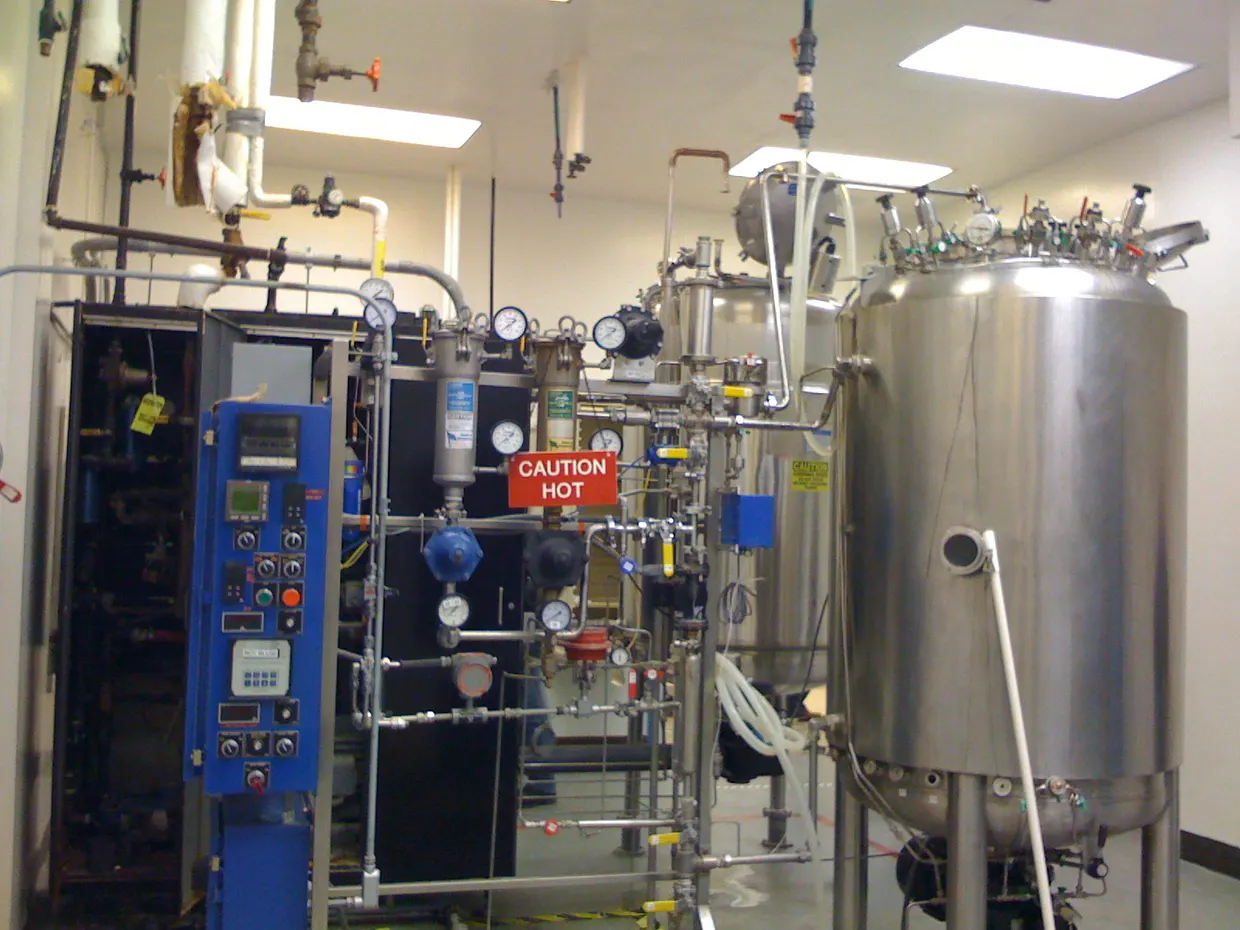
A team at Beijing University of Chemical Technology engineered Escherichia coli to produce dencichine (β-ODAP), a plant-derived hemostatic agent, at 13.46 g/L with a yield of 0.32 g/g in 3-L bioreactors. The work was published in The Innovation Life, and the authors describe it as the highest reported titer for this compound doi.org
The Innovation Lifedoi.orgOpen source ↗. The result was obtained in a laboratory strain at bench scale; scale-up beyond 3 L is still ahead.
Dencichine is found in Panax notoginseng and also shows neuroprotective activity. Extraction from plants is slow and inefficient, so earlier work moved its synthesis into E. coli, where the first attempt stalled at 1.29 g/L.
Growth defect and toxic byproduct
The team first selected the oxaloacetate-cleavage route by flux-balance analysis. Multi-copy integration of key genes and deletion of serB raised the precursor L-2,3-diaminopropionate to 3.07 g/L. Tuning the two acyl-transfer steps, ScAAE and LsBAHD, added another 223%, and balancing the PEP–OAA–pyruvate node brought the titer to 2.3 g/L.
Then growth collapsed. Knocking out serB blocks the competing L-serine pathway and makes cells dependent on L-serine, but adding L-serine or L-glycine restored growth only partially doi.org
The Innovation Lifedoi.orgOpen source ↗. Adaptive laboratory evolution of the stunted strain produced lines with mutations in glpK and serA. Reverse engineering showed that overexpressing serA, which supplies the precursor, led 3-phosphoglycerate dehydrogenase to convert α-ketoglutarate into the toxic byproduct 2-hydroxyglutarate (2-HG).
Dual-dynamic circuit and cofactor balance
To address both constraints, the authors built a growth-phase-dependent circuit that needs no external inducer. It gradually activates serA and progressively represses serB as cells enter the stationary phase, which reduces 2-HG accumulation and eases serine auxotrophy. The resulting strain, ODAP28, reduced the toxin to trace levels and reached 4.43 g/L with biomass largely restored.
The pathway also generates surplus NADH. The team introduced an NADH-dependent glutamate dehydrogenase, BsuRocG, creating a cofactor-recycling loop that lowers the NADH/NAD+ ratio and supplies glutamate as a substrate. The final strain, ODAP32, produced 13.46 g/L.
The authors say the approach may apply to other products of the serine pathway, such as L-cysteine and L-tryptophan. They note that how 2-HG arrests growth, and whether the circuit can be made more responsive, remain open questions doi.org
The Innovation Lifedoi.orgOpen source ↗.