Sulfonate interlayer in perovskite solar cells yields 26.21% efficiency and 90% retention after 4500 h
Researchers placed 2-formylbenzenesulfonic acid sodium salt between the SAM and perovskite layers of inverted cells. Lab devices reached 26.21% efficiency and kept over 90% of it in nitrogen storage.
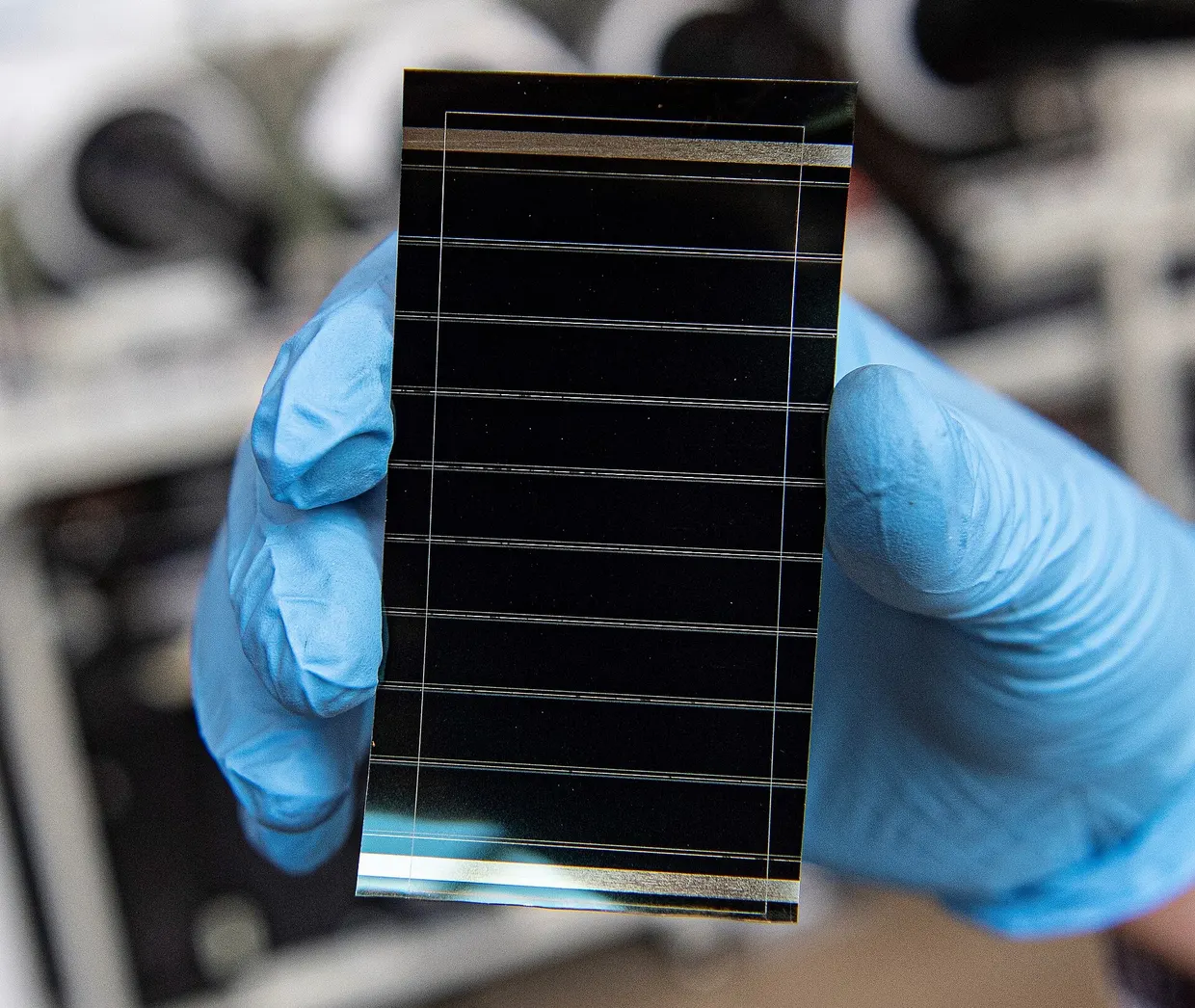
A team from Henan University, the Institute of Process Engineering of the Chinese Academy of Sciences, The Chinese University of Hong Kong and Beijing Institute of Technology has modified the buried interface of inverted perovskite solar cells. According to a paper in Nano-Micro Letters, the modified laboratory devices reached a champion power conversion efficiency of 26.21% springer.com
Nano-Micro Lettersspringer.comOpen source ↗.
The interlayer is 2-formylbenzenesulfonic acid sodium salt (2-FAS), a low-cost, readily available compound. It is placed between the self-assembled molecule (SAM) hole-transport layer and the perovskite absorber, where it acts as a molecular bridge.
Buried interface and charge transport
The quality of the interface between the SAM and the perovskite governs charge transport and non-radiative recombination. Poor SAM adhesion, along with defects at the perovskite surface, remains a problem for inverted cells. The authors report that the benzene ring of 2-FAS interacts with the SAM through π–π stacking, which strengthens adhesion and promotes hole transfer.
The sulfonate group (-SO3−) coordinates with Pb2+ ions. According to the authors, this regulates crystallization and passivates surface defects springer.com
Nano-Micro Lettersspringer.comOpen source ↗.
Efficiency and stability
The best 2-FAS-modified device showed an efficiency of 26.21%, an open-circuit voltage of 1.164 V and a fill factor of 86.15%. The untreated control reached 24.58%, and devices with a second sulfonate, sodium methyl allyl sulfonate (SMAS), reached 25.41%.
The authors also report that Na+ from 2-FAS occupies A-site vacancies in the perovskite lattice. This suppresses ion migration and phase transitions, which improves structural integrity.
Unencapsulated devices retained 90.06% of their initial efficiency after 4500 hours of storage in a nitrogen atmosphere. Both the control and the SMAS-based devices performed worse in this test springer.com
Nano-Micro Lettersspringer.comOpen source ↗.
The results come from laboratory cells. The work combines interfacial bridging, defect passivation and lattice stabilization in a single low-cost additive layer. The paper was published on 14 August 2026 (DOI 10.1007/s40820-026-02278-6).