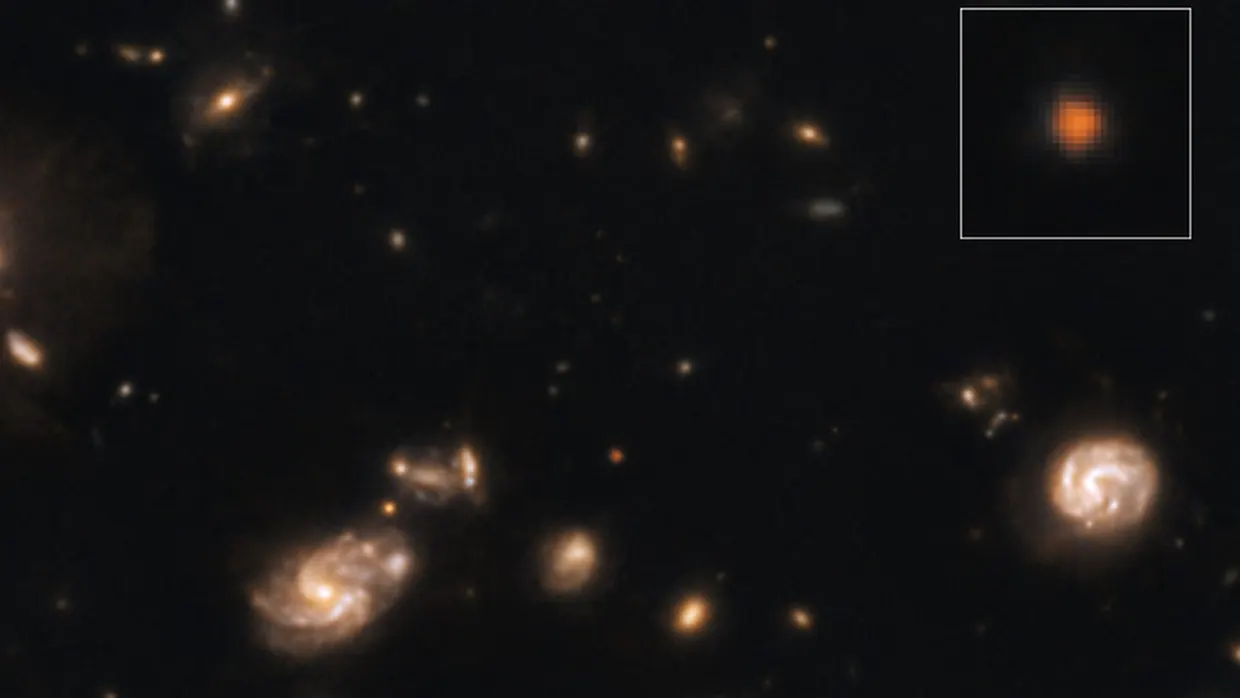
Quasar J2318 shows a UV-absorbing outflow at 0.3 c, the fastest first detected in ultraviolet
Astronomers detected C IV and Si IV absorption at −77,000 to −90,000 km/s in quasar SDSS J231854.31+243954.2, the fastest outflow first seen in ultraviolet.
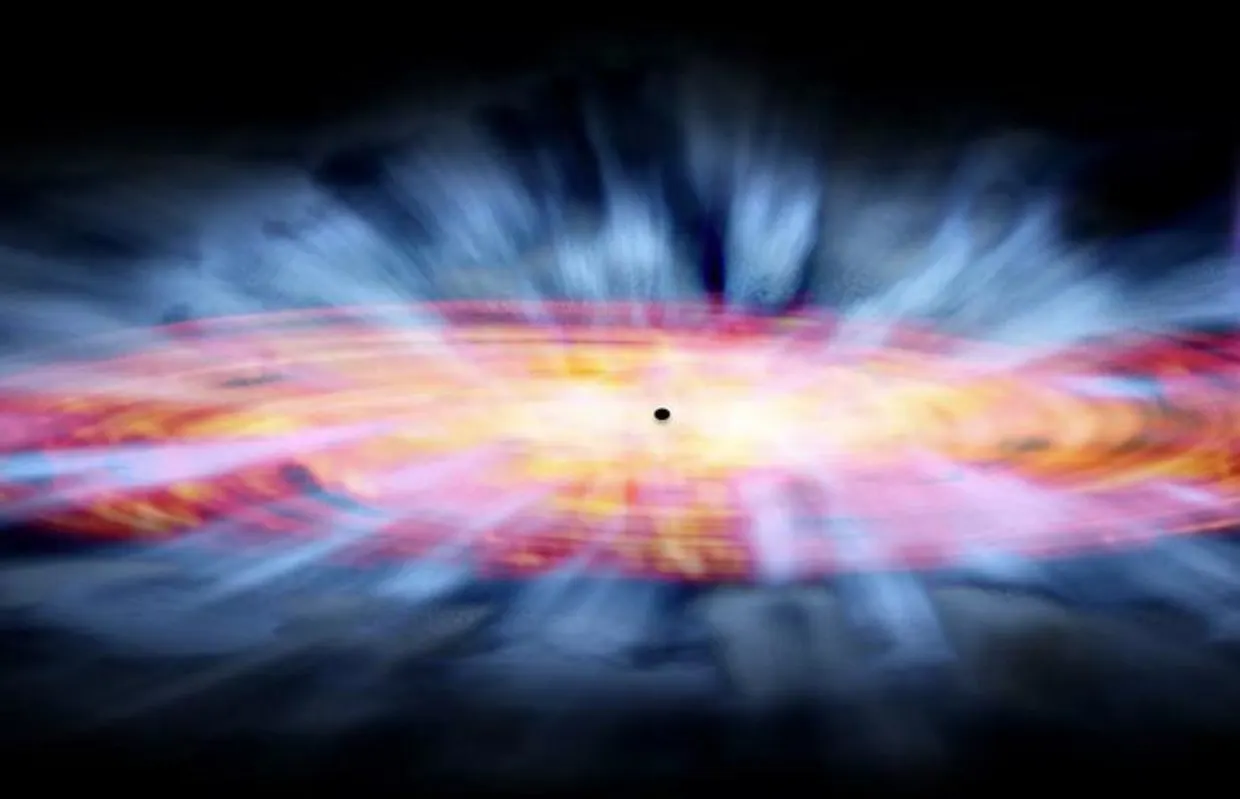
A team led by York University reported the fastest quasar outflow first detected in the ultraviolet, in the radio-quiet quasar SDSS J231854.31+243954.2 (J2318). According to a paper in The Astrophysical Journal, variable C IV and Si IV absorption shows gas moving at outflow velocities from −77,000 km/s to at least −90,000 km/s, about 30% of the speed of light iop.org
The Astrophysical Journaliop.orgOpen source ↗. The quasar was flagged in SDSS-V in 2023 and followed up with Gemini North.
Source and observations
J2318 is a weak-lined quasar in the rest-frame ultraviolet. Gemini GNIRS spectroscopy gives an Hα redshift of z = 2.6781 ± 0.0004. A 20-year photometric time series shows peak-to-peak variability of 0.5 mag in the g band. The C IV outflow strengthened monotonically over three epochs spanning about 2.2 rest-frame years.
Virial estimates give a black-hole mass of 1.65 × 10^9 solar masses. This corresponds to an Eddington luminosity of 2.4 × 10^47 erg/s and an Eddington ratio of 0.45.
Energetics and open questions
Under very conservative assumptions, the UV-absorbing outflow alone has an estimated mass loss of more than 0.82 solar masses per year. Its kinetic luminosity ratio L_kin/L_bol is at least 0.75% iop.org
The Astrophysical Journaliop.orgOpen source ↗. The authors note that this lower limit lies just above the threshold usually cited for significant feedback on the host galaxy.
PDS 456 is the only other known quasar with a UV-absorbing outflow at 0.3 c. Comparison with it suggests, according to the authors, that the true mass loss and L_kin/L_bol could be up to two orders of magnitude larger.
The authors point out a constraint for quasar-wind models. They must either accelerate gas to 0.3 c while preserving C IV and Si IV ions, or allow those ions to form in gas that has already been accelerated to that speed. Faster winds have been seen in X-rays, but J2318 is the fastest found in the ultraviolet, as lead author Lucas Seaton noted.