Chinese Academy of Sciences synthesizes superconducting Mg2RhH6 at 30 GPa
Researchers obtained the polyhydride compound through a two-step process, achieving superconductivity at around 30 K under accessible industrial pressures.
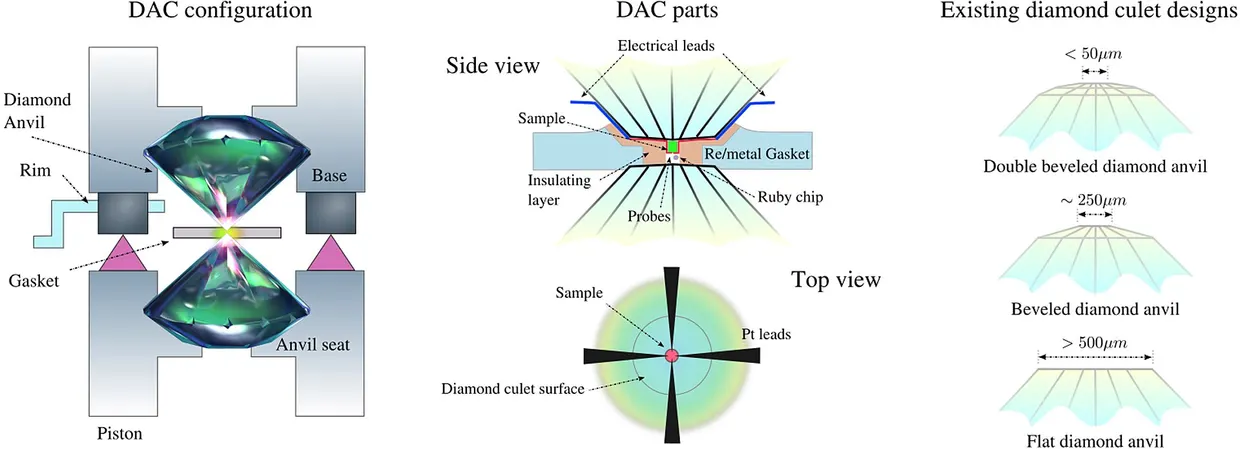
Researchers from the Institute of Physics at the Chinese Academy of Sciences synthesized the polyhydride superconductor Mg2RhH6 at pressures significantly lower than standard polyhydride thresholds, according to EurekAlert. Led by Professor Changqing Jin at the Beijing National Laboratory for Condensed Matter Physics, the team documented the transition occurring around 30 GPa eurekalert.org
EurekAlerteurekalert.orgOpen source ↗.
Two-step synthesis route
The synthesis relies on a two-stage chemical reaction designed to overcome the extreme pressure requirements typical for hydrides. In the initial stage, the authors prepared an Mg2RhH5 precursor, in which hydrogen atoms remain stabilized within the lattice via covalent bonding.
During the second stage, introducing additional hydrogen drove electrons into antibonding orbitals under pressures above 30 GPa. This charge injection triggered a structural transformation from RhH5 square pyramids with a P4/nmm space group into ideal RhH6 octahedra with Fm3m symmetry, yielding the target polyhydride.
Superconductivity at reduced pressures
Experimental measurements confirmed that Mg2RhH6 exhibits superconductivity at approximately 30 GPa. The superconducting state was identified by an immediate drop in electrical resistivity to zero, alongside the systematic suppression of the critical temperature (Tc) under applied external magnetic fields eurekalert.org
EurekAlerteurekalert.orgOpen source ↗.
The resulting phase demonstrated thermodynamic stability above 30 GPa with a critical transition temperature near 30 K. According to the researchers, this makes Mg2RhH6 the first superconductor operating at 30 K under pressure regimes accessible with industrial pressure equipment, offering a viable route within the phonon-mediated BCS framework.