Tianjin University develops organic phototransistor array with 2,920 dichroic ratio
Researchers created a scalable organic crystal array for neuromorphic polarization vision, reaching an energy consumption of 1 aJ per synaptic event.
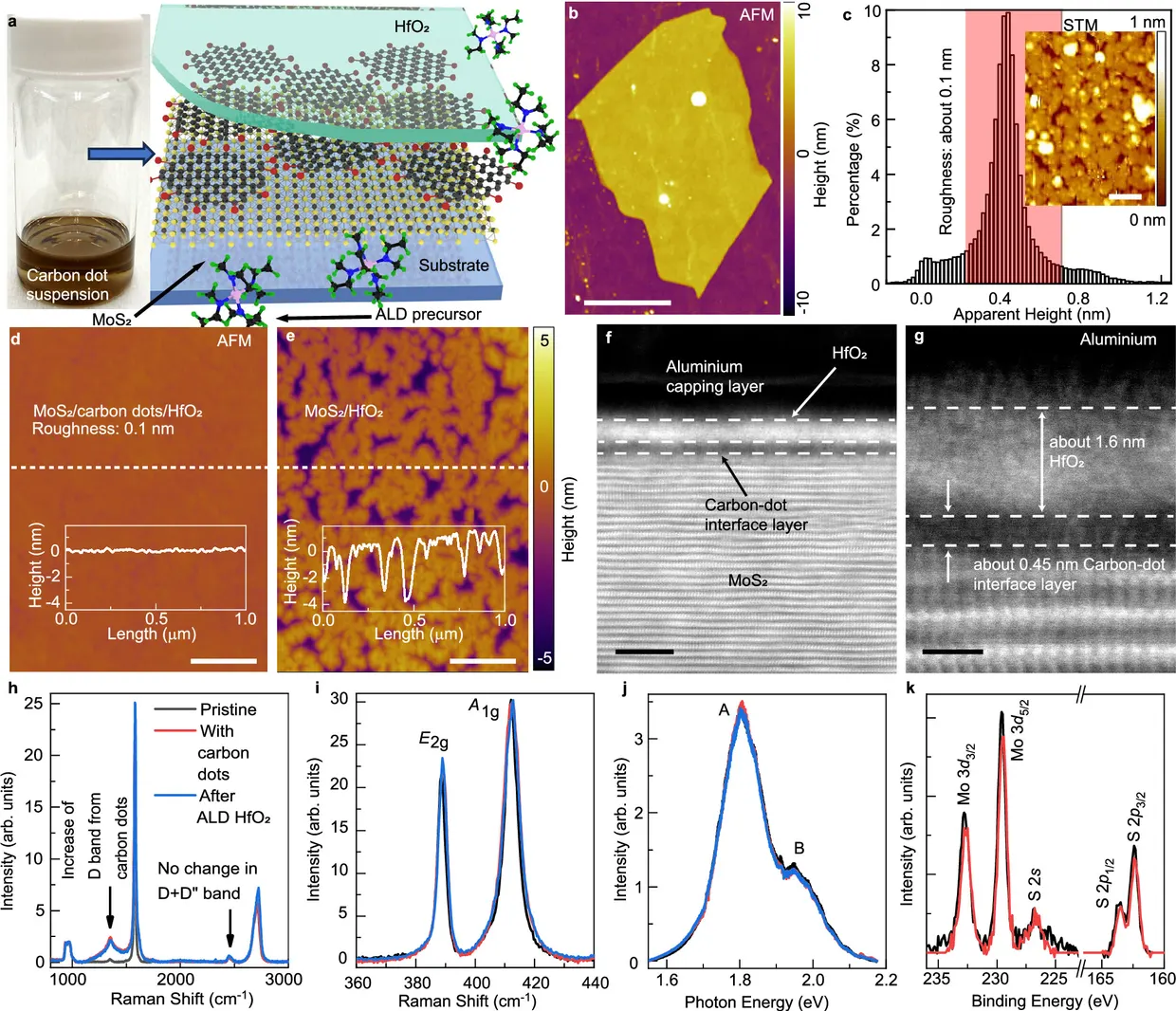
Researchers from Tianjin University reported an electret-mediated biphasic dip-coating technique to fabricate large-area organic phototransistors for neuromorphic polarization vision, according to a study published in National Science Review. The platform couples ultrathin, highly oriented few-layer organic single crystals with an in-situ polyvinyl alcohol (PVA) electret layer, enabling synchronized light sensing, memory, and preprocessing within a single device architecture oup.com
National Science Reviewoup.comOpen source ↗.
Scalable growth and charge trapping
Polyvinyl alcohol plays a dual role during the dip-coating process. Its amphiphilic structure regulates interfacial nucleation and stabilizes molecular mass transport, allowing uniform organic single crystals to grow across centimeter-scale areas. Simultaneously, the underlying hydroxyl-rich PVA layer functions as an electret, capturing photoexcited electrons and inducing a photogating effect that nonlinearly magnifies the material's optical anisotropy.
Individual phototransistors reached a dichroic ratio of 2,920, which is more than three orders of magnitude above the pristine crystal's intrinsic limit. In a fully operational 7×7 transistor array, the average dichroic ratio reached 2,400 with a standard deviation of approximately 200 and a coefficient of variation of 7.3%.
Synaptic plasticity and visual recognition
The charge-trapping mechanism also establishes pronounced synaptic behavior. The system recorded a paired-pulse facilitation index of 6,594%, supported a photocurrent modulation range exceeding five orders of magnitude, and operated at an estimated energy consumption of approximately 1 aJ per synaptic event oup.com
National Science Reviewoup.comOpen source ↗.
To demonstrate image processing, the authors evaluated a 5×5 sensor array that recorded and retained polarization-dependent optical patterns. In a semantic recognition test using polarization angles of 0, 45, 90, and 135 degrees across five fruit types, hardware-derived convolution kernels achieved a classification accuracy of 95.25% by fusing the multi-angle datasets.