Tongji University team boosts thermoelectric cooling 10% via graded Seebeck coefficient
Researchers created a single-leg cooler with a spatial Seebeck gradient, making solid-state cooling 10% more effective depending on current direction.
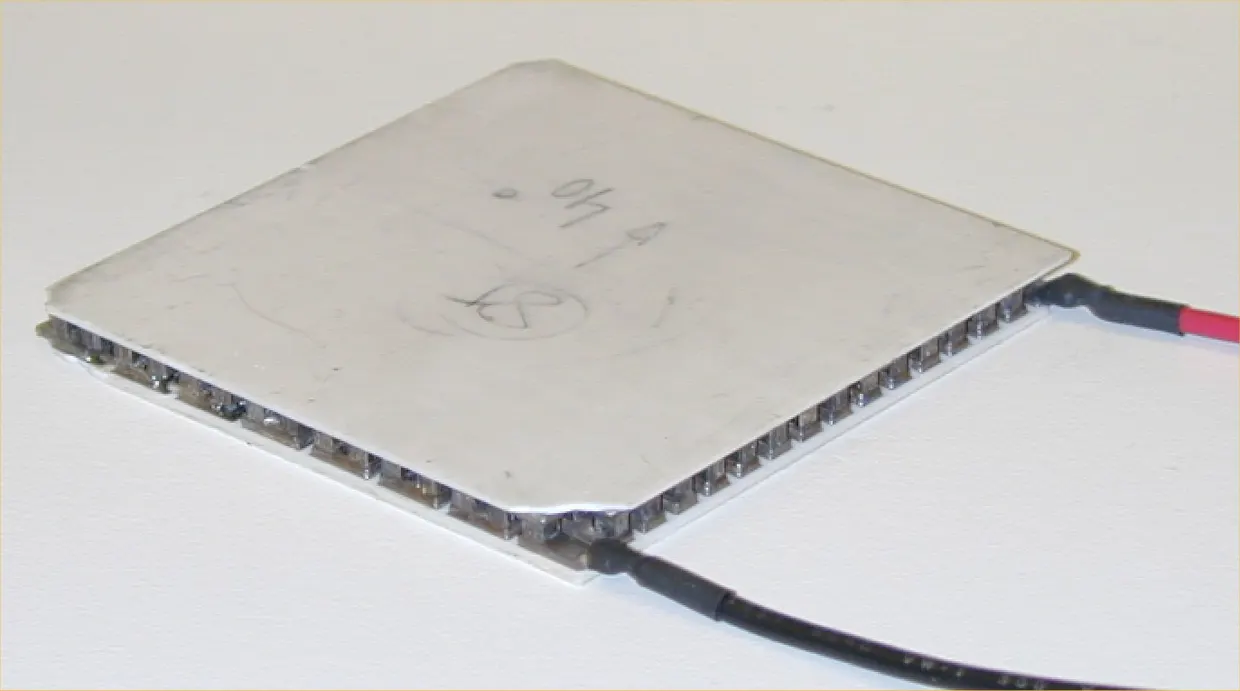
In November 2026, researchers from Tongji University and Shanghai University demonstrated a solid-state cooling element that runs 10% colder by introducing an internal gradient in its Seebeck coefficient, according to EurekAlert. The peer-reviewed study, published in The Innovation, introduces nonreciprocal thermoelectric cooling that depends on the direction of current flow without altering the core alloy family eurekalert.org
EurekAlerteurekalert.orgOpen source ↗.
Solid-state thermoelectric coolers rely primarily on the Peltier effect at material-electrode junctions, while the internal Thomson effect remains negligible in conventional homogeneous elements. To broaden this heat-exchange mechanism, the research team introduced an extended figure of merit that factors in electronic entropy changes across the entire transport path. Instead of optimizing only the classic figure of merit, the design leverages shifts in chemical potential, temperature, and magnetic fields to absorb extra heat internally.
Spatial grading and nonreciprocal performance
The team grew a compositionally graded n-type bismuth telluride selenide single crystal (Bi2Te2.7Se0.3). In this prototype, a chemical-potential gradient shifted the Seebeck coefficient by roughly 50 microvolts per kelvin from one end to the other. By comparison, hot and cold ends in standard commercial legs of the same composition differ by approximately 2.5%.
Because of the internal gradient, the single-leg demonstration device exhibited directional asymmetry. Reversing the electric current altered the maximum temperature span by about 20%. When current flowed along the gradient, the maximum cooling span increased by approximately 10% compared to an identical uniform element without a gradient, whereas the uniform control leg showed practically no directional dependence eurekalert.org
EurekAlerteurekalert.orgOpen source ↗.
Low-temperature outlook and full module design
The prototype reached an absolute cooling span of about 15 kelvins, with part of the thermal budget lost through parasitic heat leaks in the lead wires. Modeling indicates that this bonus becomes more pronounced as the electronic quality factor decreases. That property makes the method particularly promising at cryogenic temperatures, where lattice thermal conductivity normally suppresses conventional thermoelectric efficiency.
The authors noted that the spatial grading strategy relies only on dopant adjustments and can theoretically be adapted to any dopable thermoelectric material. Future implementations will require integrating both n-type and p-type graded legs into paired, multi-junction modules to evaluate system-level gains in practical applications.