HIT Engineers Built a Windmill-Shaped Ceramic Fork Detecting 19 ppb Methane
A prototype multi-unit piezoelectric sensor achieved an Allan-deviation detection limit of 0.87 ppb through coupled acoustics and four-pass excitation.
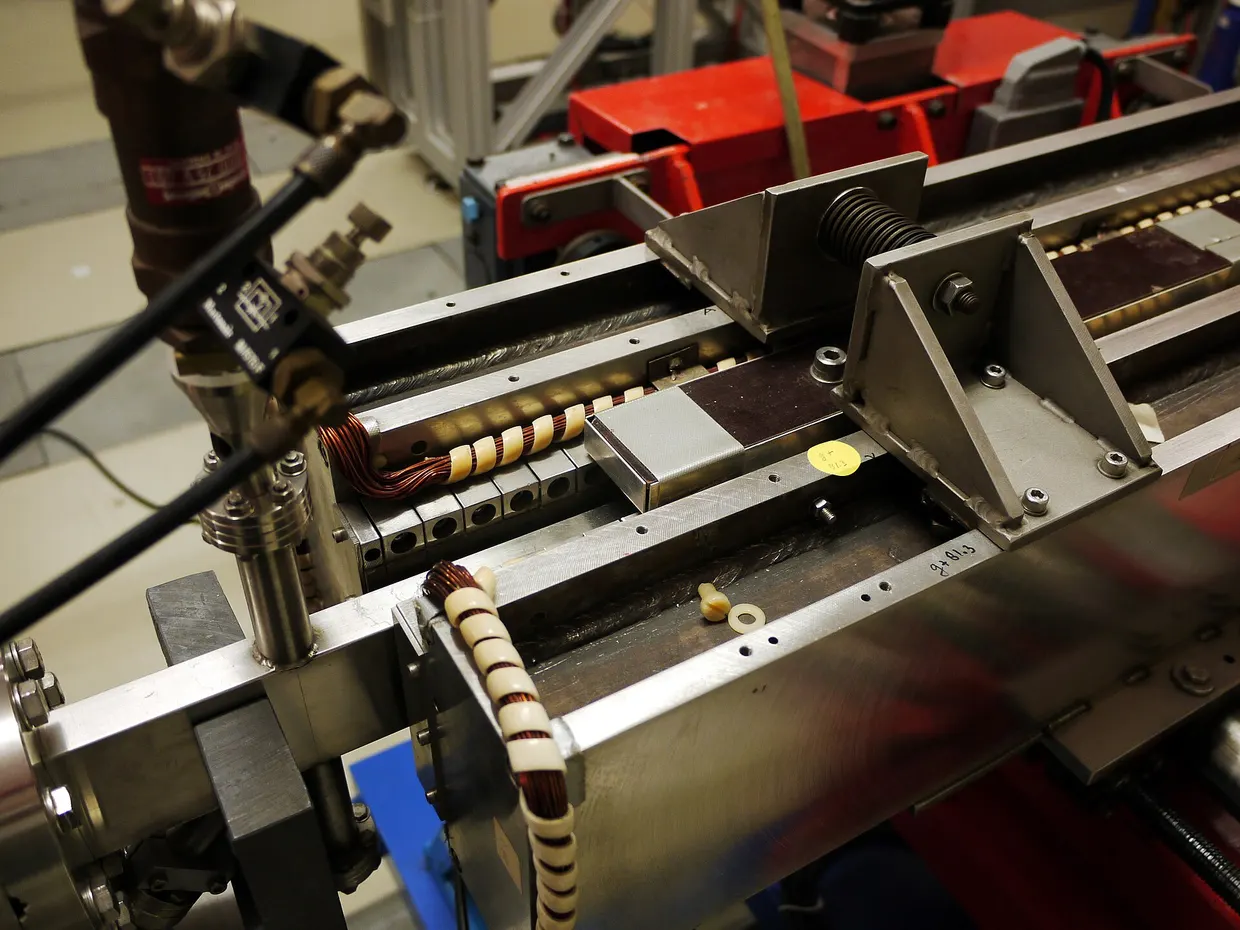
A research team led by Harbin Institute of Technology, collaborating with the Institute of Semiconductors of the Chinese Academy of Sciences and Politecnico di Bari, has developed a windmill-shaped multi-unit piezoelectric ceramic tuning fork (WMPCTF) for photoacoustic methane spectroscopy, as reported in Opto-Electronic Science doi.org
Opto-Electronic Sciencedoi.orgOpen source ↗. The prototype design replaces conventional single-pair quartz forks with four symmetrically arranged ceramic units, reaching a minimum detection limit of 19 parts per billion (ppb) at 300 mW optical power.
Multi-Unit Architecture and Charge Superposition
Quartz tuning forks traditionally used in quartz-enhanced photoacoustic spectroscopy feature low piezoelectric coefficients and crystallographic constraints that restrict geometric modifications. The researchers utilized thickness-poled polycrystalline piezoelectric ceramics, which exhibit equivalent macroscopic electromechanical responses along orthogonal in-plane directions. This isotropic in-plane behavior enabled a fourfold symmetric layout where four local tuning-fork units are mechanically coupled through a common central zone.
Finite-element analysis showed that the synchronously vibrating prongs generate an additive piezoelectric charge output of 118.5 nC, representing a 3.76-fold increase compared to the 31.5 nC generated by a conventional piezoelectric ceramic tuning fork. Experimental measurements confirmed consistent resonance frequencies and piezoelectric responses across all four local branches.
Optical Amplification and Acoustic Resonators
To maximize acoustic excitation, the team integrated the ceramic assembly with four pairs of optimized acoustic microresonators and a folded four-pass optical beam path doi.org
Opto-Electronic Sciencedoi.orgOpen source ↗. Relative to an isolated single-pass WMPCTF without acoustic microresonators, the complete configuration produced signal and signal-to-noise ratio enhancement factors of approximately 453 and 394, respectively.
Optical power delivery was augmented using a Raman fiber amplifier. Under 300 mW excitation, the sensor demonstrated a linear response to methane concentrations, yielding a 19 ppb limit based on signal-to-noise calculations. Allan deviation analysis showed that extending the averaging time to approximately 760 seconds lowered the minimum detectable concentration to 0.87 ppb.