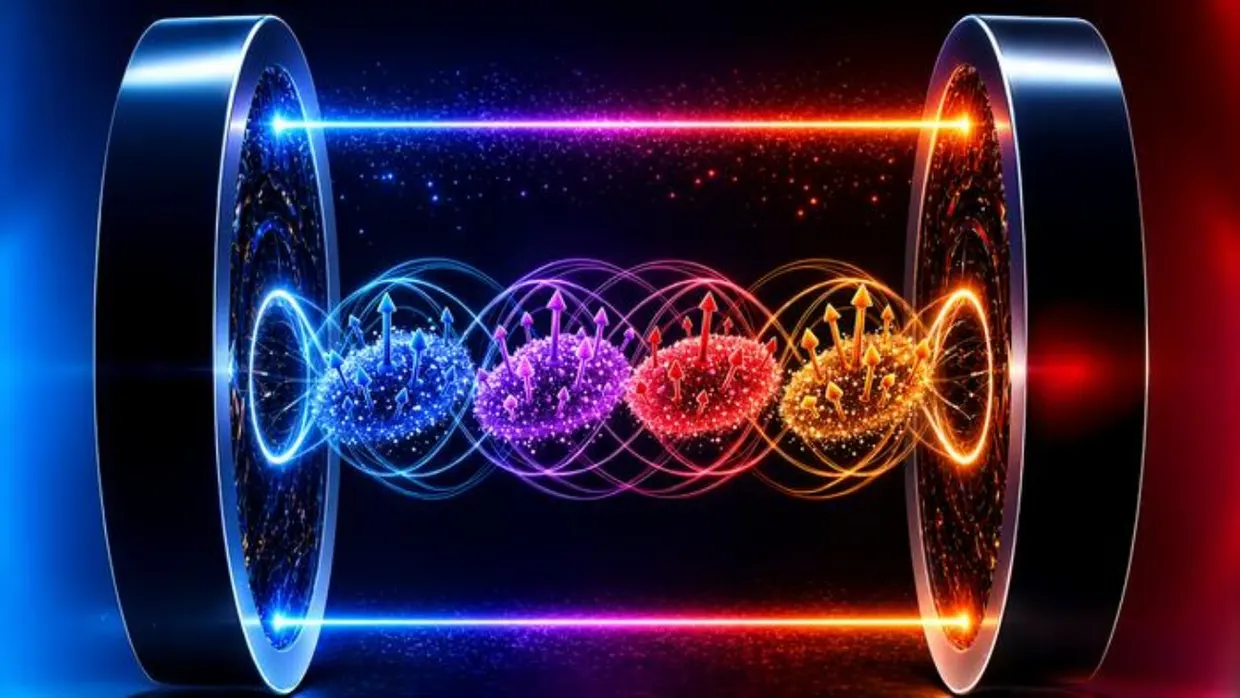
Delft team resolves nuclear spin transitions of a single 47Ti atom with a scanning tunnelling microscope
Delft researchers controlled the nuclear spin of a single 47Ti atom with radio waves where it hybridizes weakly with the electron spin; the mechanism is unclear.
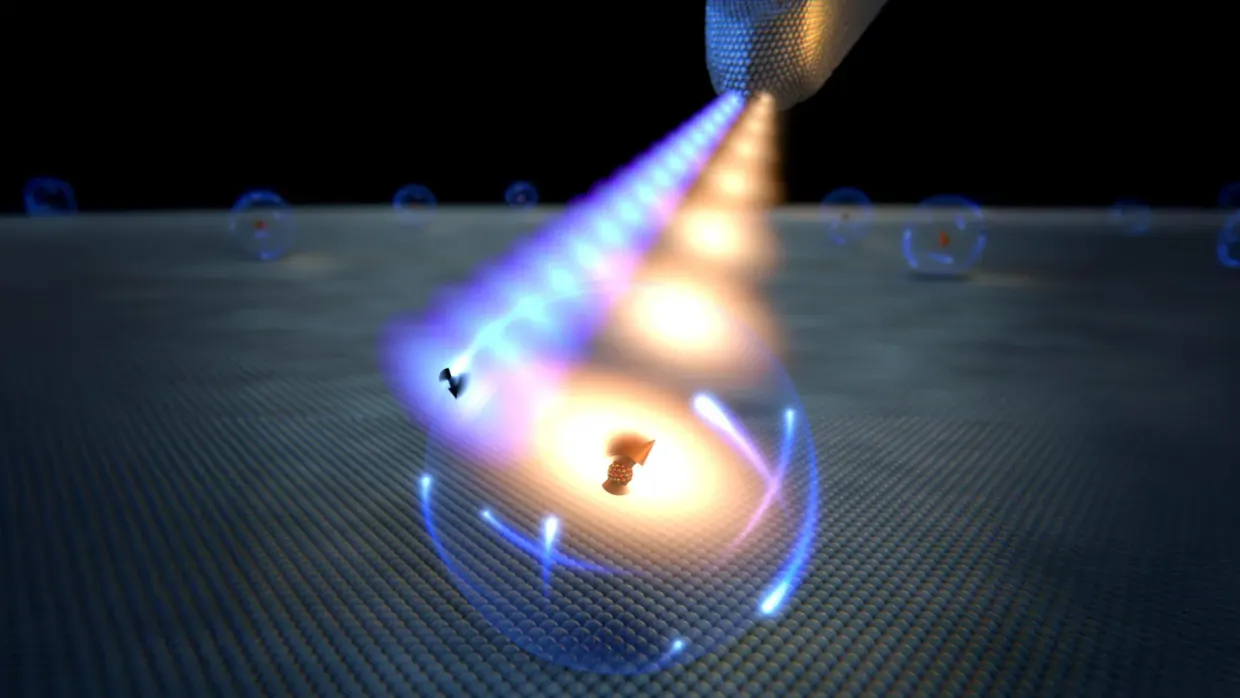
Researchers at Delft University of Technology in the Netherlands have resolved nuclear magnetic resonance on a single atom on a surface using a scanning tunnelling microscope. The work, led by Sander Otte with first author Hester Vennema, was published in Nature Communications in 2026. nature.com
Nature Communicationsnature.comOpen source ↗ The authors studied the 47Ti isotope, whose nuclear spin is I = 5/2.
The team used an electron-nuclear double resonance scheme. Two signals were applied to one atom at the same time, one aimed at the electron spin and one at the nuclear spin, so that their effects could be examined separately. This allowed the authors to resolve nuclear spin transitions of the single atom.
Weak hybridization regime
Earlier nuclear magnetic resonance on individual on-surface atoms relied on hybridization between the electron and nuclear spins. Here the authors addressed the nuclear spin in the weak-hybridization limit, which they describe as a requirement for direct control of the nuclear spin in the long-lifetime regime.
According to the researchers, the nuclear spin could be flipped even when it was largely disentangled from the electron spin. Otte said that, by the simple picture, the nuclear spin should not be sensitive to the electrical signals of a scanning tunnelling microscope. The physical mechanism that makes it respond is not yet explained.
Couplings and frequencies
Measurements and numerical analysis revealed the nature of the hyperfine and quadrupole couplings in the studied system. nature.com
Nature Communicationsnature.comOpen source ↗ Each allowed spin transition requires its own frequency. Vennema said that the transition frequencies of a nuclear spin are a hundred to a thousand times lower than those of an electron spin, which lets the two be addressed separately.
Nuclear spins are well isolated from their environment and show long-lived spin states. The same isolation makes them harder to control and read out. The authors present the study as a development relevant to other platforms that use nuclear spins.
The result is an early experimental step, not a ready quantum memory technology. The researchers say the mechanism behind the nuclear spin response remains to be worked out.