IGZ team shows COP1 protein in Arabidopsis acts as a built-in temperature switch
Researchers at the Leibniz Institute IGZ found that COP1 in Arabidopsis changes its conformation with temperature, which alters how strongly seedlings respond to warmth.
Researchers at the Leibniz Institute of Horticultural Science (IGZ) in Großbeeren, Germany, led by Philip Wigge, have shown in the model plant Arabidopsis thaliana that the protein COP1 regulates its own activity depending on temperature, igzev.de reports. The study was done together with the Max Planck Institute of Molecular Plant Physiology and the Karolinska Institutet, and was published in the journal Cell in 2026. igzev.de
igzev.deigzev.deOpen source ↗
COP1 is a central regulator of signalling in plants. It integrates light and temperature signals, binds other proteins and triggers their degradation. The team used molecular and biophysical methods and found that the protein adopts two different conformations.
A built-in lock in the protein
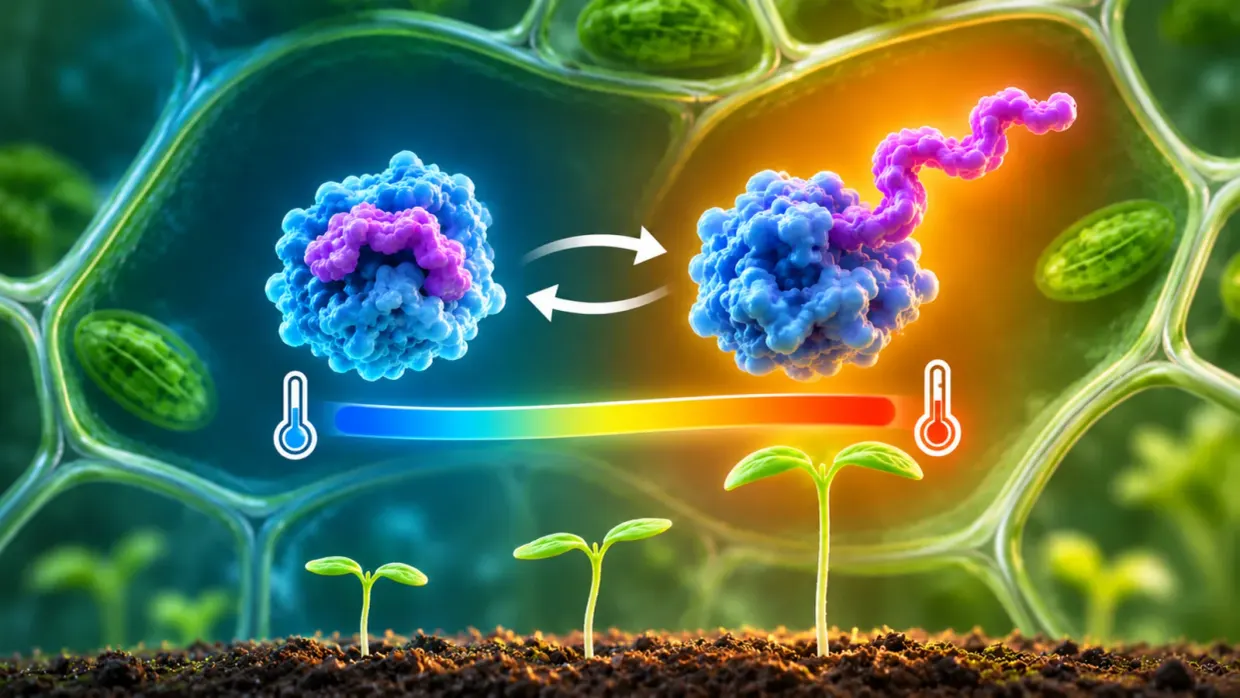
At lower temperatures COP1 exists mostly in a closed, less active form. A short segment at one end of the protein contains two consecutive amino acids, valine and proline (VP). This segment can bind to the WD40 domain, the site where target proteins would normally interact. This internal interaction works as a built-in lock, so other proteins, including the growth regulator HY5, have less access to the binding site.
As temperature rises, the internal interaction loosens and COP1 becomes more open. It can then bind other proteins and mark them for degradation, the amount of targets such as HY5 falls, and growth inhibition is reduced. igzev.de
igzev.deigzev.deOpen source ↗ In the seedlings studied, the amount of HY5 at 27 °C was lower than at 22 °C, while key genes for shoot elongation were more strongly activated. Microscopy showed COP1 changing shape in response to warmth, and molecular dynamics simulations on supercomputers showed a flexible part of the protein moving away as temperature increased.
Differences between plant species
The researchers deliberately modified the VP motif and its binding strength to the WD40 domain. This changed the temperatures at which COP1 becomes active and how strongly the plants respond to temperature differences. Natural variations in the COP1 amino acid sequence were also associated with altered temperature responses.
Comparing the protein across plant species, the team found that COP1 from cooler climate zones is more flexible and responds more strongly to temperature changes than COP1 from warmer regions. Changing the flexibility of COP1 likewise changed the strength of the response. The authors state that the mechanism could serve as a starting point for modifying temperature responses in crops, but whether and how this can be applied remains to be investigated.