Chicxulub crater suevite magnetism is not a reliable clock for the hydrothermal system's duration
Rutgers University researchers re-examined peak ring suevite from the 200 km Chicxulub crater. Scatter in magnetic directions does not prove 150 thousand years of hot-water activity.
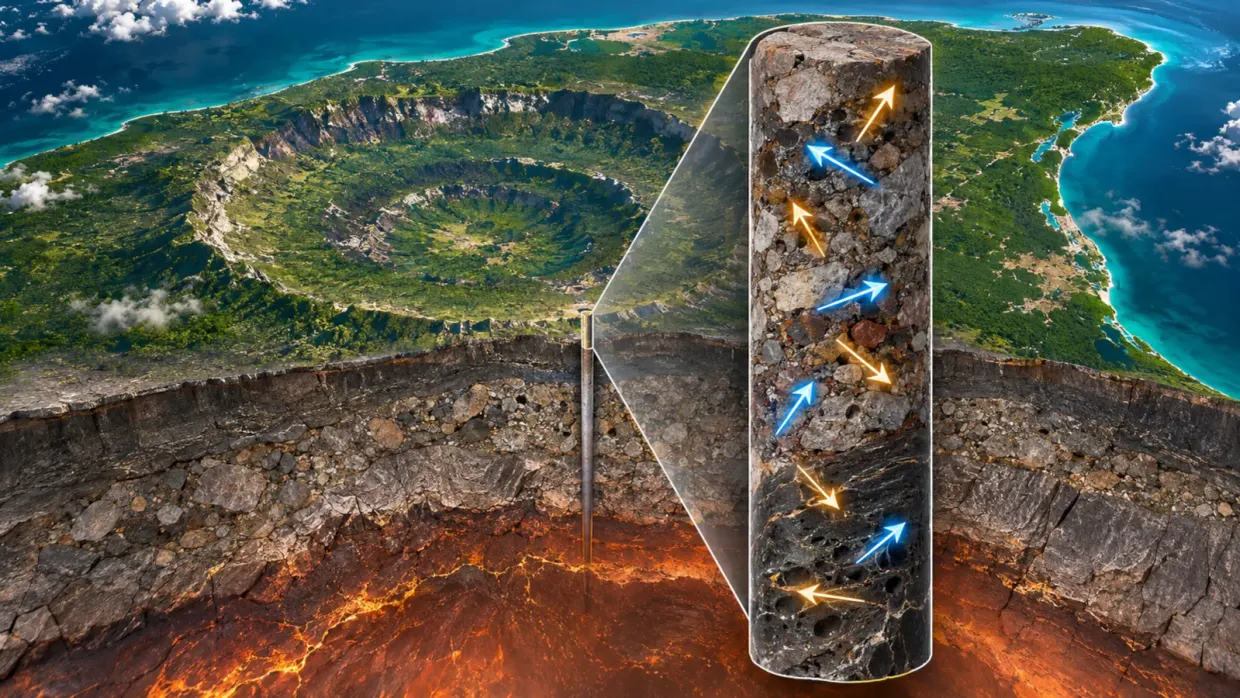
Researchers led by Christina M. Verhagen at Rutgers University re-examined magnetic records in rocks from the 200 km Chicxulub crater on the Yucatán Peninsula, Mexico. In Meteoritics and Planetary Science they report that the record of the upper peak ring suevites is not well suited for timing the post-impact hydrothermal system. wiley.com
Meteoritics and Planetary Sciencewiley.comOpen source ↗ The crater formed about 66 million years ago. The team added 24 suevite samples to earlier measurements, 20 of them from one continuous block of rock.
Large impacts may produce vast subsurface hydrothermal systems that can create conditions favorable to the origin of life. Modeling suggests that such systems may persist for more than 1 million years in basin-sized craters, but direct experimental constraints on their duration are needed. The cores studied were drilled in 2016. They include suevite, a rock made of fragmented material and impact melt.
Magnetic record as a clock
Iron-bearing minerals can store the direction of Earth's magnetic field when they form during cooling or through reactions with hot water. Because the field has reversed polarity several times, the recorded direction can help with dating under favorable conditions.
Earlier work found that upper peak ring suevite samples carry magnetizations with negative and positive inclinations, most of them close to −44°, the expected paleoinclination at the crater at the time of impact. This was interpreted as chemical remanent magnetization acquired over at least 150 thousand years, from the impact in geomagnetic Chron C29r into Chron C29n. wiley.com
Meteoritics and Planetary Sciencewiley.comOpen source ↗
What the new measurements show
The team used stepwise demagnetization in alternating fields and heating to separate overlapping magnetic components. Most samples likely contain chemical remanent magnetization acquired during Chron C29r. According to the authors, it probably formed when hot water after the collision produced iron oxides such as magnetite and altered existing minerals.
In a coarser suevite layer, the measured directions scatter much more. The authors attribute this to rock fragments that carry their own magnetization acquired before deposition, overlapping later signals, rather than to recorded magnetic reversals. The impact melt rock beneath, by contrast, more likely documents the original cooling after the collision.
The scatter of directions therefore loses its value as direct evidence for at least 150 thousand years of hydrothermal activity. The data do not show that the system ended earlier; they show that its duration cannot be read unambiguously from these magnetic traces. Some positive magnetizations may come from later-formed minerals, but the present data cannot confirm this. More samples with a known original spatial orientation are needed for a more reliable time constraint. wiley.com
Meteoritics and Planetary Sciencewiley.comOpen source ↗