ZnO crystals driven by mid-IR pulses emit harmonics with four-fold, not six-fold, symmetry
Odd harmonics from zinc oxide at ELI-ALPS showed four-fold angular modulation, though lattice symmetry alone predicts six-fold; theory points to band anisotropy.
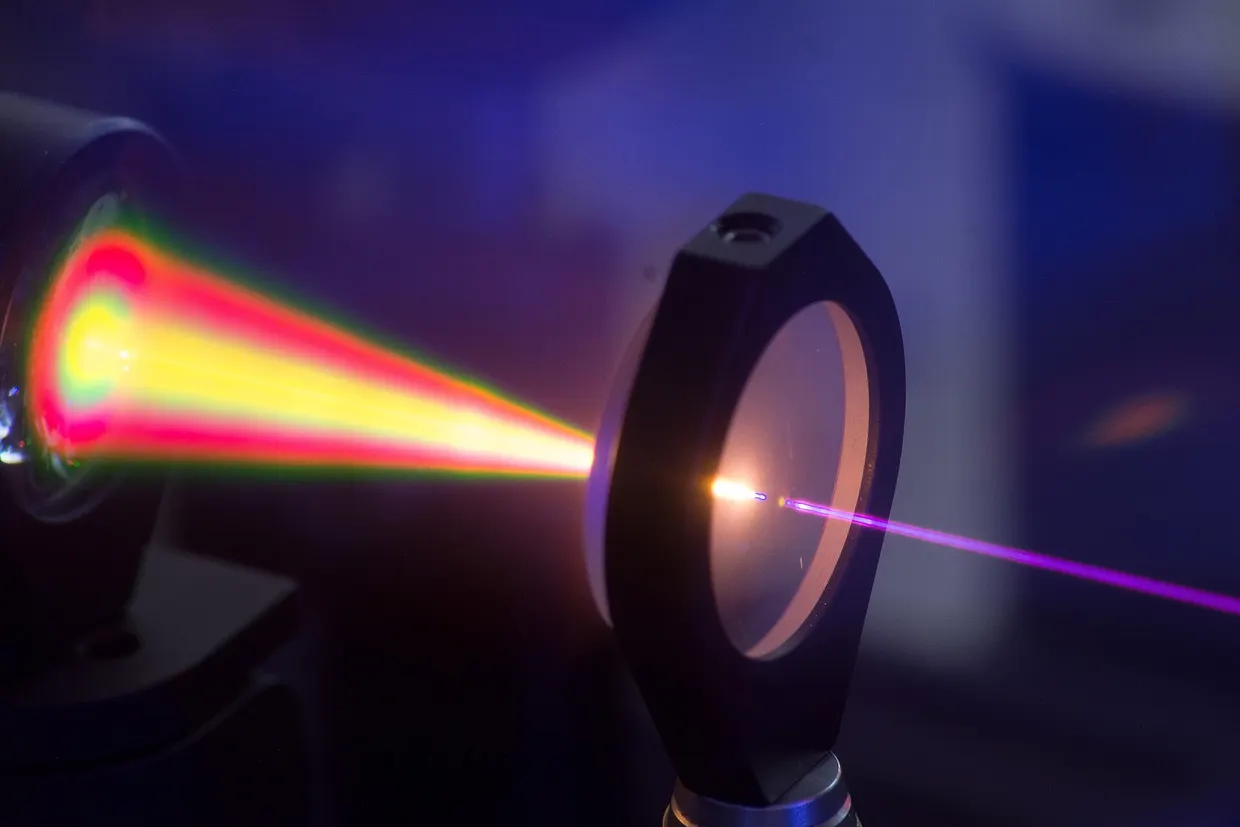
A team studying orientation-dependent high-harmonic generation (HHG) in zinc oxide reports in Applied Physics B that the harmonic yield under intense femtosecond mid-infrared pulses follows a four-fold angular pattern. The symmetry of the hexagonal lattice alone would give a six-fold pattern springer.com
Applied Physics Bspringer.comOpen source ↗. The measurements were made at the ELI-ALPS Research Facility with a 3.2 µm source at 100 kHz repetition rate. It delivered 45 fs pulses, about four optical cycles long. Peak intensity was held at roughly 1 to 1.2 TW/cm², below the damage threshold.
Four-fold modulation in two crystal cuts
A 50 µm sample cut along the c-plane (0001) produced spectra of odd harmonics only, up to the 13th order, extending beyond the band gap. When the linear polarization was rotated through 180°, the odd-harmonic intensity peaked at 0, 45, 90, 135 and 180 degrees. This is a four-fold symmetry, whereas the hexagonal basal lattice suggests three-fold or six-fold.
A 50 µm a-plane (11-20) sample, where inversion symmetry is broken, gave both odd and even orders. Below-gap harmonics ranged from the 2nd to the 9th, and above-gap harmonics reached the 19th in the vacuum ultraviolet. The odd harmonics showed the same four-fold pattern. The even ones peaked at 45 and 135 degrees and were suppressed along the principal crystallographic axes.
Three independent scans confirmed that the modulation is reproducible. In a 200 µm a-cut sample at 1.2 TW/cm², the spectra broadened and developed satellite structures, most visible near the sixth harmonic. The authors attribute this to nonlinear propagation. The odd harmonics kept their four-fold periodicity, and the even ones showed two-fold modulation.
Band-structure model
The authors built a microscopic model of Bloch electrons in a pulsed field, with the ground state computed by the empirical pseudopotential method. The direct band gap of 3.3 eV requires absorbing at least nine 3.2 µm photons to create an electron–hole pair. Three upper valence bands couple to the lowest conduction band, and two lower valence bands lie 0.8 eV deeper, a separation that matches two laser photons. Rotating the polarization changes the coupling strengths and opens multiphoton pathways between valence states.
The simulations show electron–hole pairs forming in sub-femtosecond bursts in each half-cycle through Landau–Zener transitions at the field extrema. The theory predicts six-fold modulation of the odd harmonics in the (0001) plane, in contrast to the four-fold pattern measured springer.com
Applied Physics Bspringer.comOpen source ↗. According to the authors, the anisotropy of the multiple band structure plays an essential role in pair excitation and in solid-state HHG.