Tohoku University team builds palladium hydrogen sensor working at 80 °C and 90% humidity without heater
A palladium nanoparticle sensor with abundant grain boundaries detected 100 ppm hydrogen in hot, humid air without an external heater, the authors reported in Advanced Materials.
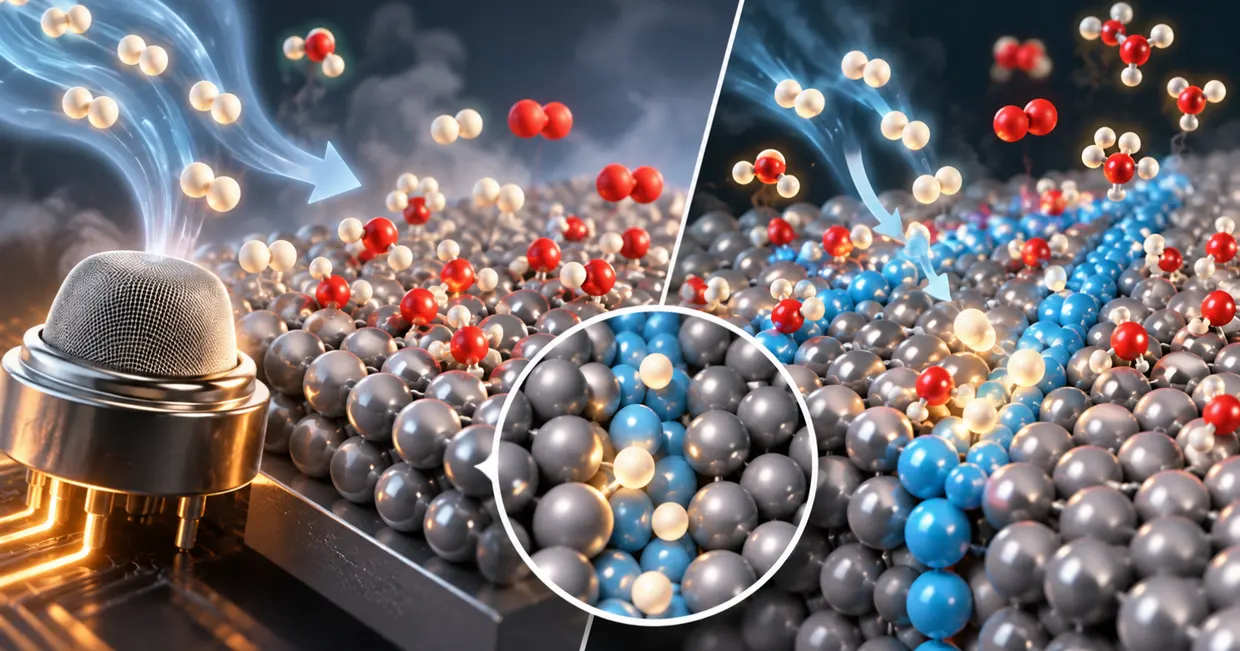
An international team from Tohoku University's Advanced Institute for Materials Research (WPI-AIMR), the University of Utah and Pacific Northwest National Laboratory has developed a catalytic hydrogen sensor that works in hot, humid air without an external heater, according to tohoku.ac.jp. The study was published in Advanced Materials on October 23, 2026 tohoku.ac.jp
tohoku.ac.jptohoku.ac.jpOpen source ↗.
Humidity is a persistent problem for hydrogen detectors: water molecules can cover their active surfaces and prevent accurate response, especially in hot, moisture-rich environments. Reliable sensors matter wherever hydrogen is produced, stored, transported or used, since even small leaks create safety risks.
Grain boundaries and sensor performance
The device is built from a network of palladium nanoparticles with abundant grain boundaries, the interfaces where neighboring crystals meet. According to the authors, these boundaries are the key to resisting moisture interference.
The sensor detects hydrogen at ambient temperatures from 22 to 80 °C and relative humidity from 0% to 90%. It detected hydrogen at concentrations as low as 100 parts per million at 80 °C and 90% relative humidity tohoku.ac.jp
tohoku.ac.jptohoku.ac.jpOpen source ↗. The team also reported selectivity against 21 potentially interfering gases, reproducible performance over 100 consecutive sensing cycles and stable operation in tests spanning 125 days. The device satisfies the relevant ISO 26142 humidity-response requirements under demanding conditions.
Why moisture does not block the signal
The researchers combined experiments tracking structural changes and water desorption with molecular dynamics and first-principles calculations. "We found that grain boundaries help hydrogen enter palladium and rapidly form palladium hydride, even when the surface is wet," said Hao Li, Distinguished Professor at WPI-AIMR.
The hydride binds water weakly, which leaves catalytic sites more accessible to the hydrogen-oxygen reaction that generates the measurable sensing signal. The interplay of crystal boundaries, hydride formation and water adsorption explains, according to the authors, why the material stays responsive where conventional catalysts struggle.
The team also built a machine-learning model into a portable sensor prototype. Accounting for changing temperature and humidity, the system estimated hydrogen concentrations with deviations within 5% in prototype tests under randomized conditions tohoku.ac.jp
tohoku.ac.jptohoku.ac.jpOpen source ↗.
The authors present grain-boundary engineering as a promising strategy for hydrogen monitoring in industrial facilities and future hydrogen-energy infrastructure.