Yonsei: higher blood musclin before colorectal cancer surgery linked to less muscle loss, 95-patient study
A retrospective analysis of 95 patients at Gangnam Severance Hospital found that preoperative musclin levels tracked with skeletal muscle preservation after surgery.
Researchers at Yonsei University's Gangnam Severance Hospital in South Korea reported that blood levels of musclin measured before colorectal cancer surgery correlate with how well skeletal muscle is preserved afterwards, according to biz.heraldcorp.com on 11 November 2026. The team was led by Ahn Chul-woo (endocrinology) and Kang Jung-hyun (colorectal surgery), with Kim Yu-sik, Nam Ji-sun, Shin Su-jin and Kim Young-hyun. biz.heraldcorp.com
biz.heraldcorp.combiz.heraldcorp.comOpen source ↗
Musclin is a myokine, a hormone expressed and secreted mainly by skeletal muscle. It is known to be involved in maintaining muscle mass, metabolic adaptation of muscle and suppression of protein breakdown. Muscle loss after cancer surgery, driven by malnutrition and inactivity, slows recovery and worsens prognosis. CT measures current muscle mass, but it has been limited in predicting how much muscle a patient will lose.
Study design and results
The researchers measured preoperative blood musclin and inflammatory markers in 106 patients (mean age 63.3 years) who underwent colorectal cancer surgery at the hospital. For 95 patients with CT before and after surgery, they retrospectively analysed the change in skeletal muscle index (SMI) at the third lumbar vertebra (L3). The median interval between scans was 198 days, about 6.5 months.
SMI fell by more than 5% in 28.4% of these patients (27 of 95). biz.heraldcorp.com
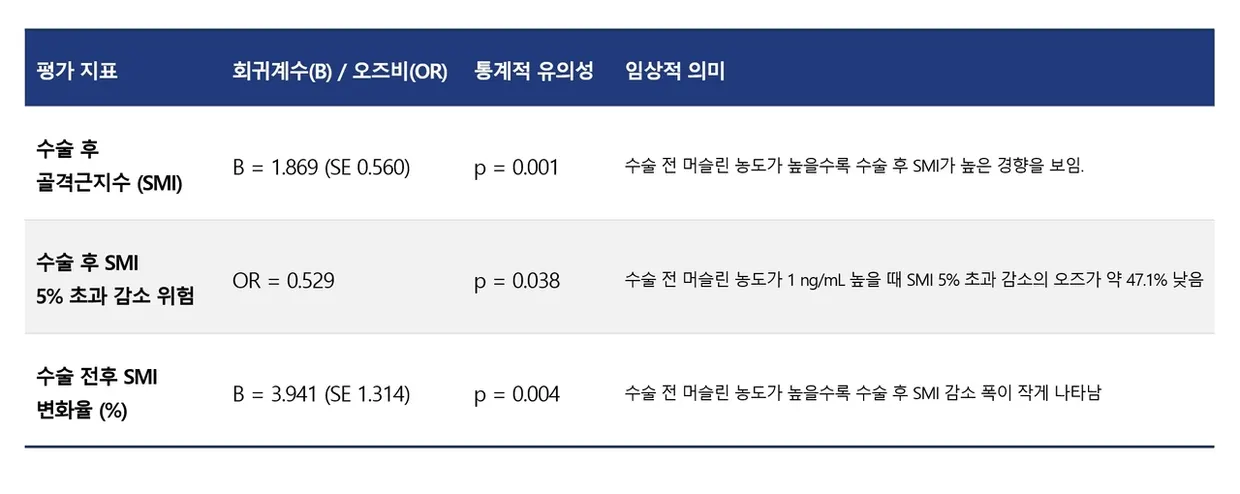
biz.heraldcorp.combiz.heraldcorp.comOpen source ↗ After adjustment for age, sex and inflammatory markers in a multivariate analysis, preoperative musclin showed a clear positive correlation with postoperative SMI (p=0.001). Each 1 ng/mL increase in musclin was associated with an odds ratio of 0.529 for a loss of more than 5% (p=0.038).
Added value for prediction
Adding musclin to a model that predicted postoperative SMI from clinical data and inflammatory markers raised its coefficient of determination (R²) from 0.767 to 0.794. According to the authors, this suggests that musclin carries information on vulnerability to muscle loss that CT and inflammatory markers alone do not capture.
The authors describe musclin as a candidate blood biomarker for identifying patients at high risk of muscle loss before cancer surgery. Kang Jung-hyun said he expects that identifying such patients by blood test before surgery could help in planning patient management. The study was published in the European Journal of Surgical Oncology (EJSO) under the title "Preoperative circulating musclin as a candidate biomarker of postoperative skeletal muscle vulnerability in colorectal cancer."