TMH assembles first Russian hydrogen passenger train, 435-mile range, ahead of tests
The first low-floor passenger train on hydrogen fuel cells has been assembled at Demikhovo and moves to testing. It is intended for non-electrified lines on Sakhalin.
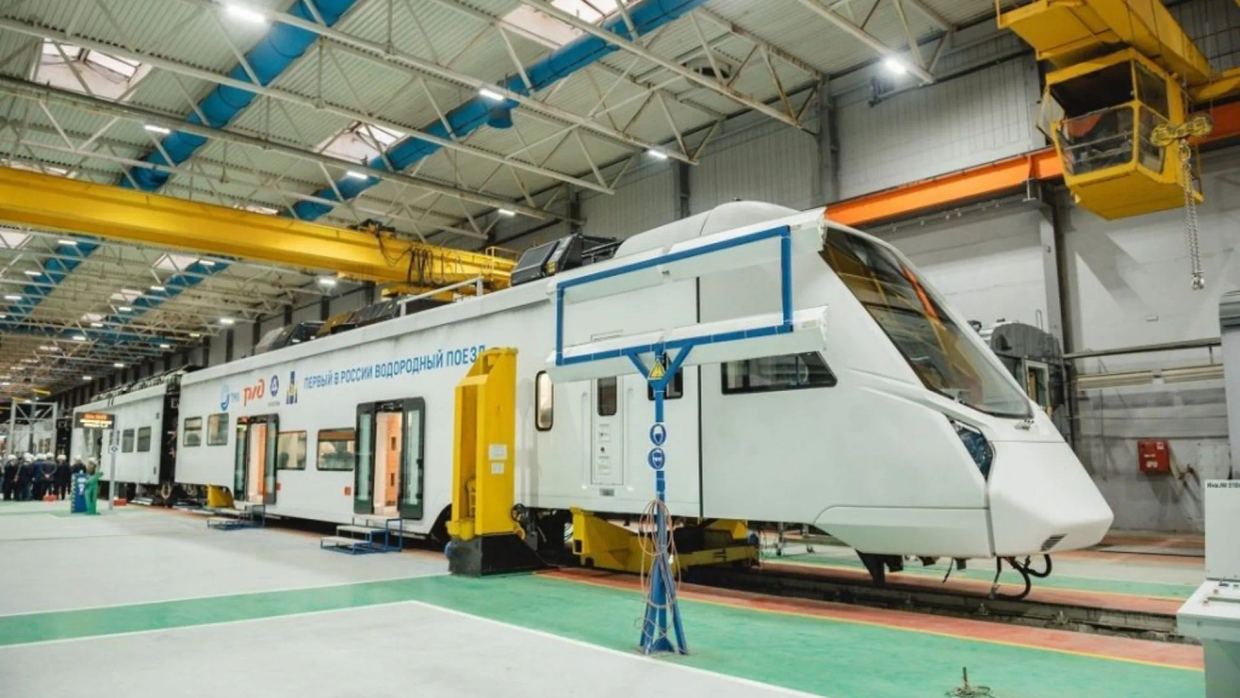
According to Interesting Engineering, Russia announced on Wednesday, October 28, that its first domestically built hydrogen-powered passenger train has been assembled at a factory in Demikhovo. The train is rated for more than 435 miles (700 km) on hydrogen alone and up to 460 miles (740 km) with onboard battery support. interestingengineering.com
Interesting Engineeringinterestingengineering.comOpen source ↗
The train is designed for non-electrified lines. It is described as the first low-floor passenger railcar model built in Russia to run on hydrogen fuel cells. It is being developed by Transmashholding (TMH) together with Russian Railways, Rosatom and the Sakhalin regional government under an agreement signed in 2019. interestingengineering.com
Interesting Engineeringinterestingengineering.comOpen source ↗ The first sets were assembled at TMH's Demikhovski Machine-Building Plant and at Tver Railcar Works, a TMH subsidiary.
interestingengineering.com
Interesting Engineeringinterestingengineering.comOpen source ↗
Configurations and onboard hydrogen system
The trains will be built in two configurations. The two-car version is expected to cover more than 435 miles (700 km) using the hydrogen power module alone, and about 460 miles (740 km) with its battery units. interestingengineering.com
Interesting Engineeringinterestingengineering.comOpen source ↗ The three-coach version uses the same hydrogen module and is expected to travel nearly 300 miles (480 km). Its onboard energy storage system adds about 50 miles.
interestingengineering.com
Interesting Engineeringinterestingengineering.comOpen source ↗
Both configurations include a separate technical railcar housing the hydrogen power system. The compartment is equipped with hydrogen concentration and fire detection sensors. The fuel cell system emits water vapor instead of the exhaust gases of diesel engines. interestingengineering.com
Interesting Engineeringinterestingengineering.comOpen source ↗
Production of a second hydrogen fuel cell system is already underway. It is part of a plan to create a unified platform for urban, suburban and inter-regional trains on the 1,520 mm gauge network. interestingengineering.com
Interesting Engineeringinterestingengineering.comOpen source ↗
Testing schedule and Sakhalin line
Valeri Limarenko, Governor of the Sakhalin Region, said the work has been underway for several years and the train is moving into the testing phase. Testing of the first low-floor hydrogen train is scheduled to begin in November this year. interestingengineering.com
Interesting Engineeringinterestingengineering.comOpen source ↗ Dynamic tests in Moscow and the Moscow region will start in 2027, and the train will be transferred to Sakhalin in the middle of that year, according to the governor.
interestingengineering.com
Interesting Engineeringinterestingengineering.comOpen source ↗
The trains are expected to enter commercial service by the end of 2027, after certification trials scheduled for the same year. They will initially run on Sakhalin, where a dedicated hydrogen testing center is also under development. interestingengineering.com
Interesting Engineeringinterestingengineering.comOpen source ↗
The project relies on the island's modernized rail network. Conversion to the Russian 1,520 mm broad gauge began more than two decades ago, and Russian Railways completed it in 2020. It replaced the 1,067 mm gauge built in the region before World War II. interestingengineering.com
Interesting Engineeringinterestingengineering.comOpen source ↗