Hubble data on 37 dwarf galaxies show much of their expected oxygen is missing
A study in The Astrophysical Journal found that dwarf galaxies retain only a small fraction of the oxygen their stars produce, far less than simulations predict.
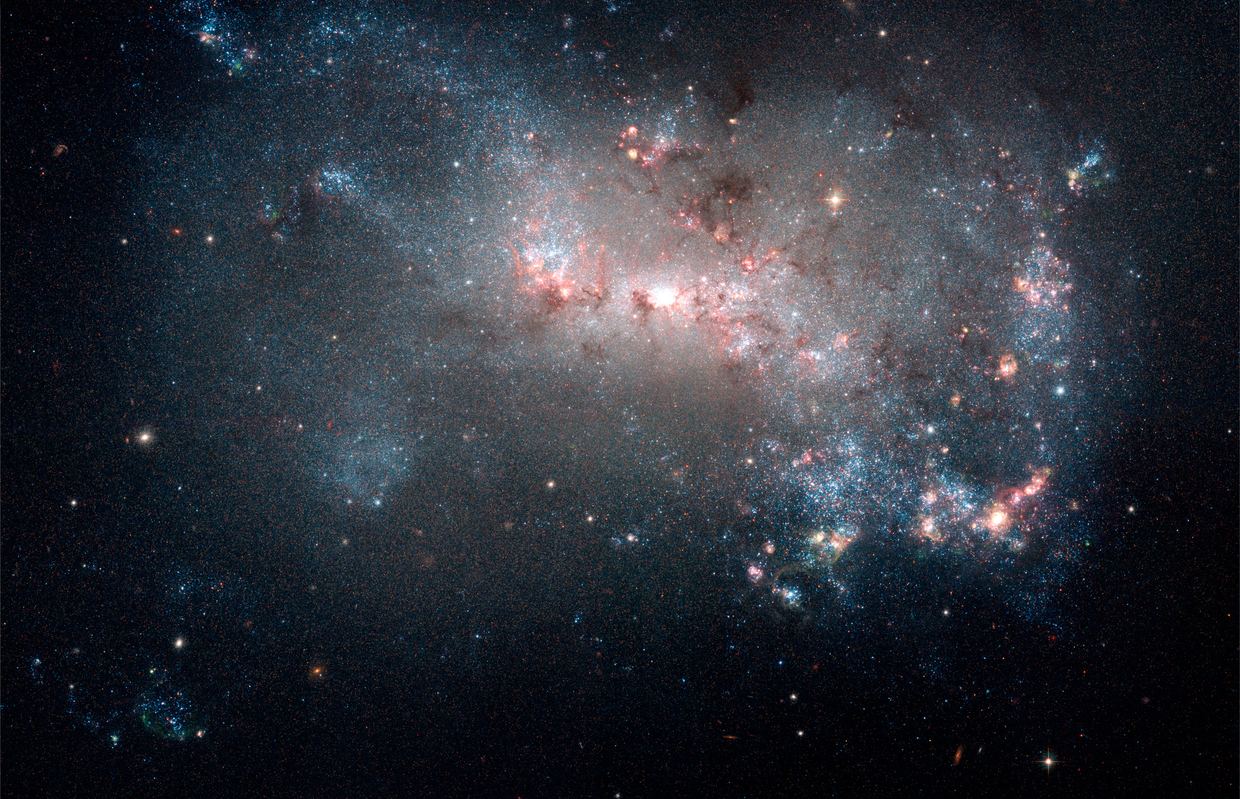
Researchers using NASA's Hubble Space Telescope studied 37 nearby dwarf galaxies and found that much of the oxygen they expected to see is missing, according to a paper published Monday in The Astrophysical Journal and reported by newswise.com newswise.com
newswise.comnewswise.comOpen source ↗. Dwarf galaxies contain from a few thousand to hundreds of millions of stars. Simulations predict that significantly more oxygen should reside in them
newswise.com
newswise.comnewswise.comOpen source ↗.
Where the oxygen went
Oxygen is produced by stars inside galaxies, so it must have been ejected at some point, said co-investigator Grace Telford of the University of Utah. Ejection requires energy from massive stars and supernova explosions to drive material out of the host galaxies into intergalactic space newswise.com
newswise.comnewswise.comOpen source ↗.
According to the study, galactic winds unleashed by supernovae remove oxygen from low-mass galaxies more effectively than current models predict. The authors report that dwarf galaxies can hold onto only a small fraction of the oxygen made by their stars newswise.com
newswise.comnewswise.comOpen source ↗.
It remains unclear whether most of the missing oxygen sits in the circumgalactic medium, the diffuse gas halo around a galaxy outside its disk, or has been ejected from the galaxy's surroundings entirely. A 2014 study of Milky Way-like star-forming galaxies found that they lost a large fraction of their oxygen, some of which is found in that halo newswise.com
newswise.comnewswise.comOpen source ↗.
Data and the choice of oxygen
The work is part of the Galaxies Losing Oxygen via Winds (GLOW) project, funded by NASA and the National Science Foundation. The team used archival optical Hubble images to resolve stellar populations and determine star-formation histories and compositions. They combined these with data from the retired Spitzer Space Telescope and the ground-based Very Large Array and Australian Telescope Compact Array newswise.com
newswise.comnewswise.comOpen source ↗.
The 37 galaxies were chosen because their masses fall in the range where theory predicts that a growing share of oxygen is expelled by supernovae. They are also close enough for Hubble to resolve individual stars, which is not the case for the vast majority of known dwarf galaxies newswise.com
newswise.comnewswise.comOpen source ↗.
Principal investigator Kristen Wingfield McQuinn said oxygen was chosen for practical reasons. It is the most abundant element after hydrogen and helium, is relatively easy to detect and measure, and its production is well understood newswise.com
newswise.comnewswise.comOpen source ↗.
McQuinn has an approved program to use the Roman Space Telescope to find fainter, lower-mass galaxies, and plans follow-up with Hubble and the James Webb Space Telescope. Telford is using Hubble to observe individual massive stars in some of the nearby GLOW targets newswise.com
newswise.comnewswise.comOpen source ↗.