James Webb data suggest interstellar comet 3I/ATLAS formed over 11 billion years ago
Astrophysicists measured the deuterium-to-hydrogen ratio in the methane of 3I/ATLAS and found it about 13 times that of comet 67P. The exact age remains uncertain.
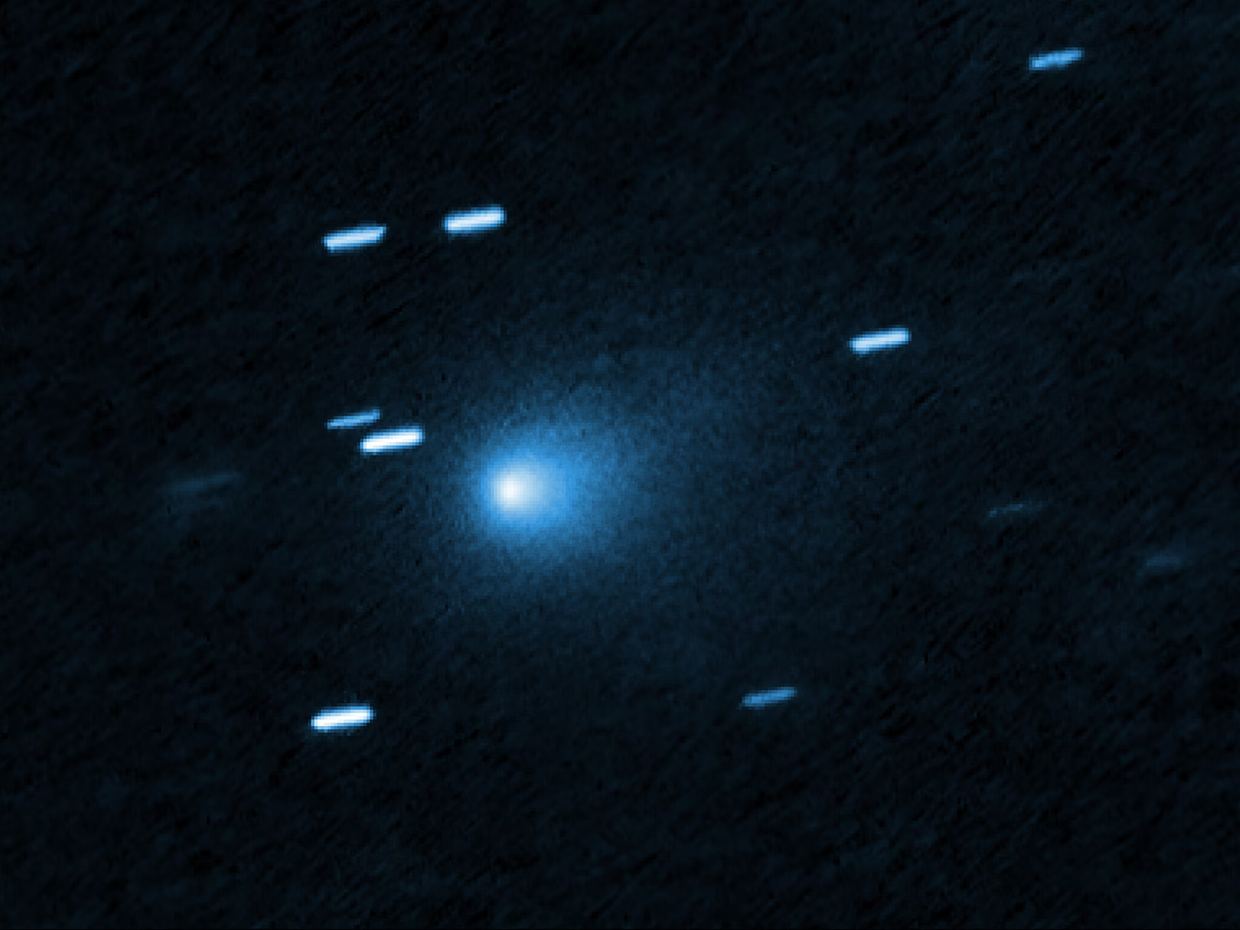
Comet 3I/ATLAS, the third known interstellar object, may have formed more than 11 billion years ago, before the Solar System began to form. This follows from an article in Nature Astronomy by a team of astrophysicists (Roth et al., 2026), based on observations with the James Webb Space Telescope, as reported by Futura Sciences. futura-sciences.com
Futura Sciencesfutura-sciences.comOpen source ↗
The comet was discovered on 1 July 2025 by the ATLAS telescope (Asteroid Terrestrial-impact Last Alert System) in Chile. It moves at about 220,000 km/h on a hyperbolic trajectory, so it cannot be a satellite of the Sun. It follows 1I/'Oumuamua (2017) and 2I/Borisov (2019). futura-sciences.com
Futura Sciencesfutura-sciences.comOpen source ↗
Deuterium-to-hydrogen ratio
The authors derived the abundance ratio of two hydrogen isotopes: H, with one proton in the nucleus, and D (deuterium), with a proton and a neutron. The D/H ratio was measured in methane released from the ice of 3I/ATLAS as it was heated by solar radiation. It is about 13 times higher than in comet 67P/Churyumov–Gerasimenko, studied by the Rosetta mission. futura-sciences.com
Futura Sciencesfutura-sciences.comOpen source ↗
According to the laws of cosmochemistry, such an isotopic signature points to a very cold place of formation, at temperatures near −263 °C: probably a dense molecular cloud or the cold regions of a protostellar disk. futura-sciences.com
Futura Sciencesfutura-sciences.comOpen source ↗
Carbon-13 and age
The most decisive datum is the low abundance of the carbon-13 isotope. It would indicate a formation site poor in heavy elements. Over billions of years, successive generations of massive stars have enriched the interstellar medium of the Milky Way with heavy elements, which then become part of newly born stars. Low carbon-13 may therefore mean that the comet's matter formed early in the history of the galaxy, before several stellar generations had done this. futura-sciences.com
Futura Sciencesfutura-sciences.comOpen source ↗
By this estimate, 3I/ATLAS could have formed more than 7 billion years before the Sun and may be a witness of the physical and chemical conditions in the early galaxy. An age greater than the Sun's appears very probable, but the exact age is not certain. futura-sciences.com
Futura Sciencesfutura-sciences.comOpen source ↗