GATA transcription factors coordinate the switch from division to differentiation in Arabidopsis root
Single-cell transcriptome and chromatin accessibility data for the Arabidopsis root ground tissue point to GATA factors as regulators of the switch from cell division to differentiation.
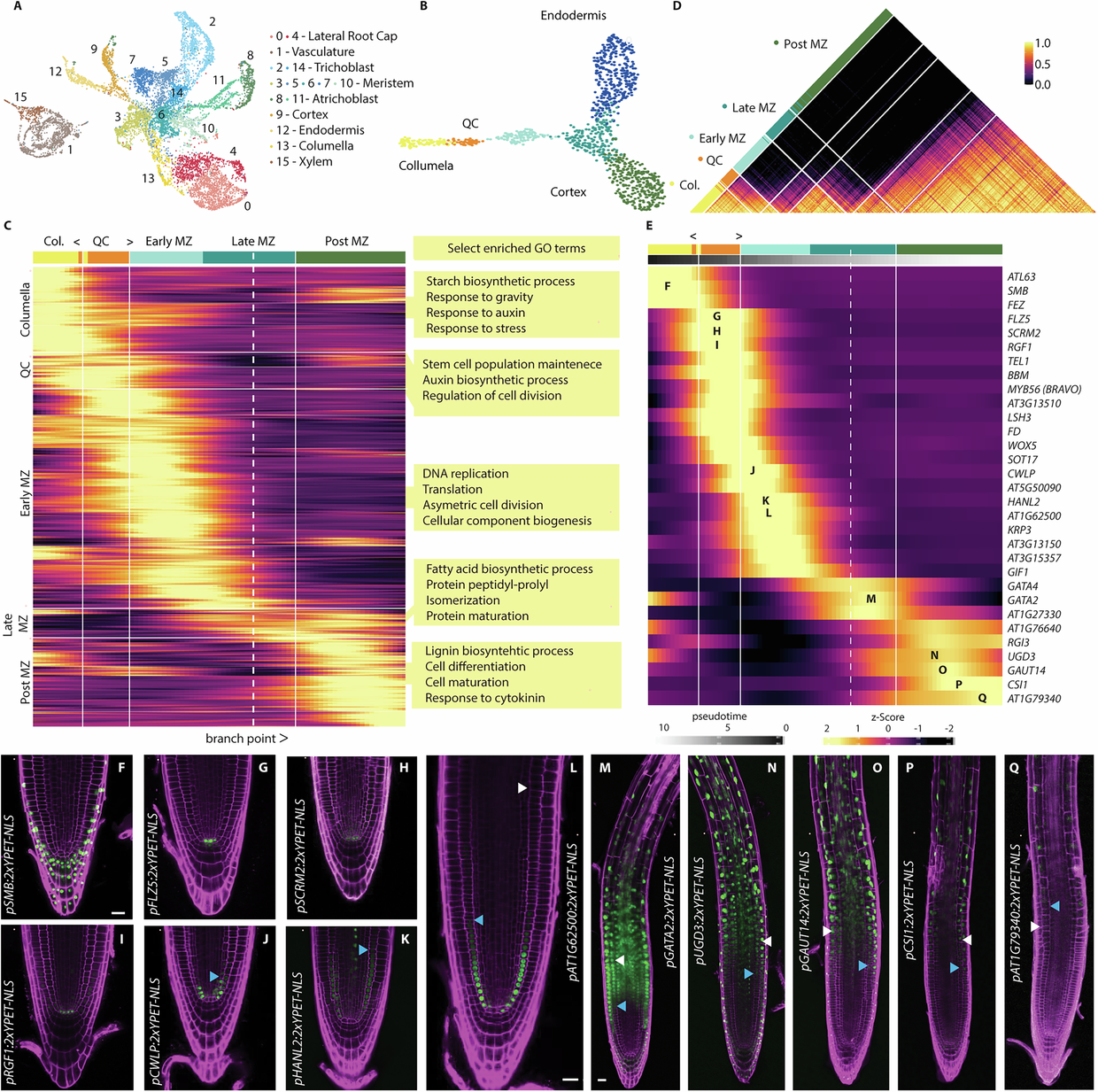
Authors of a study in Nature Communications reconstructed developmental trajectories of the ground tissue of the Arabidopsis thaliana root, which comprises the endodermis and cortex. They worked at single-cell resolution, using both transcriptomic and chromatin accessibility data doi.org
Nature Communicationsdoi.orgOpen source ↗. The analysis identified GATA transcription factors as central coordinators of the transition from cell division to differentiation, and the authors validated this role experimentally
doi.org
Nature Communicationsdoi.orgOpen source ↗.
Single-cell trajectory of the ground tissue
The work used previously published scRNA-seq data from Arabidopsis thaliana. Cells of the stem cell niche, endodermis and cortex were identified by marker genes in an atlas of about 11,000 cells doi.org
Nature Communicationsdoi.orgOpen source ↗. The stem cell niche cluster was inspected manually to exclude cells of epidermal and vasculature lineages, which, according to the authors, markedly improved the resolution of the final trajectory. Columella cells were kept because they anchor the basal end of the trajectory
doi.org
Nature Communicationsdoi.orgOpen source ↗.
The final subset of 1,095 cells forms a trajectory that bifurcates at one end, reflecting the anatomical division of the ground tissue into endodermis and cortex doi.org
Nature Communicationsdoi.orgOpen source ↗. Expression changes gradually from the columella and quiescent center end up to a region just before the bifurcation, where the expression profile changes abruptly. In the cortex-terminal trajectory the authors describe five defined phases of expression that match the arrangement of cell clusters
doi.org
Nature Communicationsdoi.orgOpen source ↗.
GATA factors and the bistable network
The authors report that chromatin accessibility is a strong predictor of the activation of developmental genes. A major transcriptional switch in the late meristematic zone, accompanied by extensive chromatin remodeling, drives the transition from cell division to differentiation doi.org
Nature Communicationsdoi.orgOpen source ↗.
To identify the regulators of this switch, the authors applied network inference to the integrated transcriptomic and chromatin accessibility trajectories. It pointed to GATA transcription factors doi.org
Nature Communicationsdoi.orgOpen source ↗. According to the authors, these factors sit at the tipping point of a feedback-driven bistable gene regulatory network. The network integrates auxin and cytokinin signaling and balances proliferation against differentiation
doi.org
Nature Communicationsdoi.orgOpen source ↗. They report that this ensures temporal precision of the switch at the cell, tissue and organ scales
doi.org
Nature Communicationsdoi.orgOpen source ↗.
The root is a convenient model for this question. Its cell types are arranged in concentric rings that originate from a stem cell niche near the tip. Daughter cells undergo several rounds of division before they begin to elongate and differentiate within defined longitudinal zones doi.org
Nature Communicationsdoi.orgOpen source ↗.